Want more from Front Office Sports
in your search results?
The college athletics facilities arms race is as alive as ever with two new universities, Maryland and Pittsburgh, joining the competition just weeks into 2020. The pair of new participants both announced massive athletics facilities projects that will impact the majority of their teams, but each will take a unique approach to financing and building the facilities that will help them compete for bragging rights and bolstered success.
Recent college facilities renovations have ranged from Minnesota’s $190 million plan announced in 2013 to Clemson’s $55 million football facility which opened in 2017 to Northwestern’s $270 million lakefront Ryan Fieldhouse, with its adjoining Walter Athletics Center and the Wildcats’ $110 million Welsh-Ryan Arena renovation.
This past year saw schools like Kansas, which opened a $26 million new indoor practice venue, and South Carolina, home to a new $50 million football operations building, also add to their athletics’ arsenals, to name a few.
Oregon State, Alabama, Nebraska, Tennessee, Virginia, and West Virginia, among other Power Five schools, have all also recently announced plans or begun construction on renovations projects.
Some schools have sought funding through a small number of private donations. Northwestern’s facilities came courtesy of billionaire businessman Pat Ryan; Kansas relied on a $50-million gift from alumnus David Booth; Oregon’s 145,000 square-foot training center, which reportedly cost between $95 and $140 million, was a gift from Nike co-founder and Oregon alum Phil Knight.
But for schools like Maryland and Pittsburgh, the path to project funding isn’t as simple.
Maryland: Cash Now, Donors Later
Costs are still being calculated for the entirety of the Terrapins’ ‘Building Champions’ project, but Maryland is beginning construction with $25 million committed by the athletics department to build the planned Olympic sports facilities. The department’s investment allows building to begin in a way that’s not fully dependent on fundraising and the timeline of incoming donations, Damon Evans, the school’s athletic director, said.
“That $25 million will allow us to start building some of these facilities sooner rather than later because that’s money we have currently,” Evans said. “Each facility is going to come about on its own time but our expectation is that by this fall we’ll be able to start some construction on some of these facilities, if everything goes accordingly, and then just to build from there.”
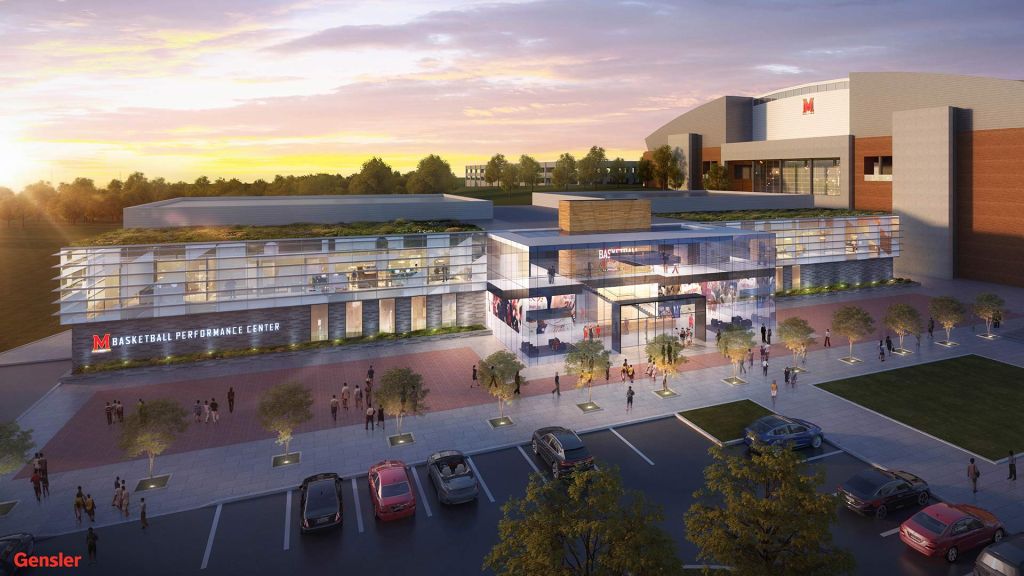
Maryland’s massive endeavor includes completion of Phase II of the Cole Field House project, which will turn the site into a $210 million indoor football building, as well as a $36 million basketball performance facility, initially announced in October, and several Olympic sports projects.
In addition to the $1.8 million Evans said the school has raised for the Building Champions project since its announcement, they’ve already rallied more than $21 million for the basketball-specific project.
READ MORE: SEC Schools Begin to Answer Million-Dollar Question About Alcohol Sales
“Down the road, to be able to do all the things we’d like to do, fundraising is going to continue to be a major component,” Evans said. “But we didn’t want this to be something that was totally dependent upon fundraised dollars. We wanted to be able to show the donors and our coaches and student athletes that by combining the [fundraised money and the committed money from the athletics department], we can move forward in a much quicker manner and we’re committed to doing so.”
When asked if the department would contribute more to the project if fundraising fails to progress as needed, despite already being $24.3 million in debt, according to InsideMDSports, Evans said “things will start according to the dollars that we have available.”
The athletics department, which as of last fall had raised almost $60 million in private donations for the Cole Field House project, including a $25 million gift from Under Armour CEO Kevin Plank, contributed an additional $19 million when the indoor project was expanded during Phase I of construction.
The dollars they’ll have available down the line for the rest of the Building Champions project will be donor-dependent, Evans said. Donations required for naming rights are listed directly on the project’s website for several of the facilities, with larger naming opportunities costing as much as $10 million for the basketball facility and $2 million for the field hockey and women’s lacrosse stadium. Everything down to lockers and offices is listed.
Maryland secured their first substantial gift for the comprehensive renovations plan last fall. Evans was approached at halftime of the Penn State game – which “was a great football game until kickoff” – by the Bobb family for the baseball development center.
The Stanley Bobb Baseball Player Development Center is the only new named facility listed on the project’s website outside of the fieldhouse. The late Stanley Bobb, a former star Maryland baseball player, and his widow, Sandy, had given back to the University previously, but not to this magnitude, Sandy said.
“Both of us were interested in giving back to the University that paved the way for our lives,” Sandy continued. “After Stanley passed away and this opportunity presented itself, it was just the perfect way to honor his memory and name, and the start that Maryland baseball had given him with his scholarship.”
While the Terrapins haven’t put a number on how many more donors like the Bobb’s they’re expecting, Evans does believe that they’ll “have a significant amount of individuals who step up for those various naming opportunities” which will help them as they aim to elevate their programs through these facilities upgrades.
“As we all know there’s been an arms race in facilities for quite some time so hopefully [these projects] enable some of our teams to jump up and become more competitive,” Evans continued. “The hope is that they’ll bring us in line with what’s going on in the Big Ten and around the country.”
Becoming more competitive is key to the institution seeing a return on their investment, but it’s not guaranteed.
“The goal is to be able to recruit better high school players and be more competitive in your conference and maybe nationally which, in turn, would create more revenue from tickets and concessions and potentially memorabilia and merchandise,” sports economist Andrew Zimbalist said. “But that can take a long, long time for some of these schools.”
Pitt: Debt Financing in Lieu of Donor Dollars
Time is why Pittsburgh has planned to debt finance their $250 million renovation project, ‘Victory Heights,’ which the university hopes to break ground on in 2021. Knowing the need for enhanced facilities to stay competitive in today’s college landscape, the Panthers are moving forward with their project regardless of donor dollars raised. They will, however, try to offset the debt undertaken with fundraising.
Their approach means adding the expense of interest to the project, which was something athletic director Heather Lyke and chancellor Patrick Gallagher could swallow.
“The need was great enough that any hesitation [about financing the project through debt] was eliminated,” Lyke said. “16 of our 19 teams – so 84% of our student athletes – [are] working out of a building that was built in 1951 and doesn’t have air conditioning. It was pretty evident to see the need for new facilities. And our debt in athletics is not significant as is, so the chancellor and the board of trustees agreed we were in a spot where we could take that on.”
READ MORE: Carolina Hurricanes Reaching Students With College Colors Campaign
Zimbalist notes that now is not a bad time to take on debt as a means of financing with “interest rates being so low.” That statement is, he clarifies, dependent on the rest of the university’s finances both inside and outside of athletics.
Lyke said the University as a whole is in “very good financial shape,” which, although they will still try to raise as much money as possible and stay within budget, contributed to the school feeling financially secure enough to take on the debt needed to move forward with the project.
In order to optimize fundraising efforts, Lyke has strategically formed an advisory board of their largest donors so far, who she says have a unique perspective into how to reach other prospective supporters.
“We’ve raised over four million dollars in a month and a half since we had the official green light and we started approaching donors,” Lyke said. “We’ve obviously been super strategic about it. We’ve created a [board of] advisors [who] are advocates for the project but every advisory board member is also contributing a major gift toward Victory Heights which is huge.”
Zimbalist notes that for both schools, and any others embarking on a similar endeavor soon, donations could be more difficult to come by in light of the new tax code.
“The boosters used to get [tax] deductions for making donations to athletics departments but they can’t get them anymore after the last tax reform,” he said. “Some really wealthy individuals – like Phil Knight who has given hundreds of millions of dollars to Oregon – they don’t care. But most programs rely on a large number of medium or small donations, and those are going to be affected by the absence of a tax deduction. So the challenge is larger to raise the money. But that’s not to say it can’t be done.”
As more schools continue to plan and execute renovations of their own, both athletic directors question when the arms race will end. With no end in sight, schools, including Maryland and Pittsburgh, are prepared to do whatever it takes to keep pace.
Download the FOS App
The business of sports, in your pocket.



Scan the QR code to get the app now.