The platform has kept the conversation going 365 days a year.
We’re nearing the end of perhaps the most exciting NBA offseason ever – but this isn’t something completely new. For the past couple seasons, there has been lots of talk about the NBA’s ascension into an all-year sports league. In addition, the growth in social media usage has coincided with the number of marquee offseason events — leading to a league that provides entertainment outside of the limited scope of its season.
Twitter has played a large role in this success, and in examining it, it’s important to look at the three major roles it plays:
a) improving the fan experience
b) a SportsCentre substitute
c) social interactions
Improving the Fan Experience
While the NBA product is immensely exciting to watch, it is a sport, that by nature (and design) has a lot of dead time.
The strength of Twitter has been its ability to occupy this dead time — improving overall fan experience (or consumer surplus).
If the only option presented to a fan is to watch a game, the average game’s utility curve (a fan’s enjoyment over the course of a game) could look like this:
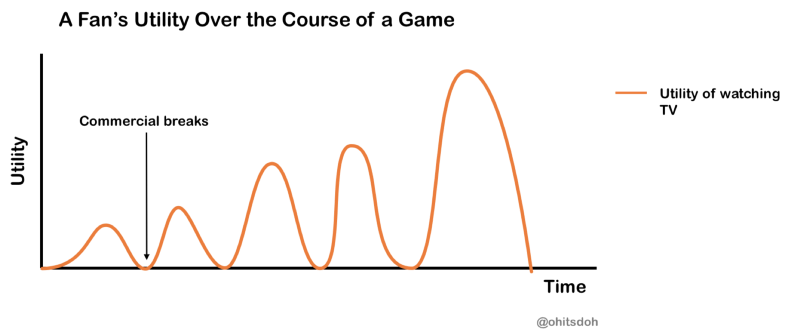
Where peaks are experienced while fans are watching the game, and the troughs are commercial breaks.
However, if an option were presented to fans that could improve their utility at no added cost (ignoring the cost of ad consumption), the graph would look like this:
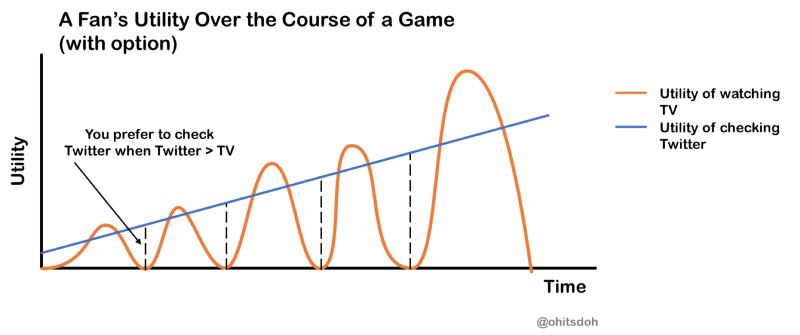
Where fans would check Twitter when the consumer surplus (willingness to pay minus price) of checking Twitter is greater than watching the game on TV. While advertisements are far from the only moments when fans prefer to use Twitter, it does serve as a useful comparison, especially since the utility gained by watching these advertisements is zero (at most).
Treating TV consumption and Twitter consumption as a bundle, this is obviously good for fans — but it’s also good for the league. Sports is a medium where a premium is placed on emotion (there’s a reason why brands will continue to sponsor sporting figures and events). This results in an improved overall consumer surplus, providing fans, leagues, teams, and broadcasters added value.
SportsCentre
While Twitter has served as a clear substitute for SportsCentre when it comes to viewing highlights, its other, more subtle innovation has been the democratization and capitalization of sports analysis and journalism.
In the pre-Twitter world, sports analysis and journalism was dominated by journalists hired by networks such as ESPN. This meant that the barriers to entry were extremely large.
Since the advent of the internet, and blogging as a viable platform, barriers to entry were significantly reduced. But when Twitter became the one-stop platform to share and consume ideas, search costs were also reduced. Users only needed to scroll through the app to find content.
This led to the capitalization of sports analyses, where users were motivated to increase their Twitter followers and engagements in what effectively can be described as an unregulated market.
By extension, we can say that Twitter has exhibited the true beauty of capitalism: where collective competition surpasses the production of few.
The best example of the capitalization of sports analysis and journalism is insiders: where there is a heavy incentive to be the first to report stories.
Social Interactions
The basic network effect curve looks like this:
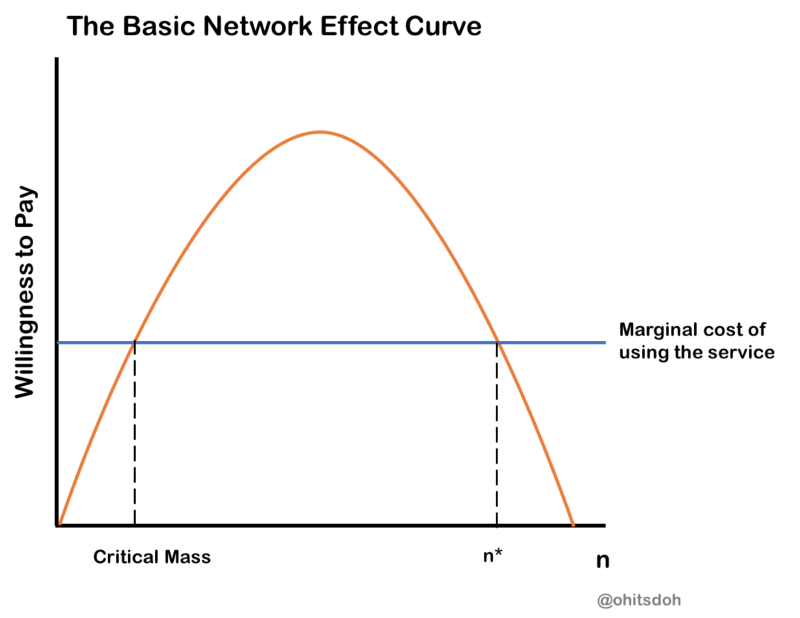
Users would consume where their willingness to pay for the service (orange), exceeds the marginal cost of using the service. n is the total number of people in the network, and n* is the equilibrium quantity. The short-term goal is to reach critical mass: where there are enough people in the network to sustain it.
The importance of this graph is to show the value that users will gain from social interactions on Twitter. Their willingness to pay is intrinsically linked to the number of users on their timeline, and users are usually benefitted with a greater number of users.¹
While watching sports, and especially when watching alone, Twitter acts as a substitute for real social interactions, where ideas can be shared and confirmed. A consequence of Twitter has been the filter bubble — but this also contributes to its value to fans.
Similar to competition, Twitter exhibits one of the best examples of network effects — which also act in a virtuous cycle. The more users, the greater the quantity of contributions and resulting quality, which again, leads to more users self-selecting onto the platform.
¹ Important Twitter caveat: Twitter actually neuters negative network effects by having user-curated timelines. Users can pick and choose how much content they want to see, and who they want to see. ^
Front Office Sports is a leading multi-platform publication and industry resource that covers the intersection of business and sports.
Want to learn more, or have a story featured about you or your organization? Contact us today.