Want more from Front Office Sports
in your search results?
Bidding for the U.S. media rights to the 2030 FIFA World Cup could start at $1 billion, sources tell Front Office Sports.
Fox Sports forged the last major steal in American sports when it scored English language media rights for the current men’s World Cup at the bargain basement price of $485 million. But with Fox pulling record TV ratings for the first American World Cup in 32 years, it’s now a seller’s market.
With multiple media bidders expected to drive up rights fees, FIFA is poised to score a massive payday as it auctions off rights to the 2030 men’s World Cup in Morocco, Spain, and Portugal, and the 2034 tournament in Saudi Arabia.
Doug Perlman, chief executive of Sports Media Advisors, declined to comment on specific dollar estimates. But he says there’s little doubt the Switzerland-based FIFA will have a strong bargaining position as it competes for media rights dollars with the NFL, MLB, NHL, and other North American leagues. A starting negotiating price of $1 billion would mark a 100%-plus price increase from the current tournament.
“There’s no question that FIFA is going to get a huge increase for its U.S. rights,” Perlman told FOS. “First of all, the rights fee for the current World Cup is well under market so they’ll be coming off a low base. Second, soccer generally and the World Cup specifically have driven tremendous value for numerous media companies. Fox and Telemundo will certainly want to retain the rights but lots of others, including the streamers, will go after a ‘must see’ property that can drive subscriber acquisition, retention and engagement. When a property becomes strategic, like the World Cup now has, that’s when you see dramatic increases.”
When all is said and done, this year’s World Cup could go down as the “most successful soccer tournament ever,” according to Daniel Cohen, executive vice president of Octagon’s media advisory.
The veteran media advisor sees an opportunity for FIFA to package English and Spanish language media rights together for the 2030 and 2034 World Cups at an eye-popping price of $3 billion.
As Cohen emailed FOS on his way to witness USA-Belgium in Seattle: “With ratings soaring across FOX and Telemundo the tournament is delivering on retransmission fees, on the cable side MVPDs recognize the value of FS1 more than ever when matches are played on cable, the digital consumption numbers are impressive, and advertisers are flocking to traditional media spend along with experiential and digital packages like never before. FIFA can go to market in the U.S., package the next 2 cycles together, and achieve a $3 billion result.”
But you never know until the contracts are signed. Unlike this year’s World Cup, the time zones in 2030 won’t be nearly as advantageous for U.S. media partners.
Nearly all of the matches four years from now will be played at least five hours ahead of U.S. East Coast time, and eight hours ahead of U.S. West Coast time. That will create even more daytime broadcast windows for American viewers, and cut into the primetime opportunities that have drawn the largest audiences this year.
The time zone issue is also a particularly underrated part of this year’s meteoric viewership boost, with U.S. audiences enjoying much more convenience compared to the 2022 World Cup held in Qatar and the 2018 event staged in Russia.
“I think the time zones have an even bigger impact than comparing November to now,” Nielsen SVP Brian Fuhrer tells FOS, in part referencing the Qatar event held in the late fall that year due to climate-related issues. “As we’ve also seen with the Olympics, when [viewership is] really off, that’s a big reason why.”
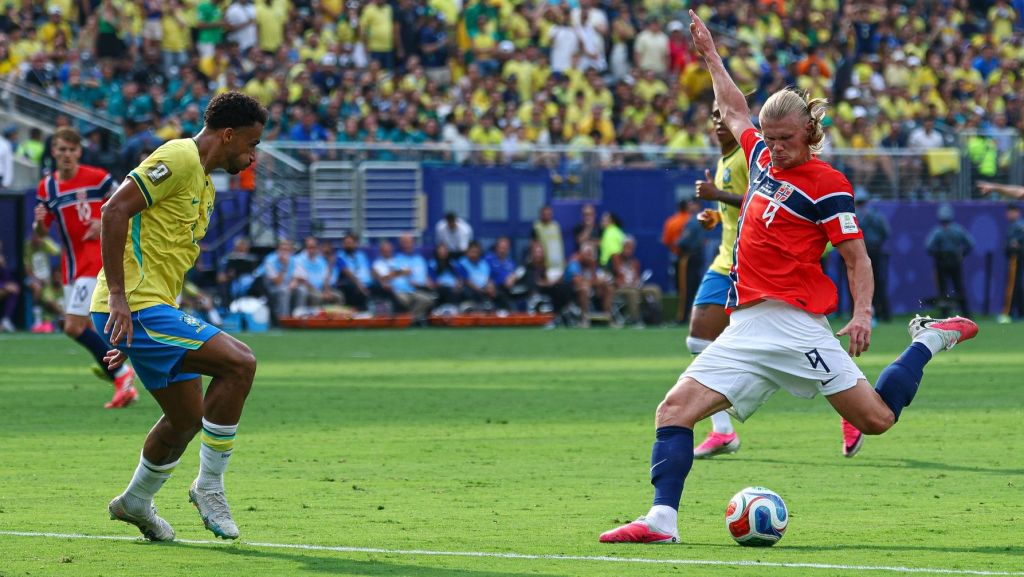
The 2030 FIFA men’s World Cup will also be missing legendary TV draws such as Neymar of Brazil, Cristiano Ronaldo of Portugal, and possibly Lionel Messi of Argentina. So it will need new stars. But U.S. striker Folarin Balogun could be the next big thing. And superstar strikers Kylian Mbappe of France and “Striking Viking” Erling Haaland of Norway will still be in their primes.
Meanwhile, Cohen notes the addition of lucrative “hydration breaks” has made World Cup rights even more attractive.
“The hydration breaks, as controversial as they may be, have been brilliant from a creative revenue generating perspective,” Cohen says. “In a media market as tough as the one we are in, properties must innovate to deliver greater revenues. Nearly $300m in incremental revenue alone can be achieved with this new asset.”
What media and tech giants could bid on the 2030 and 2034 World Cups? Round up the usual suspects.
Start with giant streamer Netflix, which holds the U.S. and Canadian rights to the 2027 and 2031 FIFA women’s World Cups. With everything from the NFL to the Masters, Amazon Prime Video has developed an insatiable appetite for marquee sports properties. On the legacy TV side, there’s NBC Sports, which could replicate its successful global formula with the Olympic Games, and is eyeing a potentially massive combination of both English-language and Spanish-language rights for the World Cup. ESPN has been pining for the World Cup since it last broadcast the event in 2014. And don’t count out the incumbent Fox, which has controlled U.S. English-language rights for the last three World Cups.
FIFA won’t have to sell upcoming rights very hard because this year’s numbers sell themselves. Fox averaged a record 26.4 million viewers for the USMNT’s win over Bosnia-Herzegovina on July 1. That made it the most-watched English language soccer telecast in history–and most-watched broadcast on any network since NBC’s telecast of Seahawks-Patriots in Super Bowl LX on Feb. 8.
Through Wednesday’s match, 103.4 million viewers have watched World Cup coverage across Fox, FS1, and Tubi, wrote Fox ratings guru Mike Mulvihill on X/Twitter.
“Asking if soccer will ever really be popular in the U.S. has become like asking if Americans will ever eat sushi,” tweeted Mulvihill. “Once exotic things now completely mainstream. The few people still having this debate are old, irrelevant and stuck on a question that was answered years ago.”