Want more from Front Office Sports
in your search results?
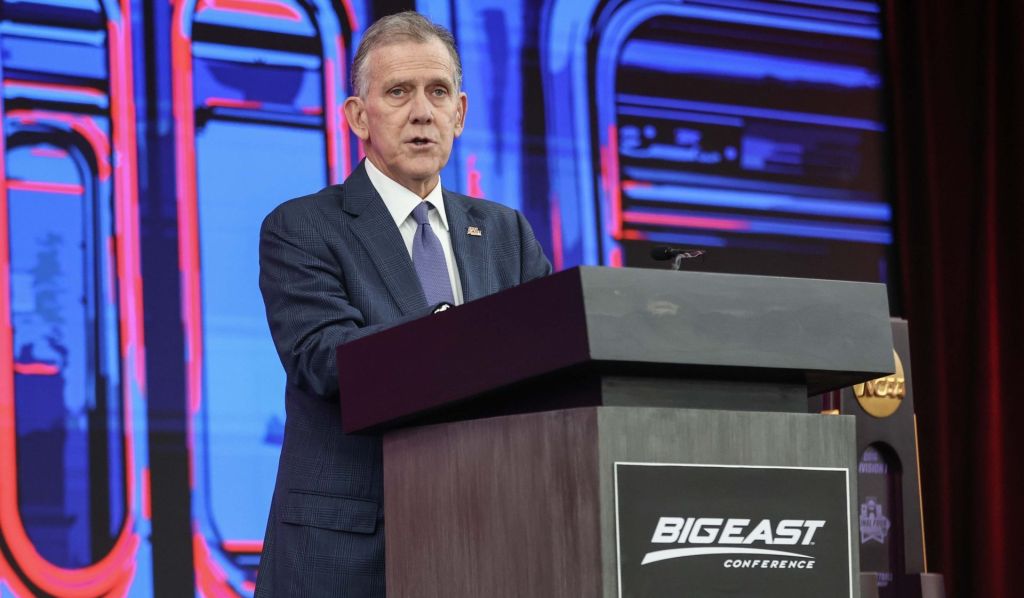
NEW YORK — New Big East commissioner Tim Brosnan isn’t ruling out a future private-equity investment in the conference.
The longtime Major League Baseball executive, who replaced Val Ackerman as commissioner in September, said during his opening remarks at Big East media day that he would be focused on commerce and revenue opportunities for the conference. When asked specifically about private equity during an interview with Front Office Sports, Brosnan suggested he was open to a deal.
“Is there a role for investment in the Big East, somewhere down the road? I would think yes,” he said. “What that specific role is today, I couldn’t tell you. I’ve only been here 30 days.”
Brosnan noted the league has been approached. “The question is: What specific need is it that you think private equity may be able to address for your conference?” he said. “We’ve been reached out to by any number of private equity shops … and there are uses for private equity. But I don’t think we’ve seen a use case yet that we think we would get involved in.”
He added: “When I say we—these are policy issues that have to be decided by the membership. I’m the chief executive, so I report to the membership. To the board.”
To date, only one conference has signed a league-wide deal with a private equity firm.
Earlier this year, the Big 12 signed a deal with RedBird Capital Partners and Weatherford Capital. (RedBird IMI, in which RedBird Capital Partners is a joint venture partner, is the primary investor in Front Office Sports.) The league received a capital infusion, a business partnership, and an option for a school-specific capital infusion; it did not sell off an equity stake of the conference. (The University of Utah is the only school to sign a private equity deal at the school level, selling a portion of its assets to the firm Otro Capital.)
Though the Big 12 is the only conference to consummate a deal, it isn’t the only one to consider the prospect. Last year, the Big Ten explored a partnership that would sell a portion of conference assets in exchange for a capital infusion from UC Investments, the pension fund for the University of California system. But UC Investments abandoned the deal after multiple schools objected.
Meanwhile, the ACC, SEC, and the American have explored options but have not landed on any specific proposals.
Download the FOS App
The business of sports, in your pocket.



Scan the QR code to get the app now.