Want more from Front Office Sports
in your search results?
NEW YORK — Three days before the 2026 New York City Marathon, British distance runner Patrick Dever stood on a small stage in an air-conditioned media tent in Central Park, and accepted a third-place trophy.
The odd moment came and went quickly with little ceremony, and for good reason: The trophy was for last year’s race.
Last November, Dever was fourth to cross the finish line. But four months later, the man who crossed the finish line just one second before him, Albert Korir, received a five-year ban for testing positive for the blood doping substance CERA a month before the race. Dever moved into third in the official results.
It also meant—belatedly—some extra money. Third place in NYC earns $40,000 from the New York Road Runners’ prize purse, while fourth gets paid $25,000. Korir had to forfeit his money, and Dever got what he called a “pretty good amount of money”—an extra $15,000.
“Some people could go their whole career and you might never know if someone’s cheated who’s finished ahead of you, so I suppose in that sense, I’m glad that the system is working and people are getting caught,” Dever told Front Office Sports in New York, days before his return to the race. “But yeah, you never want to be the one in that position, obviously. You want to have that moment on the day, but I guess this is the next best thing.”
Doping is a major storyline in New York this year after Korir—who won in 2021—and several other high-profile athletes have recently received bans.
The Athletics Integrity Unit issued a provisional five-year suspension to reigning women’s world marathon champion Peres Jepchirchir on Oct. 23. The highly decorated 33-year-old from Kenya, who also won NYC in 2021, tested positive for the banned blood booster EPO. Jepchirchir did not immediately respond to a message seeking comment.
The AIU also handed out a six-year suspension on Oct. 22 to another top marathoner, Ethiopian Ruti Aga, who tested positive for the banned steroid methylprednisolone.
And all the pro women are chasing the shadow of a world record set two years ago in Chicago by Ruth Chepngetich, who last fall was handed a three-year suspension after testing positive for the banned diuretic HCTZ. All her records and results before her March 2025 positive test still stand—including her widely questioned world record in Chicago, where she won $150,000 in prize money and bonuses, and presumably more from her sponsor, Nike.
‘It Doesn’t Have the Same Impact’
The doping cases have ripple effects stretching back years.
The main source of income for elite runners is through their sponsorships with shoe and apparel brands, which typically have incentives based on how the athletes place at major races; the races themselves also pay prize money.
On Sunday in New York, first-place finishers will earn $100,000, second-place will get $60,000, third-place $40,000, and fourth-place $25,000, all the way down to $2,000 for 10th. Athletes can also get a $50,000 bonus if they break the course record.
In addition to the extra $15,000 from NYRR, Dever said his new status as a third-place finisher meant a higher appearance fee, and sponsor Puma retroactively paid the third-place bonus in his contract. He declined to say how much his additional Puma payment was; running contracts are often under strict non-disclosure agreements.
But even for those like Dever who are able to recoup some of their losses, any runner who places behind a doping athlete still misses out on opportunities that come from getting the spotlight on race day, says Dathan Ritzenhein, the retired Olympic marathoner and head coach of On Athletics Club.
“Your marketability from that moment is so much lower,” Ritzenhein tells FOS. “You might be considered the champion later, but no one remembers. There’s no pictures of you standing on top of the podium, and that’s the stuff that sells. … When you can’t utilize that, it doesn’t have the same impact for an athlete.”
Few are as intimately familiar with the subject as Ritzenhein. As an athlete, he competed in an era that was pervaded with questions about doping; he was also coached by the notorious Alberto Salazar, who was banned four years for doping violations and is now banned from the sport for life for sexual misconduct. A leaked report in 2019 showed Ritzenhein worried about both the safety and legality of Salazar’s methods.
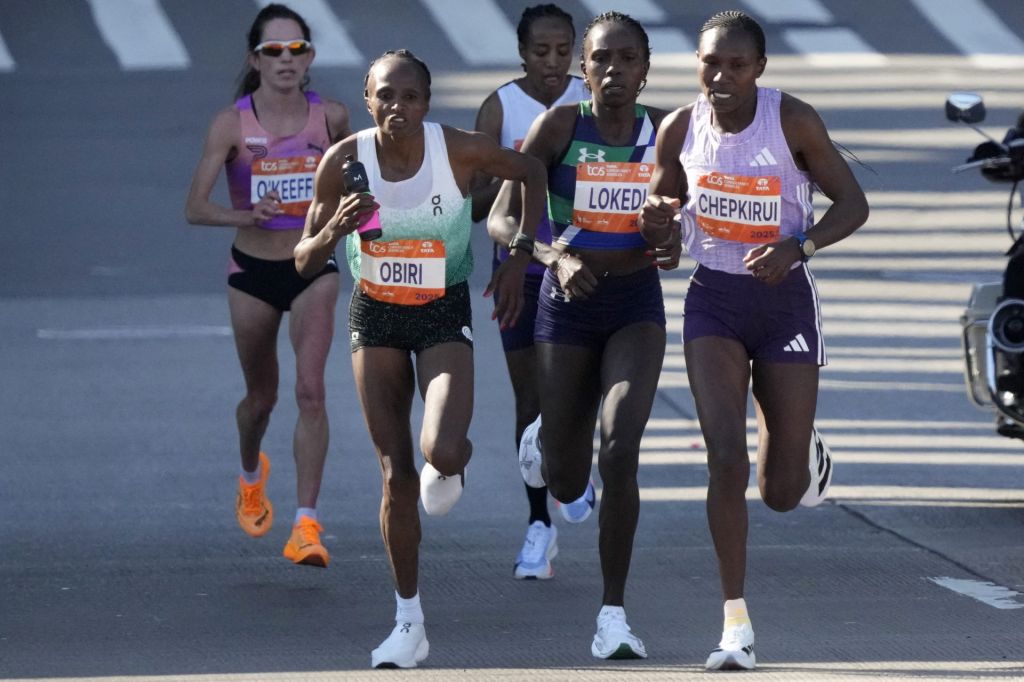
Ritzenhein now coaches 2023 and 2025 New York women’s champion Hellen Obiri, who is among the favorites on Sunday. Obiri tells FOS she supports organizers withholding prize money until athletes are cleared by the AIU.
“We need to start testing much earlier before we come to this race,” she said Thursday.
The World Marathon Majors—which includes Boston, Chicago, New York, London, Tokyo, Berlin, Sydney, and Cape Town—ban athletes for life after a positive doping test, even after their suspension ends.
The 2014 Boston Marathon winner, Buzunesh Deba, wasn’t paid for a decade after the race because its original winner, Rita Jeptoo, didn’t return her first-place prize money after she was disqualified because of doping. In 2024, Boston organizers changed their policy, paying out prize money to around 80 runners including Deba who had lost to dopers.
On Thursday, athletes spoke about fellow runners who placed behind Jepchirchir in past competitions—even years before the Kenyan’s positive test. Jepchirchir won four World Marathon Majors.
“I think it’s unfortunate, because now you have a person that has had this really long, great career, and none of it really matters,” Ritzenhein says. “That one test tells the whole story.”
Download the FOS App
The business of sports, in your pocket.



Scan the QR code to get the app now.