Want more from Front Office Sports
in your search results?
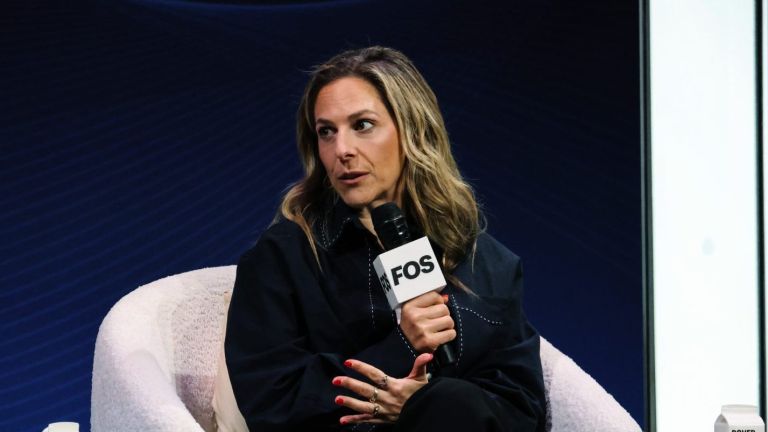
ESPN and NFL Network data analyst Cynthia Frelund also devotes time to tending to her investments. She spoke to Front Office Sports about being part of a massive exit in the mac and cheese brand Goodles, as well as additional investments in beekeeping, AI, and alternative energy.
Front Office Sports: I’ve heard you’ve had a series of eclectic investments. Can you walk through some of the more interesting ones?
Cynthia Frelund: We’ll start with a home run here, which was Goodles, a macaroni and cheese company co-founded by a woman named Jen Zeszut. I invested in 2021 and they just got acquired by Barilla, I think last week or two weeks ago is when it closed.
So that was the first one, which was in part because I asked my business school professor from Kellogg [Northwestern’s business school], who’s one of her cofounders Paul Earle, I was like, ‘I’d like to meet a bad bleep woman who is an entrepreneur and thinking about things in different ways so I can learn something.’
And so once I became connected with her, she let me in on how the process was going, how they were testing the noodles; they had to get the right fiber, protein, and taste profile because she wanted to create a clean version of macaroni and cheese that had the right nutritional components to make comfort food more accessible. So, when she told me all of that and then I tried some samples of it, I was completely in.
We did a combination of an investment and some sweat equity. I helped with some data and we did some fun content together … I don’t know if I’m ever going to do better than that.
FOS: I know that you’re probably not going to be able to say exactly how much money you put in and what your exit was, but what was your multiple?
CF: I made over a 50x return on that. I’m never going to do it [again]. I should have mortgaged every penny I could possibly have gotten. I just really liked the founder and believed in her. And, food and cooking is one of the things that I really enjoy. So, again, I wish I would have put way more money into that.
FOS: In general, do you think that the individual or individuals involved in these types of ventures is actually more important than like the underlying product line?
CF: Yes. I mean, it has to solve a problem people would like to solve. So let’s say it’s 70–30 because you have to be using your brain in a way that can serve other people. I went to business school, so I have to use the word ‘product-market fit,’ right? You have to find the right solutions and the why’s so that people can adopt it.
But it takes a very, very special person to make that why and to make that product come to life. So I think you have to have that product market fit, but you don’t do that without having the right sort of founders and surrounding them with the right sort of blends of personalities to actually get things done.
FOS: I’ve heard through the grapevine, you’ve also started dabbling in the beekeeping business. Can you tell me about that?
So, I was not quite successful with that one. Like I said, we lead with our home run, but about 12-13 years ago I was reading about how beekeeping populations and beekeepers were a dwindling unit and that bees were something that we really need to protect because—not just the actual bees or honey or the market for those things, but there are so many different reasons down the chain, causes and effects of when we don’t have enough bees in our society.
At the time, people weren’t talking as much about going to trade school and doing trades as much as they are now. So I was looking at ways that I could be involved and use the thing that I have some disproportionate knowledge about, which is data. Bees actually give us great data. So when I was looking at ways I could be involved in helping, I started looking at beekeeping schools and beekeeping. It’s usually learned by an apprenticeship [as opposed to in school].
So I made a small investment in a company that subsequently donated itself to Cornell’s agriculture school. But I was glad to do it because I learned a lot from that and I also felt like I got to learn what the American Beekeeping Federation was all about, and the American Honey Producers Association, and and when hobbyists or commercial beekeepers all lose their colonies, what that does to the rest of our environment.
It was very cool, not from an ROI standpoint, but a good learning lesson and a good opportunity for me to get involved in something a little bit outside.
FOS: Are there some other things you’re dabbling in right now?
CF: A number of years ago, also in 2021, I invested in Audigent, which was actually acquired by Experian a couple of years ago. It was really on the forefront of anticipating how ad delivery systems could be monetized with interesting uses of data. So I believe I have a lot of information about how to look at and gain insight from data as I have a master’s degree in predictive analytics and I worked in a financial capacity for a long time prior to my current job.
And then I have looked to models other than football to help understand football data better because the more you understand about patterns, and pattern recognition, the better you can be. It just gives you a fresh set of eyes for when you’re looking at something that you’ve maybe looked at over and over again. So, that was a cool one.
But currently, I’m looking at large tabular models—LTMs. So, instead of an LLM [large language model], which is based on data that has been gleaned from reading—so language models—a large tabular model uses and “studies” huge data sets to find correlation, causation, really interesting ways of keeping numbers not just sorted but predictive, not specious reasoning. We want to have more causal and highly correlated data. So with large tabular models, the one I think is the best in class is called Fundamental.
FOS: And then any others before we go?
CF: Yeah—Arbor. I think it’s very interesting to talk about alternative sources of energy. I like science. I’m clearly a dork. And I think it’s very interesting to look at how nuclear, and how different sources of power can help serve our country and get us off of the reliance on natural gas and coal, things like that.
Another is happy coffee. It’s all about sourcing, they say ‘people, planet, progress’—the focus is on ingredients and the process but mostly I like how they treat their grower partners.