Want more from Front Office Sports
in your search results?
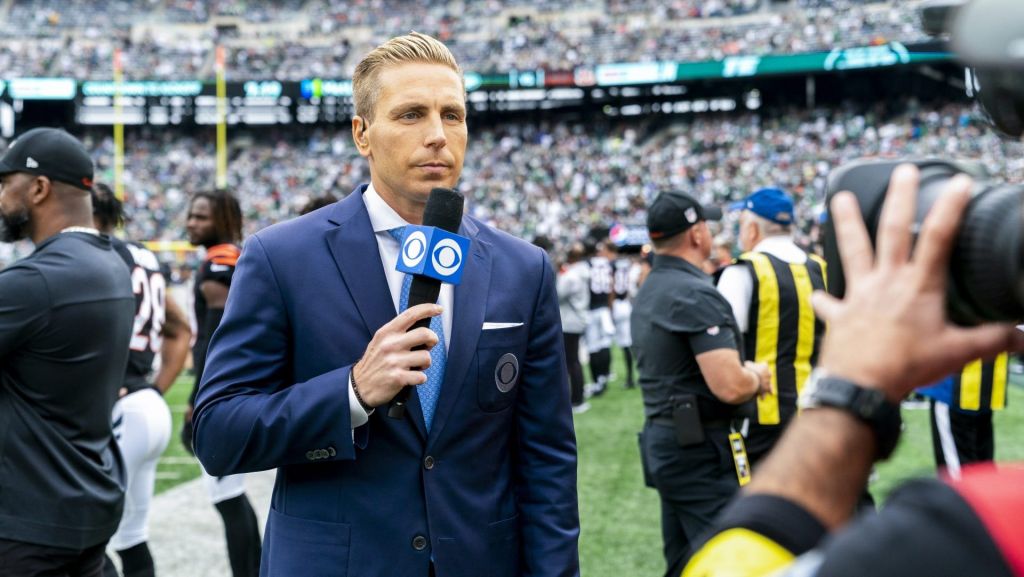
Every once in a while a sports TV innovation comes along that’s so fresh and addictive, you have to tip your cap. This year, that innovation is Evan Washburn’s “Instant Film Room.”
Rather than asking the usual postgame questions, the CBS Sports sideline reporter has been showing NFL quarterbacks like Bryce Young, Aaron Rodgers, and Josh Allen the key play of the game via a portable video monitor. In many cases, it’s the first-time the players see the actual game footage after it’s happened. Their fresh-from-the-field film breakdown is providing some fascinating insights for football viewers.
On Sunday, Young recounted how his fake handoff froze Eagles linebackers long enough for him to hit tight end Tommy Tremble with a play-action pass for a TD. “As much ‘sell’ as possible to try to sell ‘keeper,’” the Panthers QB explained.
The normally taciturn Rodgers was delighted to narrate how hulking 265-pound Steelers tight end Darnell Washington turned a short pass into a 48-yard gain that led to a go-ahead field goal. Said Rodgers: “All I’m trying to do is get him the ball where he can catch and turn. Because once he catches and turns, it’s pretty incredible the big man. If you run it back, I don’t do anything. I throw a ball for two yards.”
Earlier this week, Washburn spoke with Front Office Sports about his Instant Film Room and the possibility of incorporating it into his March Madness coverage.
This interview has been edited for length and clarity.
Front Office Sports: Tell us about why you started Instant Film Room—and what the reaction has been like?
Evan Washburn: It’s been in my brain for a little while now. I go back to last season, really, when it first sort of came to me. We were doing a game in Carolina where it was the Seahawks versus the Panthers late in the season. And our director, Andy Freedman, had a great cutaway into the stands of a fan, a Seattle fan in Charlotte, that looked exactly like Sam Darnold.
It obviously kind of went viral on the internet. I think Ian [Eagle] and J.J. [Watt] called him ‘Stan Darnold.’ It was classic. And I was thinking, ‘Hey, in the post game, I’d love to show Sam this as part of the post game interview.’ Because I have a remote monitor on the field that follows me so that I can see what the viewer at home is seeing at all times in case I’m doing a report and I’m referencing a player or a situation and I can actually see what the program feed is. So the plan was to have that in the monitor for Sam to see in our postgame interview, but we ended up having to do it live, which means you only get maybe one, if not two questions. So it just didn’t seem to fit in the moment. But that’s kind of where the idea was born.
And then, I love watching golf. I’ve become really addicted to the sport the last few years. It’s a big part of golf coverage. After a round, they’ll have a player come, whether it be on the desk or a reporter will grab them and walk them through their round. I think it’s a great way to get perspective from the player, which we get, whether you have a monitor or not. But especially football players, they are programmed to watch film and break it down. It’s what they do more than even play on the field. So I think it’s a real natural spot for them. And we’ve gotten some great reactions from guys when they get to see the play.
FOS: I loved your Bryce interview this past weekend. And Aaron Rodgers was one of my favorites. Talk about your favorite hits.
EW: Well, I think you picked two great ones. I think the Rodgers one definitely stands probably above the rest for a couple reasons. One, it was the first time where, and this is credit to our director Suzanne Smith and our camera operator on the field. And the idea of making sure that the monitor is in the shot so you can see the player looking at the screen. Because I think our first two with Josh [Allen] and Bo Nix, Josh was great, but it was just a tight shot of his face. So it didn’t have the sense, at least for the viewer, that he was watching the play as it had happened.
The thing that was so great about Aaron, that I think has been part of what the secret sauce to this, it’s an opportunity for these guys to talk about their teammates too—which the best leaders love to do. And the thing that struck me in that Rodgers interview was that he listed off the guys that were making blocks for Darnell Washington all the way down the field. So it wasn’t a great throw or play by Aaron Rodgers, but it was one where he was so excited because of everybody around him. And I think that part is key too … So yesterday it was Tommy Tremble: Make a play. So it’s a chance for them to shout them out. But also help us understand how they got that open or how that play happened.
FOS: Some viewers might not realize it but this is usually the first time the QBs are seeing the outcome of the play, because they’re typically buried on the turf under a pile of defensive players.
EW: It’s a great point because we—and I’ve been a part of it often—ask questions about plays in post-game interviews and players and quarterbacks are good at sort of taking us through what was going on in that play. But the ability to see it, and their first time seeing it, that’s when you get that genuine reaction. It’s not as if we’re watching the play on Monday, Tuesday, or Wednesday. They’ve already seen it X number of times, whether it be on their phone or in the film room. And I would say it’s a more muted reaction.
But on the field, in some cases, like the Josh Allen play to win the game in Houston, or Aaron’s play to Darnell, those were plays late in the game that they had just finished actually completing in reality. And they get to relive it. And I think that’s led to an unintended benefit to this that I didn’t see coming. I saw this as a real X’s and O’s opportunity, which it has been. But I think the emotion’s been almost better from these, what I call the instant film room moments in the interview, than when I ask my more conventional questions in my lead up to bringing the monitor into the picture.
FOS: In an interview with Awful Announcing, you noted players are still looking at still photos of plays on the sidelines. But there’s a big difference when they see it on video.
EW: I think there’s been some evolution, but it’s all stills. It’s not a video. So they’re kind of scrolling through. You’ll see a quarterback, or really any position, and coaches obviously, doing it as well, they’re swiping through the screen. It’s just different still shots of that kind of the All-22 look where you get to see what happened or what didn’t happen.
In some cases, college basketball, they’ve started to allow video, like live feeds or replays for one person on the bench to have to show to coaches, to show to players. So it goes to what we talked about earlier. Their livelihood is built on film study and looking at these pictures and looking at monitors. And again, the ability to then show them the live action of it, as opposed to the still, again engenders some good reactions.
FOS: What’s next for Instant Film Room? Are you planning to use this during CBS’s NFL playoff coverage? Or when CBS broadcasts the Super Bowl again in 2028?
EW: I would hope so. I think it has legs in so many scenarios. I mentioned it briefly off the top. We’ve been taping all of our post game interviews because I’m often in that prime 1:00 PM window with Ian [Eagle] and now Ross Tucker. So we’re getting immediately to the studio, or immediately to another 1:00 PM game that’s wrapping up, or maybe even immediately to the 4:25 or 4:05 game. So all of our interviews are taped now. There are opportunities where we might be in the late window. It almost happened in LA in that Denver game where we could be doing a live interview. But I still think this plays live. I think you, you have the monitor there, you get the quick shot of it and then boom, we cover the entire thing for the viewer at home. So they get to see the play that the guy’s breaking down. So that’s kind of an in-the-weeds thing that I think allows this to grow and exist in every scenario.
The only other two things I’ve thought about would be a situation where, say yesterday, there was a Chuba Hubbard run that was just unbelievable. But we still want to interview Bryce Young. We see Fox do this, where I think it’s either Tom Rinaldi or Erin Andrews will interview the star of the game. And then Tom Brady has his separate segment of a post game interview. I think it’s called LFG Player of the Game. I’ve talked to my X and O guy, Ben Fennell, who works in the truck, who does such a phenomenal job with our crew and game. I was like, “I want you to give me the play that everybody in the tape world will be talking about on Monday.” So that might not be a Bryce Young throw. It could be an incredible block by a guard where he gets up to the second level. I want to have that guard break it down. So we’ll still interview Bryce post-game. And we’ll bring over [right guard] Robert Hunt from the Panthers who had the incredible block and have him in the Instant Film Room. I think that’s one of those things where I think I want the plays to dictate who’s doing the breakdown—not always the biggest star.
And then the only other thing I’ve thought about is could this work in basketball? Because we obviously do the NCAA Tournament, we do college basketball, and I do think there’s a place for it in those post-games for the same reason that it works with football players. They love watching film and breaking down why a play worked. So I think that’s kind of marinating as I start thinking about March here in a few months.
FOS: Are there currently discussions at CBS about using Instant Film Room for March Madness?
EW: We haven’t gotten in any discussions about March but when the opportunity arises, I’m definitely going to pitch it. The only thing, I don’t know if I have remote monitors for college basketball, because I’m usually just parked in a seat behind the bench, and I’ll have your traditional monitor, basically a TV screen that I’m able to watch. But since I’m not really doing a mobile thing, like I am with football where I’m walking around the field constantly. So that might be a hurdle we’d have to figure out.