Want more from Front Office Sports
in your search results?
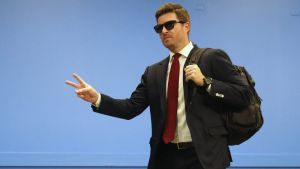
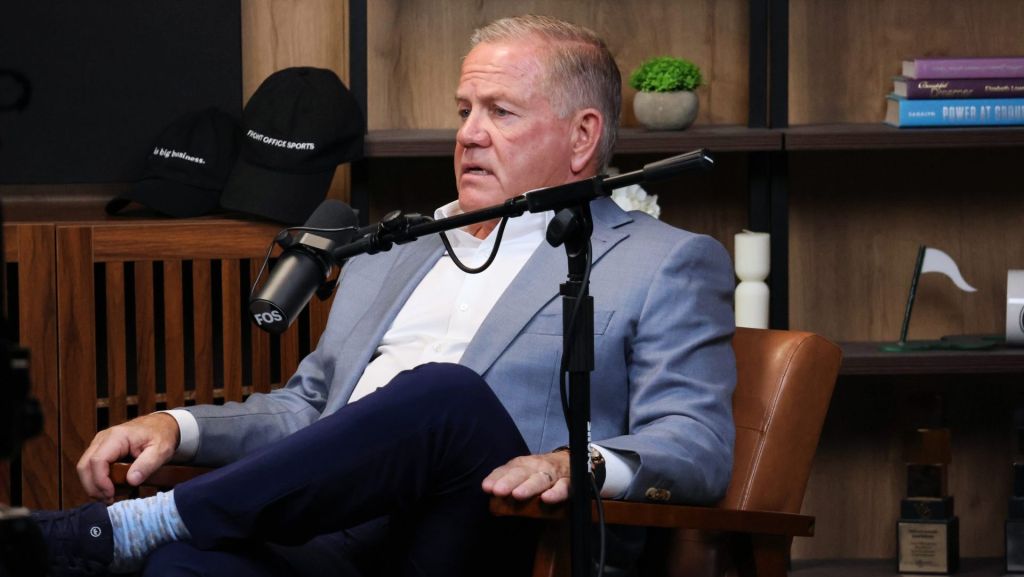
NEW YORK – Brian Kelly looks relaxed and happy in his new role with CBS Sports and SiriusXM College Sports Radio. But the former LSU and Notre Dame coach tells Front Office Sports he’s not shutting the door on a return to coaching. If the right opportunity pop ups, he’s ready to listen.
With an overall coaching record of 297-109-2 at LSU, Notre Dame, Cincinnati, Central Michigan, and Grand Valley, Kelly’s a proven winner. It’s no wonder his name is already being linked to possible Power 4 coaching opportunities at Maryland, Baylor, and NC State.
A little more than a year ago, Kelly was fired by LSU after compiling a 34-14 record with the Tigers over four seasons. But the drama didn’t end there. The school tried to wiggle out of paying him his full buyout. Kelly sued. LSU blinked and agreed to pay him the full $54 million ending the legal battle.
During the 2026 season, Kelly is serving both as a game and studio analyst for CBS’s college football coverage. The three-time Coach of the Year is also co-hosting a weekly show on SiriusXM with Danny Kanell and Roy Philpott.
Kelly visited the Front Office Sports office to talk about his rookie season in sports media, the pressures facing his LSU successor Lane Kiffin, and where he stands on an expanded College Football Playoff. This interview has been edited for length and clarity.
Front Office Sports: What’s it like calling college football games on Saturdays instead of coaching them?
Brian Kelly: Well, it was difficult. Obviously, because you’re used to the game, the lead-up to the game, all that goes along with the preparation. So I think it wasn’t just Saturday. I think it was like Tuesday and Wednesday and Thursday, looking out my window going, ‘I should be on the field here around 2:30-3 p.m.’ So after getting through that, your focus is on your job and my focus is the preparation for the game, meeting the players and the coaches associated with it. So it really filled a pretty good gap that was there for me, by having that interaction with the players and the coaches and going to practice.
FOS: How do you like calling games at CBS?
BK: I think it’s been what I was hoping for in any business or organization, you’re looking to be in a culture where there’s standards, there’s high standards for excellence and there’s good people. I think the people make the difference for me at CBS. I have a new respect for how it’s all put together. I really wasn’t sure what a director did or a producer. Obviously, the executive staff is amazing in terms of being able to plot out the course. But the audio professionals, the camera professionals, the research department…I couldn’t believe the research that I got on my computer and phone in the first week for preparation.
FOS: Some coaches go into media for a year or two to recharge their batteries, then return to the sidelines. One of the most famous examples is Bruce Arians. He called games for CBS in 2018, then went back to the NFL and won a Super Bowl with the Buccaneers in 2021. Do you see yourself staying in the media? Or returning to coaching?
BK: Well, I still have a passion for the game. I still have a passion for the relationships. I think everything that I’ve done in this business has been about developing young men and being in an environment where you can get the best out of them. So I miss that. Certainly, this is not a stopover for me. I’ve put all of my time and effort into being the best I can for CBS. If something, you know, opens up that looks like a good fit for both sides, I won’t close the door on it. But on the other hand, I love the work that I’m doing with CBS.
FOS: Let’s talk about some of the major doings in college football. With the Big Ten dominating, is the SEC no longer King of the Hill?
BK: No, I think there’s just great parity around college football. Certainly, Indiana was the national champion, and deservingly so. Michigan the year before. But there’s probably 30, 40 teams now that have invested heavily in wanting to win a championship. And because of that, we’ve got more of an NFL model. There’s great parity across the board.
I think it’d be like saying one year the NFC is better than the AFC. Nobody really buys into that argument because they’re all good. And on any given day what we’re seeing in college football, I hear it all the time, there’s chaos. I think it’s the new normal. So I don’t think there’s a preeminent conference. Clearly the Big 10 and the SEC have a leg up. But I think that parity is really the biggest single determiner of what’s happening right now.
FOS: Where do you stand on expanding the College Football Playoff?
BK: I just can’t see a negative in it. Certainly traditionalists would say, “Well, we’re gonna lose some of the passion for the regular season.” I was just talking to [FOS founder Adam White] here, and all he wanted to talk about was the Miami-Notre Dame game, and certainly that’s a regular season game. We’re going to continue to have great games—especially with the Big 10 and the SEC going to nine conference games plus a carryover game, a 10th with the other conference. It’s going to make for exciting football.
24 teams does this: For those that are just on the outside looking in, there’s hope. If you want to keep putting money into your program, your fan base needs hope. So coming to November, that brings in such a large number of teams that were never going to be part of this. And then from the top down, you still get the opportunity to host a playoff game, to get a bye, to still be rewarded from the top down. So I just think it’s really good for football.
FOS: But what about losing the Conference Championship games?
BK: Listen, I think there’s great history and tradition, but like anything in the world we live in, change is inevitable, and I think the change in college football was inevitable where we had to bring in more teams because there’s just such an investment by so many teams today. So something had to give. And if you’re going to give up a conference championship, for the betterment of college football—and I believe this is for the betterment of college football—then that unfortunately was going to have to be the thing that was given up.
FOS: We were just talking about one of your old rivals, Nick Saban. He’s a big supporter of the Protect College Sports Act. Where do you stand on it?
BK: We have to come up with some white paper, some rules. Look, I think the hardest thing for me is when you bring in a class and there’s a great chance that that turnover is in one year. When you bring in your rookie class in the NFL, they have to be there for four years. There’s no free agency until after four years.
We have to figure out how to maintain the rosters without turning over each and every year. So the unlimited transfer, through that act, is probably the single most, in my opinion, the single most important thing that we need to handle. And then whether it’s some kind of cap, or whether there’s some kind of antitrust protection for the NCAA, we all could argue about what the next most important thing is. The most important thing is making sure that we have some kind of rules and regulations on unlimited transferring.
FOS: On your SiriusXM show you weighed in on a rollercoaster season for Texas and Arch Manning. What’s the issue? Is it coach Steve Sarkisian?
BK: No, for anybody to characterize my comments that we were blaming Sark for anything is out of context. What I said, specifically, was that Sark needed to meet Arch where he is in his development. And if that’s not as far as he thought it was, then that’s what you have to do at the time. And Arch has to continue to develop as well. This is a two-way street. So anytime I ran into a problem with a player not being the best version of himself, I always looked at what I needed to do and what the player needed to do, and we needed to meet in the middle.
FOS: Does Arch Manning need a fresh start at another school?
BK: I don’t think so. I think he’s got all the resources there. He’s got an outstanding head coach who is a great play caller. I think it’s just the maturation. Look, we’re in a microwave popcorn mentality. We want it right now, we want it within 30 seconds. This one is taking a little bit longer and there was so much hype around this, that no one could live up to those expectations. I think the natural progression and progress is maybe a little slower than both of them want. But they’re going to get there.
FOS: Lane Kiffin at LSU has already lost a couple of games this season. Is he finding out it’s the national championship or bust at LSU?
BK: That’s what it is. Listen, at the end of the day, that’s why I was let go. I didn’t live up to the standards that are set there at LSU. They brought me in to win a national championship, and there was a lot of work that needed to be done to get there—more so than many thought. But at the end of the day, I didn’t get to that level of expectation that they had, and that is to win a national championship, and Lane will have the same expectation.
FOS: You took Notre Dame to the National Championship Game in 2013. You rank as the Fighting Irish’s winningest coach ever. What does that mean to you?
BK: Well, if there was a pin for that, I’d wear it, but there is no pin for that. It’s about national championships at Notre Dame. But our legacy there, my family’s legacy, is that we immersed ourselves in bringing Notre Dame back to relevancy and leaving it better than what we found it. We feel great about that. A lot of it was infrastructure and support staff and all the things necessary for that program to grow. We had five consecutive 10-win seasons at the end of my career and, and we’re able to hand it over to [coach] Marcus [Freeman] and Marcus is building off of that.
FOS: Should the Irish bite the bullet and join a conference? Wouldn’t that mean better players, more resources?
BK: No, I don’t think so. I don’t think it means better players, better resources. I think they’re well funded. I think their resources now are outstanding, that the university has really embraced wanting to be elite both in the classroom and on the football. I think one of the things that could be problematic is scheduling.
Right now, they’re in a collateral relationship with the ACC for games. If that thing breaks apart in any way, then they’re looking for games. So my only concern ever with Notre Dame has been making sure that they can put together a schedule.
FOS: Rutgers has been struggling this season. Your name has been mentioned as a possible coach for the Scarlet Knights. Your thoughts?
BK: This is the normal period of time where I’ve always, when I’ve been in the coaching business, deflected all of those, “Hey, I’m taking another job.” Now I’m out of it. It’s natural that your name is going to come up. It’s way too early for me to entertain any of those thoughts. If it materializes, we’ll certainly listen. But Greg Schiano is a friend. I’m pulling for him. I hope they win all their games. Because he’s a good football coach and it’d be good for Rutgers.
Download the FOS App
The business of sports, in your pocket.



Scan the QR code to get the app now.