Want more from Front Office Sports
in your search results?
The future of MLB’s local media business has become a central element in the sport’s labor battle, providing yet another substantial layer to the already fractious situation.
For the last six months, MLB club owners have proposed to pool the local media revenue of all 30 clubs as part of a sought-after economic system that would implement a hard salary cap and floor. Most recently, management has updated its cap offer to the MLB Players Association to a 2028 implementation, and vows there will be “no compromise” on the pursuit of a cap as the Dec. 1 expiration of the current labor deal and an expected lockout thereafter approach.
The pooling of local media revenues, and a promise to end regional blackouts that have long frustrated fans, were also part of a video recently distributed by MLB to fans.
Throughout the entrenched negotiations, though, two key questions have persisted: Why are the local media and salary cap issues so deeply linked, and why couldn’t owners just agree on their own to pool that revenue, similar to how the NFL operates?
Complex Dynamics
The beginning of the answer lies in the accelerating economic divide between the local media revenue of well-heeled teams such as the Dodgers, Yankees, and Mets, and half the league that has lost traditional regional sports network rights deal entirely and now has its local games produced and distributed by MLB—often at less lucrative terms than what they had before.
That split, exacerbated by existential disruption across the media business, has been the key driver in a $446 million spending difference this year between the Dodgers’ total luxury-tax payroll and projected taxes, and the comparable figure for the Guardians.
The total pool of local media income in MLB has also fallen, with the roughly $2.4 billion in annual revenues earlier this decade now standing at about $1.8 billion. With a cap-based system, MLB believes it can both narrow the economic spread and enlarge the overall pie of local media revenue.
“We are trying to make changes to the game that fans want and will improve the value of our media rights,” MLB EVP of baseball operations Morgan Sword said in a presentation this week to reporters.
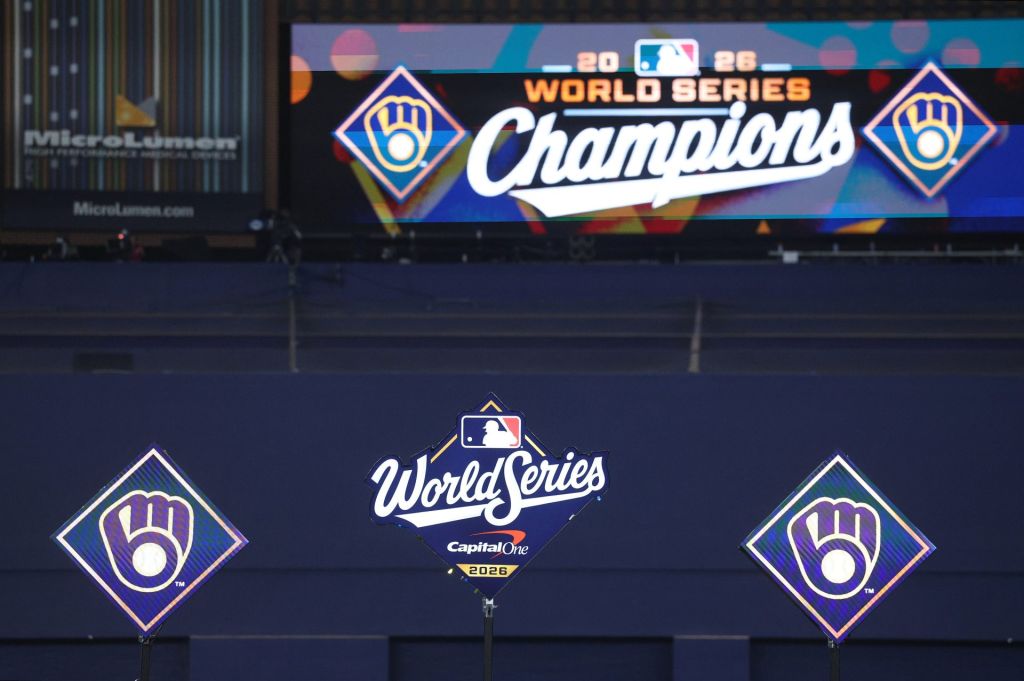
One of the teams whose games are produced by the league, the Brewers, won this year’s World Series, something Sword called out of step with the industry’s prevailing trends.
“It is truly aberrational in baseball for small markets to be successful,” he said. “It’s not impossible, but it is much, much more difficult in our sports than it is in any of the other sports.”
The second part of the question is more complicated. Pooling local media revenue has a direct connection to MLB’s revenue-sharing system, which is collectively bargained between the league and MLBPA due to its link to player compensation. In the current labor deal, teams currently pay 48% of their local revenue into a central pool. So the league says it cannot simply restructure this part of its economics without involving the union.
While that is indeed true, the blackouts remain a separate issue from a salary cap. A complete pooling of local media revenue, and an end to regional blackouts, could be negotiated with the union absent a salary cap, though that likely would create disruption in the current rights deals—something the league is reluctant to face.
Instead, management is seeking to achieve the local media pooling with a hard cap that players have long resisted. The league is also proposing several other sweeping changes in conjunction with the cap-and-floor system, including significant restrictions on free agency, a retooled draft, and a 154-game regular season.
“We’re not saying it’s the players’ fault there are blackouts. We’re also not saying a salary cap in isolation fixes blackouts,” Sword said. “What we are saying is that this economic system, which is a big series of trade-offs, for the clubs, for the players, enables us to do it.”
MLB additionally is looking to mimic the NBA’s recent strategy and pursue a much more nationalized strategy when its current rights deals expire after the 2028 season. The NBA did that to great success, nearly tripling its national deals to about $6.9 billion annually.
Union Resistance
Amid all of that, the MLBPA has consistently argued that caps reduce overall player compensation, pit player against player in a zero-sum game, and erode contract covenants.
“There can be no clearer example of the league’s lack of seriousness than their insistence that they will not negotiate over the economics outside of a radical change to the system that would dramatically reduce overall player compensation for all categories of players and strip fundamental rights from players like the ability to have truly guaranteed contracts,” MLBPA interim executive director Bruce Meyer said in a statement. “There should be no illusions about the owners’ true motivation in pushing for this system. They want to make more money in profits and franchise values by artificially suppressing player salaries.”
Download the FOS App
The business of sports, in your pocket.



Scan the QR code to get the app now.