Want more from Front Office Sports
in your search results?
The NFL’s two highest-profile games Sunday included highly debatable defensive pass interference calls at key moments that threatened to affect the outcomes—and, in one case, actually did.
Those calls served as major talking points during and after the Ravens-Cowboys and Rams-Broncos games. They are among the biggest officiating controversies of the young NFL season to date.
But they represent, ultimately, a predicament without an obvious solution, given the NFL’s past failure with making pass interference subject to review by instant replay.
The NFL declined to comment Monday.
The calls came in thrilling, down-to-the-wire games that seem likely to have generated large viewing audiences: the Ravens’ 34—31 win over the Cowboys in Brazil in the 4:25 p.m. Eastern time slot on CBS and the Broncos’ 30—26 victory over the Rams in the Sunday night game on NBC.
The fact that the calls may have been erroneous and were not subject to being overturned via replay is not an immediate threat to the league’s popularity; if anything, in the short term, such officiating controversies merely generate more public conversation about the league. But any questions about the accuracy and fairness of officiating are amplified in the current atmosphere of immense viewership, legalized sports betting, and widespread conspiracy theorizing.
The calls also came during a season in which, as Front Office Sports reported earlier this month, both offensive pass interference and defensive illegal contact in the secondary are points of clarification by the NFL competition committee. Those formerly were called points of emphasis and represent what the committee is stressing to the on-field officials in a given season.
On-Air Disagreement
On both of Sunday’s rulings, some observers thought offensive pass interference could have been called instead.
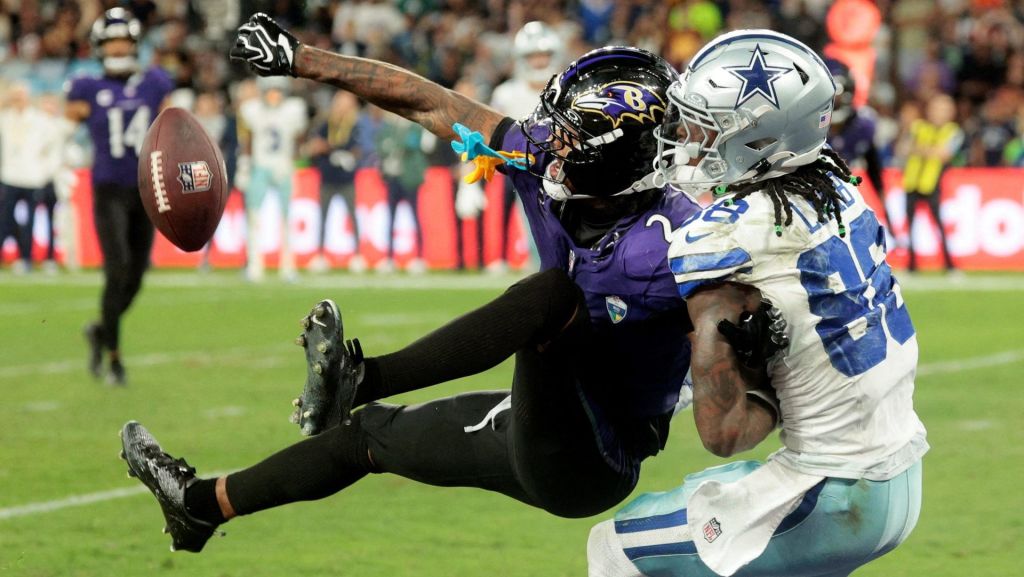
In the late-afternoon game, Cowboys wide receiver CeeDee Lamb and Ravens cornerback Nate Wiggins were maneuvering for position near the goal line on a pass by Dallas quarterback Dak Prescott. Lamb appeared to grab and pull on Wiggins’s arm. But Wiggins was flagged for defensive pass interference, giving the Cowboys a first down at the Baltimore 2-yard line with 23 seconds remaining and the Ravens protecting a three-point lead.
“Initially I thought it was just really hand fighting by both,” rules analyst Gene Steratore, a former NFL referee, said on the CBS broadcast. “Then at the end, in my opinion, CeeDee Lamb’s got Wiggins’s arm and pulls him forward. … Really tough play for the officials. But I had offensive pass interference there.”
That call did not decide the game, though. The Ravens limited the Cowboys to a tying field goal with seven seconds to play, then raced down the field and got a winning field goal by kicker Tyler Loop as time expired.
In the night game, the Rams were clinging to a three-point lead as cornerback Josh Wallace defended Broncos wide receiver Pat Bryant along the sideline on a third-down pass by Denver quarterback Bo Nix. Amid some jostling, Bryant reached back and grabbed Wallace, who managed to secure the ball on the play for what could have been a game-saving interception if he’d been ruled to have been legally in bounds.
But the officials penalized Wallace for pass interference, giving the Broncos a first down at the L.A. 7-yard line with 1:09 left on their way to a go-ahead touchdown and extra point.
“As we get toward the end, we actually see the receiver grab the defender and pulling [at] him,” rules analyst Terry McAulay, also a former NFL referee, said on NBC. “I don’t see the defender do anything that significantly hinders the receiver on this play.”
McAulay said that Wallace had his “hands on him” but “doesn’t do anything with them,” adding that he felt the play should have been a no-call and an interception: “If the knee gets down, yes. If two feet are down, yes. Absolutely. That’s what I see.”
It is somewhat unusual for network rules analysts to plainly disagree on air with on-field calls at key moments of games.
The Broncos held on at game’s end, as a final pass by Rams quarterback Matthew Stafford was intercepted in the opposite end zone with no time on the clock.
Rams coach Sean McVay was visibly angry on the sideline about the call. He said during his postgame news conference: “I’ll look at it. Looked like it was a good, competitive play from my vantage point. But we’ll go back and look at it and we’ll see what they say.”
Wallace said at a separate news conference after the game: “It’s tough, you know. I felt like we stopped them a couple times. You know, you’ve just got to keep playing, at the end of the day.”
There probably is no remedy for the NFL. The league made pass interference calls and non-calls reviewable by replay for the 2019 season amid the furor over an egregiously missed interference call against the Rams’ Nickell Robey-Coleman that led to them, rather than the Saints, winning the NFC championship game in New Orleans and reaching the Super Bowl to conclude the 2018 season.
But things went poorly. Players, coaches, and fans disliked the system and found its application to be uneven and confusing. The replay-for-interference rule was not renewed for the 2020 season after 21 of the 29 teams that responded to the competition committee’s postseason survey said they would not be in favor of making the rule permanent; 17 of 22 teams that responded to a different survey question said they did not favor extending the rule for even one more season.
The competition committee has generally opposed making judgment calls reviewable by replay, a stance that was reinforced by the failure of the pass interference experiment.
The game Sunday night in Denver marked a flashback of sorts for McVay, Broncos coach Sean Payton, and referee Bill Vinovich. All were on the field for the Rams-Saints game with the infamous non-interference ruling, although Vinovich was not directly involved in either call. Payton coached the Saints then.
“Frustrating is an understatement, a massive understatement,” former Saints offensive lineman Terron Armstead, who played in that game, said on CBS on Sunday night. “Sean McVay versus Sean Payton with Bill Vinovich as the referee and there’s a controversial pass interference call. I know this moment all too well. … I can’t even, like, really grasp what I’m witnessing right now, so many years later. … I’m biased to the Broncos, Sean Payton.
“I’m rooting for those guys. [But] it was a bad call. Truly, it was a bad call. And when you lose a game of this magnitude, you play so well as the Rams did and you lose a game and you feel like you lost because of a call, I know that feeling all too well. … It’s more than frustrating.”