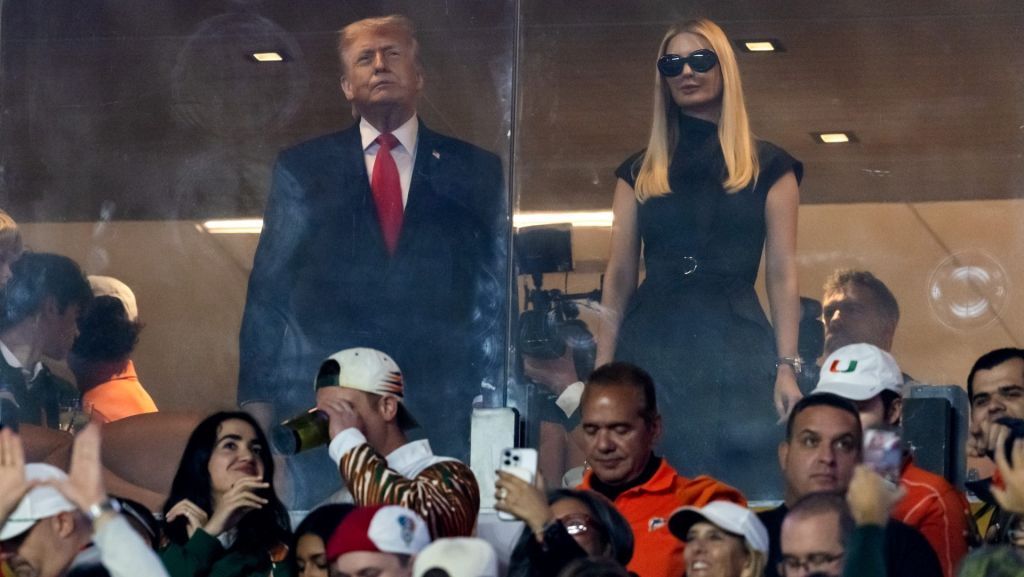
The White House is disputing reports that President Donald Trump’s appearance impacted helmet communications—and therefore the outcome of the 2026 College Football Playoff national championship game between Indiana and Miami in January.
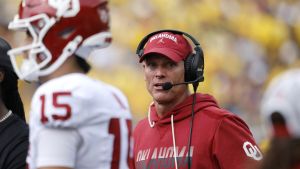
The claims arose in the wake of comments from Texas coach Steve Sarkisian ahead of Saturday’s matchup between No. 1 Texas and No. 14 Tennessee in Knoxville—a game Trump is slated to attend. Sarkisian suggested that Miami coach Mario Cristobal had told him that comms went out during the Hurricanes’ final drive of the national championship game, prompting controversy and conflicting reports.
On Friday, the White House appeared to dispute not only that the comms disruption impacted the game, but also that comms disruption took place as a result of Trump’s movements at all.
“No, President Trump’s departure from the CFP championship in January did not cause headset or comms issues for the teams,” Trump’s Rapid Response 47 account posted on X/Twitter, while quote-tweeting an Axios reporter who compared the play-by-play of the game with a pool report detailing Trump’s movements.
Inside the Dispute
On Thursday, Sarkisian said Trump’s presence at Saturday’s game would likely be felt on the field, as helmet communications cut off when Trump enters or exits the stadium. The reason, presumably, would be that the Secret Service scrambles communications when the president is on the move as a safety measure.
“They cut headsets to coaches, they cut headsets to coach-to-player communications,” Sarkisian told the Longhorn Network. “So you have to plan for that if, and/or when, and you get no warning. So that just gets cut out; you have to have a plan for that.”
Sarkisian then made a bold suggestion: that Trump’s appearance at the 2026 CFP national title game in January impacted on-field operations during the fourth quarter. “A good friend of mine is Mario Cristobal,” he said. “Last year, when they were playing Indiana in the national championship, they had that drive at the end of that game—they had no communications because he was leaving early before the game ended. You get no warning. It just cuts out. You have to be prepared for that.” (Before becoming a football coach himself, Cristobal trained for the Secret Service—making it entirely possible that the helmet comms situation came as no surprise to him.)
Two Miami football sources told CBS Sports, however, that though helmet comms did cut out, they didn’t do so during the final drive of the game. All sources reportedly added the game wasn’t impacted.
Indiana coach Curt Cignetti also disputed the claim. During an in-person appearance Thursday, he said helmet comms did go down for two to three plays around the seven-minute mark of the fourth quarter. One of these plays, Cignetti said, was when the Hurricanes scored their final touchdown. He said comms returned after the TD. “We had no problem the rest of the game,” he said. “We got a bunch of b.s., that’s what we got.”
A Miami football spokesperson did not immediately respond to a request for comment.
White House pool reports, which track the president’s movements, appear to align with Cignetti’s version of events.
“POTUS departed Hard Rock Stadium at 10:47, with just under 8 minutes left in the fourth quarter,” the pool report from that night said. The pooler “briefly” saw Trump in the Beast, the nickname for his fortified vehicle, at that time. He arrived at North Perry Airport seven minutes later, at 10:54 p.m., per the pool.
Trump was almost definitely gone by the time Miami’s final drive began; regulation didn’t officially end until half an hour after Trump left, at about 11:17 p.m. Miami’s final drive, which began with 1:42 left on the clock, ended with a Carson Beck interception with just about 44 seconds before time expired.
The White House did not respond to a subsequent request for clarification asking whether the post was meant to dispute the fact that the Secret Service’s security protocols may have affected helmet communications at all. The Secret Service did not immediately respond to an emailed request for comment.
Helmet Comms History
Coach-to-coach headset communication has been common for decades, but coach-to-player communication is a newer trend. It was approved for use before the 2024 season, with each team designating one player on offense and defense to hear communication from coaches up until the play clock reaches 15 seconds, then communication is cut off.
Teams can choose any player to communicate with, but almost always default to quarterbacks and inside linebackers, two positions that require high volumes of player-to-player communication on the field. These players are identified on the field by a green sticker on the back of their helmets, commonly referred to as “the green dot.”
Before this trend, teams used hand signals and custom-made signs on the sidelines to communicate with their players. That practice is still commonly used, and teams resort to it fully whenever communication is lost.
On Saturday, however, coaches may have to be prepared for the loss of this relatively new practice. Sarkisian has one game of experience with this; he served as offensive coordinator at Alabama in 2019 when Trump attended the Crimson Tide’s matchup against LSU. Sarkisian’s opposing coach on Saturday, Josh Heupel, has never coached a game that Trump attended.