Want more from Front Office Sports
in your search results?
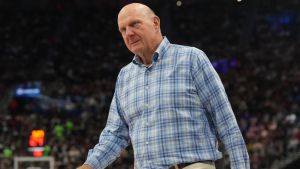
Shortly after ESPN published a story claiming the NBA has found “no evidence showing LA Clippers owner Steve Ballmer funneled money through team sponsors to pay Kawhi Leonard in order to circumvent the salary cap” on Monday morning, the league issued a statement disputing its top media partner’s report.
“ESPN’s article regarding the LA Clippers investigation — for which the NBA declined to cooperate — contains numerous and significant inaccuracies,” NBA spokesman Mike Bass said in the statement. “The results in this matter will be made clear once the investigation is concluded.”
An ESPN spokesman told Front Office Sports: “We stand by our reporting, which included numerous attempts by ESPN to get comment from the NBA.” Bass did not reply to multiple messages last week as ESPN reported the story, the three reporters—Don Van Natta Jr., Baxter Holmes, and Ramona Shelburne—wrote.
The back-and-forth between the NBA and ESPN—which pays the league $2.6 billion annually for its top media-rights package and exclusively broadcasts the NBA Finals—marks the latest twist in the nearly year-long Leonard saga. In September 2025, Pablo Torre reported on his podcast, Pablo Torre Finds Out, that the Clippers used a no-show endorsement deal with since-failed environmental start-up Aspiration to circumvent the league’s salary cap, which first triggered the league’s investigation.
More than 11 months later, that investigation remains ongoing, and has paused an agreed-upon trade sending Leonard to the Raptors as the teams wait to see any punishment that might be issued to the two-time NBA Finals MVP. Speaking at the NBA’s Summer League last month, commissioner Adam Silver admitted that the investigation has “gone on longer than I would have hoped,” and said that he was “hopeful” it would be completed by the end of the summer.
With the investigation yet to conclude, more layers continue to be added, including Torre’s recent report that Leonard benefited from another endorsement deal—this one with the Clippers’ scoreboard manufacturer, Daktronics—intended to circumvent the NBA’s salary cap. (ESPN’s new story mentioned a third company for the first time: Boingo Wireless, though it stressed that the league found no evidence that Ballmer used any company to pay Leonard. Daktronics is publicly traded.) In a statement Monday, the Clippers said that they routinely introduce players to companies for marketing opportunities, but it was ultimately Leonard and his representatives who handled the negotiations.
“We did not overpay any vendor or provide any sponsor, vendor, or business partner with discounts or other favorable terms in order to funnel money to Kawhi,” the statement reads, in part. “The fact that a player has an endorsement relationship with a company that also does business with his team is not evidence of salary-cap circumvention.”
In its report on Monday, ESPN said that while the NBA hasn’t found any evidence that Ballmer funneled money to Leonard, it is investigating if the Clippers’ introduction to such sponsors constituted a violation of the league’s salary cap rules and whether the team failed to properly supervise its employees. Posting a screenshot of that passage in the article on X/Twitter, Torre wrote: “When the time is right: I am extremely, extremely excited for our episode about this.”
Torre and the law firm representing Ballmer didn’t immediately respond to a request for comment from FOS. Wachtell, Lipton, Rosen & Katz, the law firm leading the league’s investigation, declined to comment.