Want more from Front Office Sports
in your search results?
A Portland Fire season-ticket holder told The Oregonian that they were spat on Friday night at the Moda Center, where the Fire were taking on the Indiana Fever. The fan also claimed the person shouted homophobic and transphobic slurs, including “there’s too many lesbians around” and “set trans on fire.”
Portland police are now investigating the incident, which took place during the national anthem, as a “possible bias crime,” according to the report.
Tensions were high ahead of the game, too. Outside of the arena, a group rallying in support of Fever guard Sophie Cunningham—who intimated in a recent ESPN profile that transgender women should not be able to participate in women’s sports—clashed with Fire fans. (Cunningham received a steady stream of boos during the game.)
The Fire released a statement after their 112–98 loss to the Fever: “We are aware of this incident reported during tonight’s game and are working with the involved parties, and Moda Center, to review the matter,” it read. “As always, we are committed to providing a safe and welcoming environment for everyone who attends Fire games and do not condone behavior that violates the WNBA Fan Code of Conduct.”
Not An Isolated Incident
It’s the latest in a string of fan-related controversies that have put the WNBA’s game-day atmosphere under increasing scrutiny.
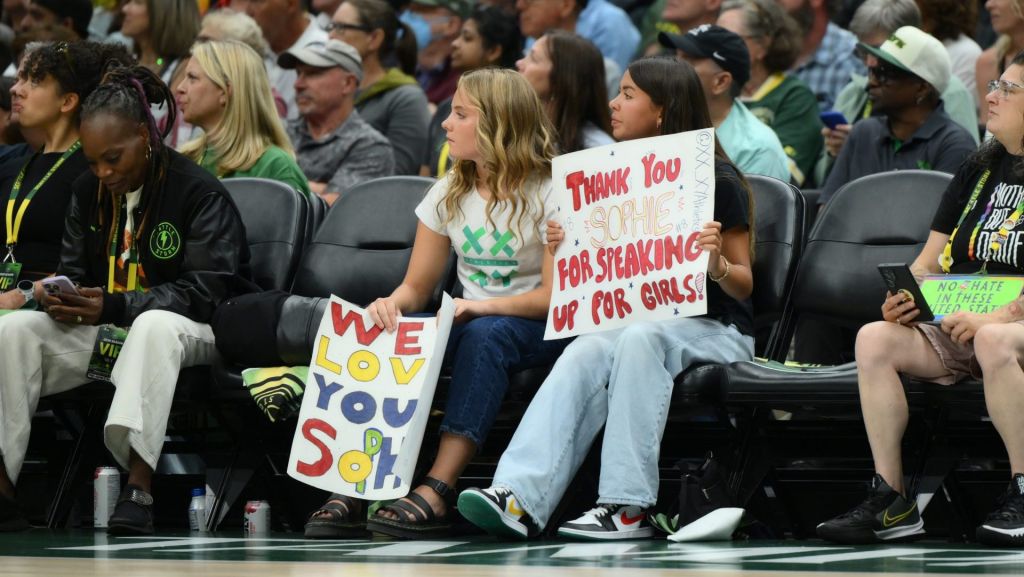
Earlier this week, two young fans attended a game between the Seattle Storm and the Fever holding a sign thanking Cunningham “for speaking up for girls.” (A pregame rally in support of Sophie Cunningham also took place outside Seattle’s Climate Pledge Arena.) Footage of the fans being yelled at by Storm fans quickly went viral across social platforms.
The duo told Undivided podcast host Brandi Kruse that a woman told them they were “effing insane” during the kerfuffle. Kruse later identified that woman as Storm minority owner Celeste Keaton.
In a statement to Front Office Sports, Storm Majority Owner Ginny Gilder confirmed that Keaton was involved in the incident, and issued an apology. “We are aware one of our co-owners made comments to two fans in attendance at last night’s game,” Gilder told FOS. “We apologize that this happened. Everyone who attends a Storm game deserves to feel welcome, and we remain committed to creating an inclusive environment where every fan is treated with respect.”
Harassment and abuse of WNBA players by fans at games and by social media users online has also been a persistent issue as the league has gained popularity. One of the most high-profile recent examples came last month when Las Vegas Aces guard Chelsea Gray shared a screenshot of a user calling her a racial slur via a direct message on Instagram following the team’s loss to the Fever on July 12.
Last year, the league also dealt with a weeks-long string of incidents in which dildos were thrown onto WNBA courts, prompting investigations, arrests, and a pledge from the league to work with local and federal law enforcement.