Want more from Front Office Sports
in your search results?
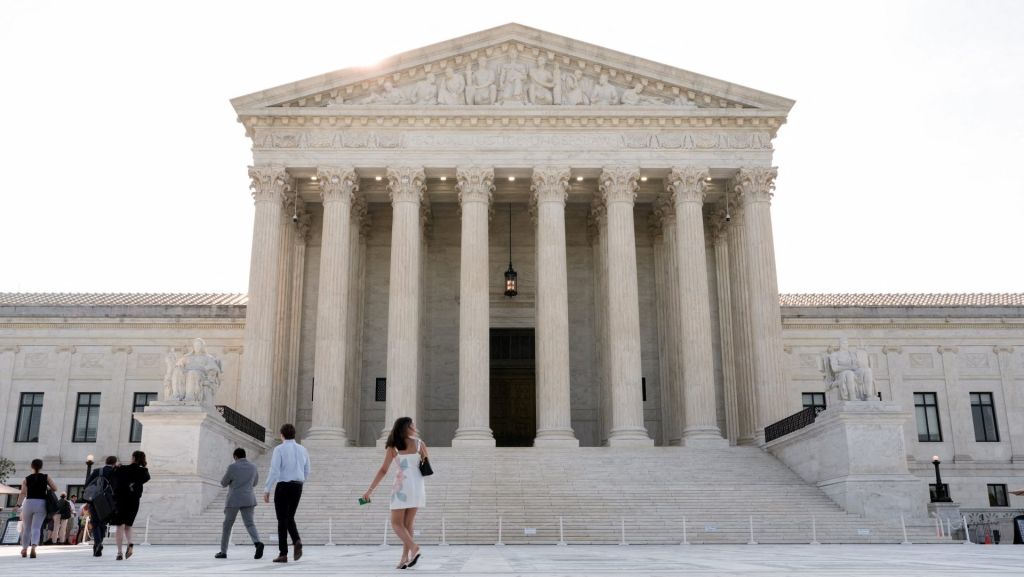
The U.S. Supreme Court on Tuesday issued a decision that allows states to bar trans athletes from competing on women’s and girls sports teams.
The two cases at the center of the opinion—Little v. Hecox, originally filed in Idaho, and West Virginia v. B.P.J.—focused on what the plaintiffs argued were violations of Title IX, which bars educational programs that receive federal funding from discriminating based on sex, and the 14th Amendment. The court ruled against the plaintiffs in both cases, upholding the state laws that prevent trans athletes from playing on women’s and girls teams.
The opinion, written by Justice Brett Kavanaugh, said West Virginia did not violate Title IX when it determined plaintiff B.P.J., a transgender girl, could not participate on her school’s girls track team. The decision says because Title IX explicitly allows states and schools to create male and female teams, the laws do not violate federal statute.
The court announced one consolidated opinion that also sided with the defendants in Little v. Hecox. Chief Justice John Roberts and Justices Clarence Thomas, Samuel Alito, Neil Gorsuch, and Amy Coney Barrett joined Kavanaugh’s opinion.
Justice Sonia Sotomayor shared a concurring opinion in part and dissenting in part. She was joined by Justices Elena Kagan and Ketanji Brown Jackson. Sotomayor writes that B.P.J.’s Title IX claim fails, but disagrees with the majority’s opinion regarding her equal protection claim. She argued that unresolved factual questions lead the court to be unable to accurately assess the merits of B.P.J.’s claim and said the court should let the district court address the uncertainties.
In the past six years, 27 states have enacted laws that limit participation in women’s sports to biological females.
How These Cases Reached SCOTUS
Little v. Hecox was originally brought in 2020, when Lindsay Hecox filed the suit after being barred from trying out for the Boise State women’s track and cross-country teams as a result of Idaho’s Fairness in Women’s Sports Act. The legislation, enacted in 2020, based participation in women’s scholastic and collegiate sports on one’s biological sex at birth.
A federal district court ruled in favor of Hecox, with the 9th Circuit upholding the ruling, arguing the act violated the 14th Amendment. After a successful petition to review the lower courts’ rulings by Idaho sent the case to the Supreme Court, Hecox asked SCOTUS to not decide her case. She filed a suggestion of mootness after deciding to no longer play sports in Idaho and dismissed the case in the district court. The Supreme Court’s decision to rule is in favor of the state’s wishes, which was to see a verdict.
West Virginia v. B.P.J. concerns the Save Women’s Sports Act, which also restricts sports participation by biological sex. Becky Pepper-Jackson’s mom, Heather, filed the suit in response to the law preventing her daughter from playing middle school sports. A federal district court’s ruling initially prevented the state from enforcing its law, but in January 2023, the same judge ruled in the state’s favor. After a reversal by the 4th Circuit and a petition to review from West Virginia, the case made its way to the Supreme Court.
President Donald Trump has made his stance on the topic clear, issuing an executive order in February 2025 to prevent transgender women’s participation in women’s sports. The order stripped funding from schools that allowed transgender women to compete on women’s teams.
The International Olympic Committee recently decided to restrict eligibility for female categories to biological females. The IOC announced in March it would not permit transgender women to compete in women’s events. President Kirsty Coventry said the policy was created to ensure fair competition, with the decision being rooted in science.
Download the FOS App
The business of sports, in your pocket.



Scan the QR code to get the app now.