Want more from Front Office Sports
in your search results?
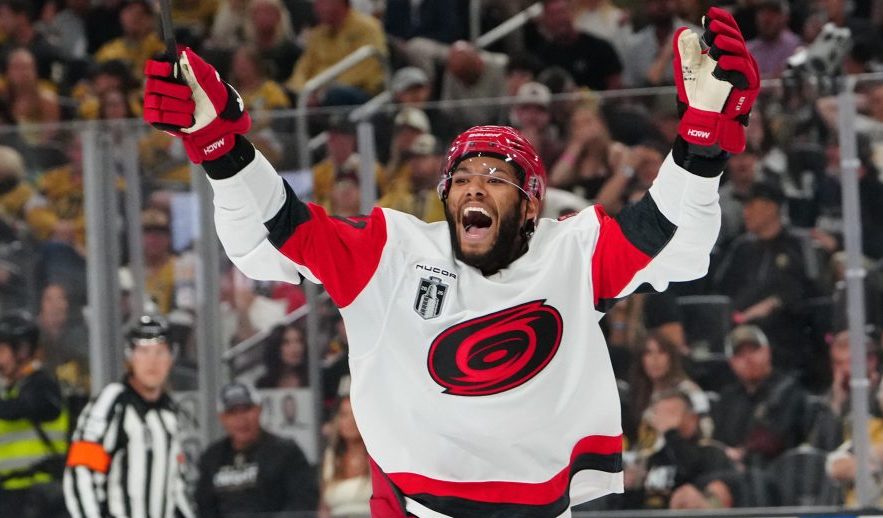
The Hurricanes have been one of the NHL’s most successful teams for nearly a decade, but they didn’t have a title to show for that sustained excellence. That finally changed Sunday night.
Carolina closed out Vegas in a six-game Stanley Cup Final to claim their first title since 2006. The victory saw the Hurricanes rally from 0–1 and 1–2 series deficits and win twice at T-Mobile Arena in Las Vegas. The championship also marks a culmination of an emphatic run that has seen the team win at least one playoff series each of the past eight seasons.
This is the second Stanley Cup title for the Hurricanes since relocating from Hartford after the 1996–97 season and changing its name from the Whalers. Notably, no Canadian team has won a championship during that 29-year period, and despite a league-leading franchise valuation of $4.4 billion, the Maple Leafs are still pursuing their first Stanley Cup since 1967.
Despite operating in a mid-tier market, Carolina has also been a key part of what has been a banner run for the Stanley Cup Final in television viewership on ABC. Through the first four games, the series averaged 5 million viewers, up 101% from a year ago, when it aired on TNT Sports, and the best figure since 2015. Further lifts are anticipated when audience data for the final two games arrives later this week.
Path to Victory
A key element in the Hurricanes’ ongoing success has been the approach and intellect of GM Eric Tulsky. Rather than rising through the ranks as a hockey lifer, Tulsky formally entered the sport a little more than a decade ago after a long background in chemistry, physics, and nanotechnology. Tulsky holds 27 scientific patents in the U.S. and turned down a potential role with Apple to go full-time into hockey.
Tulsky’s defining presence in hockey has been his insistence on possession-based tactics and his belief that traditional dump-and-chase play is no longer viable as a primary on-ice strategy. Rather than going on hunches, though, that sentiment was forged in large part by studying vast amounts of player and puck tracking data.
That approach has since been widely copied across the NHL. But under Tulsky, the Hurricanes have still stood out with a scientifically driven system that has included hires of data engineers, neuroscientists, and software developers in the front office. It also informs how Tulsky has assembled the Hurricanes’ roster.
“We’ve really focused on finding people who fit the way we want to play,” Tulsky said. “We ask our players to play a very distinctive style and our scouts have done a great job finding players who came in, look their best, and play the way we need them to play.”
A Title for Dundon
This is also the first Stanley Cup title for Hurricanes owner Tom Dundon, who first acquired a controlling stake in the team in early 2018 in a $420 million deal.
Since then, the Hurricanes’ franchise value has soared to $2 billion and is set for a further escalation with the championship now in hand. Dundon has also expanded his sports empire, recently acquiring the NBA’s Trail Blazers. There, the situation has been very different from in Carolina, with the Dundon era marked by immediate staff cuts and widespread accusations that Dundon is “cheap.”
Amid that, NHL commissioner Gary Bettman lauded Dundon’s work with the Hurricanes. Dundon is also a key figure in an ongoing $300 million renovation of Lenovo Center, the team’s home arena, that is scheduled for completion in 2028.
“Tom Dundon has been an extraordinary owner in terms of what he’s brought to this operation of this franchise. Obviously, his work in terms of creating a competitive and successful team is the reason we’re here,” Bettman said. “Tom may not always be—because we’re hearing this out of a different market—the most conventional owner, but nobody can argue with his commitment to [hockey] … He’s been great for us all the way.”
Download the FOS App
The business of sports, in your pocket.



Scan the QR code to get the app now.