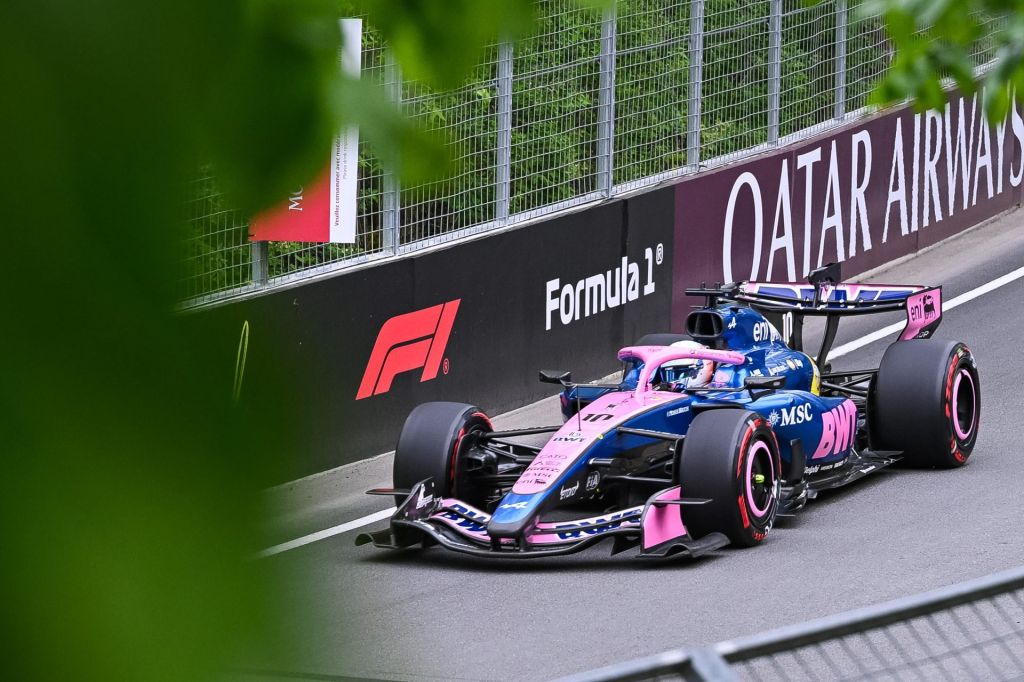
Gucci is accelerating its push into sports.
On Wednesday, the luxury brand was announced as the title sponsor for the Alpine Formula One team starting in 2027. The partnership, which will change the French team’s name to Gucci Racing Alpine F1 Team, is worth an estimated $50 million to $60 million per season for at least three years, according to The Race.
Alpine will also adapt Gucci’s brand colors (black, gold, red, and green), replacing its current blue and pink color scheme.
Gucci enters F1 at a time of significant growth for the motorsports championship. F1 expanded to a record 24 races in 2023 (though two races were canceled earlier this year due to the war in the Middle East). The grid expanded to 11 teams this year for the first time since 2016 following the addition of Audi.
Viewership numbers in the U.S. last year more than doubled the number in 2018 on ESPN networks. F1 parlayed that success into a five-year, $700 million media deal with Apple.
The announcement came just days after women’s world No. 1 Aryna Sabalenka carried a Gucci bag onto the court at the Italian Open, a move that the WTA is reportedly reviewing as a possible violation of player gear rules.
And Sabalenka, who signed with Gucci in January, wasn’t the first tennis star to trot out in Gucci. Men’s No. 1 player Jannik Sinner walked out onto the court with a Gucci duffel bag at Wimbledon in 2023.
James Denman, a brand marketing consultant for fashion and luxury brands, tells Front Office Sports that Gucci’s foray into sports signals the brand’s broader direction: “It’s starting to think of itself much more dramatically as a full luxury brand rather than simply being purely from a ready-to-wear perspective.”
He sees the brand showing more personality through sports, particularly because tennis and F1 are personality-driven. Tennis is fundamentally individualistic, while a large focus on F1 is on the drivers.
By entering F1 specifically, Gucci can be more “playful” by showcasing designs through the car’s liveries or even the way the team dresses their engineers and pit crew.
Denman also pointed out that Kering, Gucci’s parent company, becomes visible in a space dominated by rival luxury conglomerate LVMH. F1 and LVMH started a 10-year comprehensive partnership last year worth a reported $1.5 billion that includes Louis Vuitton, Moët & Chandon, and TAG Heuer.
“I think from the point of view of Gucci, it makes a lot of sense to be able to go: ‘We are a luxury brand on equal footing as a Louis Vuitton that we have that sort of ability to make something sort of fun and distinctive,’” Denman said. (Kering CEO Luca de Meo is the former head of Renault, the parent company of Alpine.)
Alpine, currently fifth in the constructors’ championship, reportedly has success thresholds in the contract. But it’s hard to see the team competing with top teams for the F1 title, especially a year after it finished last.
Denman said the value of entering F1 outweighs Alpine’s on-track results.
“You don’t want to be associated with an outright loser,” Denman said. “But the larger commercial comparative here is about the association. And the association [with F1] is rock solid in terms of viewership increasing, major brands piling in, and the expansion of the calendar.”