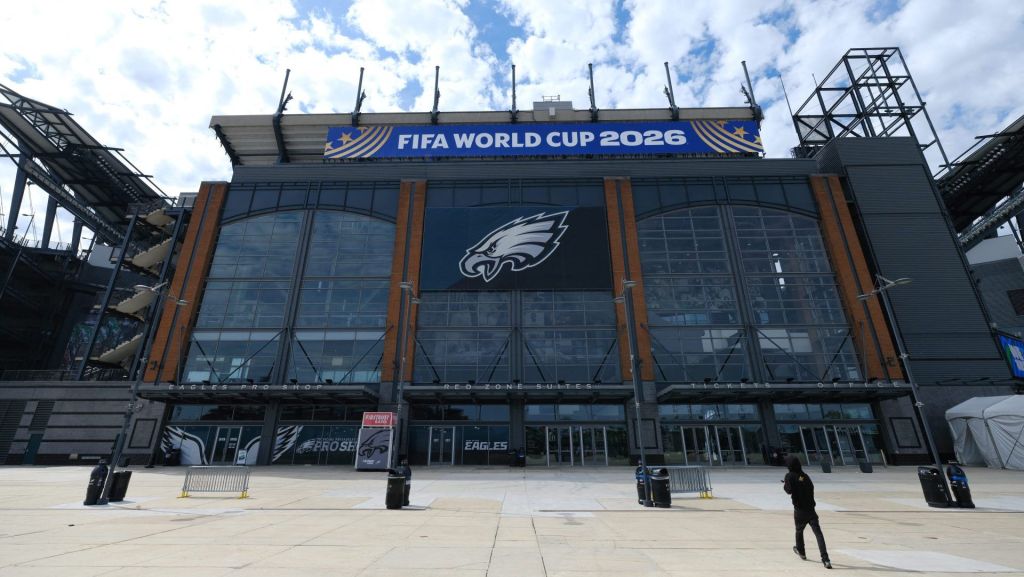
When FIFA officials took their first site visit to Philadelphia in September 2021, they received a packet of signed pledge sheets totaling $41 million from local corporate and philanthropic donors to the local organizing committee should the city win its bid for the 2026 men’s World Cup.
It was a bold move. Private fundraising has plagued cities across the country in the lead-up to the tournament, but in Philadelphia, dozens of donors were ready before the city even had any matches.
“Philadelphia is just a unique place because people are really proud to be from here, and the civic good means something,” Meg Kane, CEO of host committee Philadelphia Soccer 26, tells Front Office Sports.
By the time the first match is played on June 14 in the City of Brotherly Love, the commitments will have grown. Philadelphia Soccer 26 tells FOS its final tally for private funding will be about $60 million to $65 million, while its public funding amount will be about $77 million to $82 million.
Philadelphia’s preparedness is notable, especially because on top of six World Cup matches including one on July 4, this year the city also committed to hosting March Madness, the PGA Championship, MLB All-Star Game, and events for America’s 250th anniversary.
Many host committees found it difficult to fundraise for the World Cup because FIFA strictly polices sponsorships, including by banning deals with competitors of its official partners. FIFA also controls all the activity and sponsorship at the stadiums, which is why official venue names and branding have been removed ahead of the tournament. While each region received federal money from the Department of Homeland Security for safety and the Department of Transportation for public transit, state and city support has varied, as has private funding.
Last year, the NFL’s 49ers promised to backstop the Bay Area Host Committee should it not be able to cover costs for the World Cup. In March, Boston’s host committee revealed it had only $2 million in the bank, and last month admitted it’s hard to compete with America250 for sponsorship dollars. In New York City, the host committee initially announced its round-trip bus to the stadium would be $80 per person, until the state chipped in $6 million to bring the cost down to $20. And many host cities are dividing up their Fan Fests into smaller community gatherings, charging for tickets, or staging them only for limited days of the tournament.
In contrast, Philadelphia’s centralized Fan Fest in Lemon Hill will be free and open for all 39 days of the World Cup, with about 80 local vendors expected to pull up in food trucks over the course of the tournament.
The secret sauce to Philly’s World Cup prowess is its private fundraising, an effort that began in 2020. After the in-person presentation to FIFA was canceled in mid-March 2020 due to the COVID-19 pandemic, the hopeful organizers tightened their focus, Kane says. Former host committee chair and Comcast executive David Cohen approached the city’s business community, framing the investment as an opportunity to accelerate Philadelphia’s recovery and reposition it globally, with no guarantees of match tickets for donors.
In some ways, Philadelphia’s enterprising approach to fundraising clashed with FIFA’s sponsorship rules. FIFA is allowing host committees to make some specific sponsorship deals for the first time for this World Cup, but Kane says the host committee had more than 60 businesses and philanthropies on board, and had to “retrofit” its deal with FIFA to “structure this in such a way that this makes sense for what we had already done.” Comcast, American Airlines, Wawa, and most of the city’s major sports teams are all listed among the dozens of supporters on the host committee’s website.
The host committee structured many of its private deals to spread out the money over several years, and it got creative about where sponsors would see a return, such as branding at private host committee events or tickets to other major sporting events. And, in the end, every level of donor is getting tickets to a World Cup match, Kane says.
Visit Philadelphia CEO Angela Val tells FOS that the city is ready for its banner summer after two decades of ramping up its capacity to host big events back-to-back, including a papal visit in 2015, the Democratic National Convention in 2016, and the NFL Draft in 2017. Val says the Philadelphia Convention and Visitors Bureau was asked to bid on the World Cup—which the city had not yet been pursuing—after staging the NFL Draft.
“Philly, when we decide to do something, we are very good at working toward that thing,” Val says. “And I think that’s evident in how many large events that we’ve been able to do and have them go really well.”
The city’s unorthodox strategy in handling big events is evident in its World Cup planning.
SEPTA, Philly’s transit system, often makes subway rides on its Broad Street Line free—usually with the help of a corporate sponsor—after big events like the NFC championship and World Series. Removing the friction of riders buying tickets or tapping the turnstile gets people onto trains significantly faster. Kane says the host committee always wanted to make those rides free and would’ve covered it if they couldn’t land a corporate sponsor.
During the World Cup, the subway ride to the stadium will cost $2.90, while rides home will be free after the host committee got Airbnb to foot the more than $600,000 bill.
Philadelphia Soccer approached Airbnb with the idea after learning the official FIFA sponsor had a fund dedicated to host cities. “Their whole thing is about people going home,” Kane says. Airbnb wasn’t initially sold, but the host committee had a much stronger case after FanDuel received praise from fans for funding train service and free rides for Eagles-Cowboys during service cuts last year.
Last week, New Jersey followed Philadelphia’s lead, announcing seven sponsors that would bring down the cost of the exorbitant $150 NJ Transit ticket to matches at MetLife Stadium. Though the move collectively saves fans upward of $16 million, each round-trip ticket still costs a hefty $98.
And while many of Philadelphia’s sports-loving celebrities often show up at games, the host committee doesn’t currently have any plans to bring in Abbott Elementary, It’s Always Sunny in Philadelphia, or Eagles superfan Bradley Cooper. But Kane says “we’d love to make it happen.”
“Abbott Elementary, if you’d like to film an episode over the summer at Fan Festival,” Kane says, “I’m sure operationally, my team would be like, ‘What are you saying?’ But in our hearts, we welcome.”