Want more from Front Office Sports
in your search results?
As the World Cup draws nearer to its June 11 kickoff, politicians in the U.S. are sounding the alarm on FIFA’s ticket prices.
Fans have protested World Cup pricing since the fall, but FIFA’s recent “limited” ticket drops during its “last-minute” sales window, which began in April, are sparking further outrage. They’ve left fans waiting long hours in the virtual queue to find limited availability for games and high prices, especially for host nations.
During a “limited” drop Thursday, FIFA had a ticket to the final listed for nearly $33,000 on its official platform.
The mayor of New York City, members of Congress, and even the president are criticizing FIFA for its strategy.
A spokesperson for New York City Mayor Zohran Mamdani’s press office tells Front Office Sports that the mayor is in “active negotiations with FIFA” over ticket prices.
New Jersey is hosting eight World Cup matches including the July 19 final across the river from New York City, with serious tournament contenders like Brazil, France, England, Morocco, Senegal, and Germany all coming through during the group stage.
“Working class New Yorkers should not be priced out of one of the biggest sporting events in the world while it’s happening in their own city,” the spokesperson said. “FIFA has set the highest World Cup ticket prices in history. Mayor Mamdani believes we should be ending dynamic pricing and capping resale prices.
“The beautiful game belongs to everyone. That’s why the Mamdani administration is in active negotiations with FIFA to secure affordable tickets for New Yorkers to experience the tournament in person.”
FIFA did not respond when asked to confirm the negotiations.
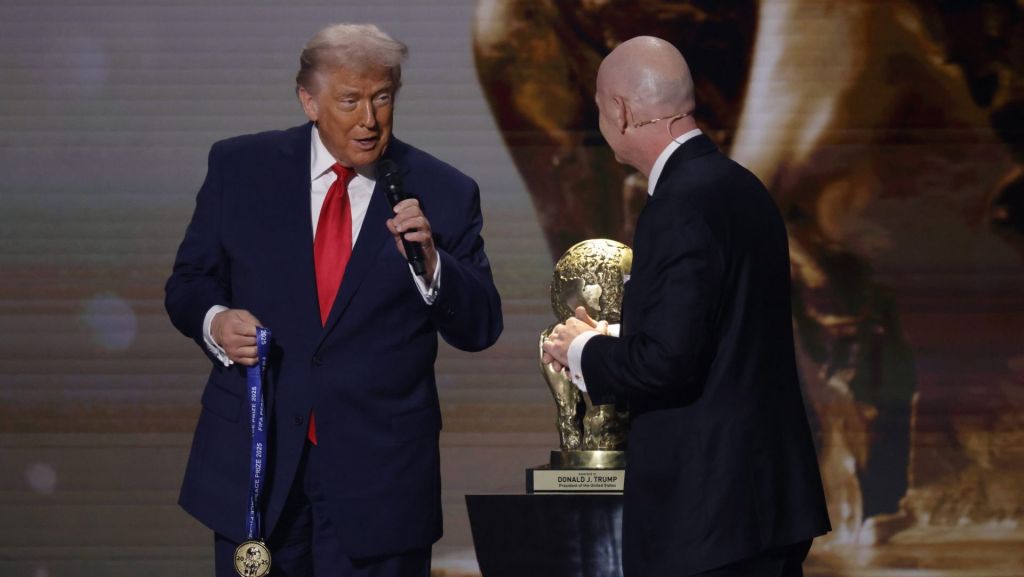
Even President Donald Trump seems to think the prices are too high. When asked by the New York Post late Wednesday about $1,000 tickets to watch the U.S. men’s national team face Paraguay in its opening match in Los Angeles, Trump said “I haven’t seen that, but I would have to take a look at it.”
“I did not know that number,” Trump said. “I would certainly like to be there, but I wouldn’t pay it, either, to be honest with you.”
“If people from Queens and Brooklyn and all of the people that love Donald Trump can’t go, I would be disappointed, but, you know, at the same time, it’s an amazing success,” he said. “I would like to be able to have the people that voted for me to be able to go.”
“I know that is extremely successful,” the president said of FIFA’s claims that it has sold 5 million tickets. “Setting every record in the book. They’ve never had anything like it.”
The White House did not respond to questions from FOS on Thursday about whether Trump or his World Cup Task Force is working with FIFA to bring down ticket prices.
But the head of that group, Andrew Giuliani, told the Financial Times that “the market will dictate the price.”
“We look to FIFA as a private entity here, we don’t really believe in price controls,” Giuliani said. “That’s kind of like what dynamic pricing can do.”
“It actually shows just how sought-after it is to come to the United States for a World Cup.”
Rep. Nellie Pou (D., N.J.), whose district includes MetLife Stadium and has been vocal on several World Cup–related issues, sent a letter to FIFA on Thursday along with Rep. Frank Pallone (D., N.J.). The message blasted FIFA for its dynamic pricing, manufacturing “artificial scarcity” in the market with the repeated “limited” drops, misleading seat maps, and taking a 15% cut from both buyers and sellers on its resale site, and demanded answers to a series of questions by May 22.
When FOS entered FIFA’s ticket drop Thursday, prices for U.S. matches (excluding ADA-compliant seats) were set at the following levels:
- U.S. vs. Paraguay in L.A. on June 12: $4,105 for Front Category 1, $2,330 for Front Category 2, $2,735 for Category 1, $1,940 for Category 2, and $1,120 for Category 3.
- U.S. vs. Australia in Seattle on June 19: $2,715 for Front Category 1.
- U.S. vs. Turkey in L.A. on June 25: $2,970 for Front Category 1, $1,345 for Front Category 2, $990 for Category 1, and $840 for Category 2.
The “Front” tiers are new levels created by FIFA this spring that take precedence over other seats in Categories 1 and 2, which were previously the highest tier of tickets available. The move has been highly criticized by fans who paid for Category 1 and 2 believing they would be getting the best seats in the building, only to be placed behind a new category of seats.
USMNT Still Not Selling
Group-stage matches featuring the three host nations have consistently been some of the most expensive of the tournament, and those prices have increased from where they were initially set in the fall. But this strategy has not translated to sales. One user on X posted a screenshot of 132 tickets available in one section alone for the U.S.-Turkey match.
Prices also remained high Thursday for openers for the Mexican and Canadian teams. For Mexico’s opener against South Africa, the only available non-ADA seat was a $2,985 Category 1 ticket.
Canada’s opener against Bosnia and Herzegovina was priced at $3,360 in Front Category 1, $2,240 in Category 1, $1,645 in Category 2, and $980 in Category 3.
For the July 19 final in New Jersey, the options were $32,970 for a Front Category 1 ticket or $10,415 for a Front Category 3 ticket.
FIFA president Gianni Infantino defended the high ticket prices earlier this week, saying “we have to apply market rates,” and that 25% of group-stage match tickets cost less than $300.
“You cannot go to watch in the U.S. a college game, not even speaking about a top professional game of a certain level, for less than $300,” Infantino said. (A spokesperson later said he was referring to college football.) “And this is the World Cup.”
Infantino also stressed it does not control prices on its official resale platform. But prices have actually been falling on secondary resale sites, multiple outlets have reported.
In addition to high ticket prices, New Yorkers traveling to games at MetLife Stadium are shelling out on transportation. Fans have two main ways to attend the game: They can ride the host committee’s $80 bus or take New Jersey Transit for $105 round-trip. Other host cities with high World Cup transit costs include Boston, whose train will be $80, and Miami’s Brightline, which will be $151.
Mamdani has been an outspoken critic of FIFA’s pricing for the World Cup since before taking office in January. In September, the then-candidate said FIFA should get rid of dynamic pricing, put a cap on resale tickets, and set aside 15% of tickets for locals.
“We know that FIFA, they’re supposed to be stewards of the world’s game, and yet for them, it has increasingly just become a question of profit,” Mamdani said in an interview with FOS last year.
Also on Thursday, FIFA released the first batch of “host city jerseys” with artful designs paying tribute to the hosting regions that also feature a non-fungible token component. The jerseys are priced at $375 each.
Download the FOS App
The business of sports, in your pocket.



Scan the QR code to get the app now.