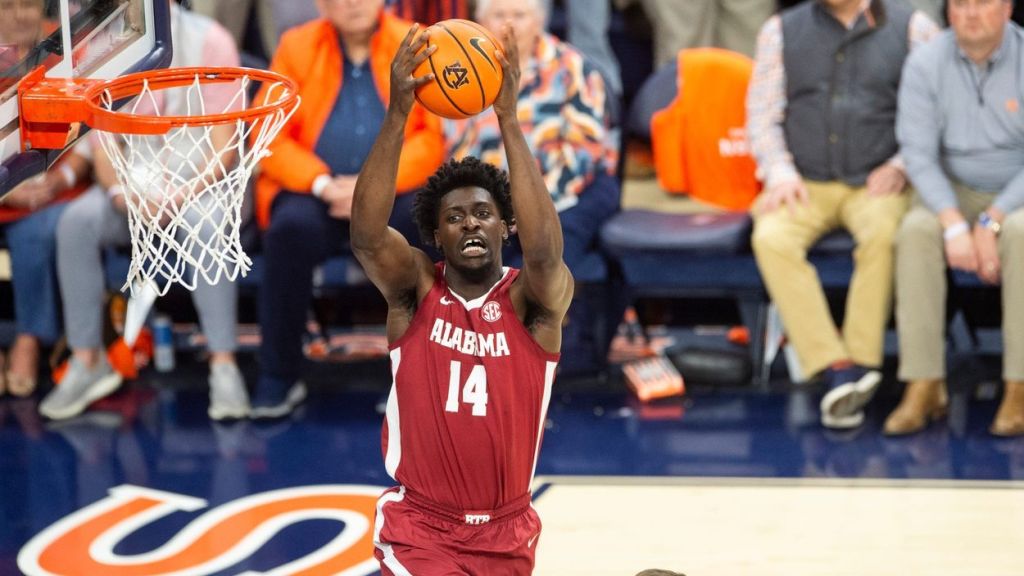
Charles Bediako’s second college basketball career is on hold again after five games.
Bediako had won a temporary order against the NCAA, allowing him to briefly play for Alabama and inflaming much of the college sports world. But local judge Daniel Pruet denied his request for a preliminary injunction, leaving Bediako ineligible again. The NCAA has said that it will not grant eligibility to players who have signed NBA contracts.
“Common sense won a round today,” NCAA president Charlie Baker said in a statement. “The court saw this for what it is: an attempt by professionals to pivot back to college and crowd out the next generation of students. College sports are for students, not for people who already walked away to go pro and now want to hit the ‘undo’ button at the expense of a teenager’s dream.” Baker again asked Congress “to stop watching from the sidelines and help us provide some actual stability.”
The decision is a landmark one, although judges in other states aren’t bound by Pruet’s ruling.
During a Friday hearing, Bediako’s attorneys said their client has only made $530,000 since turning professional in 2023. G League salaries pay no more than $40,000–$50,000.
NIL deals aren’t made public, but Bediako’s earning potential might be significantly higher at Alabama than in the G League. Kentucky’s basketball roster reportedly cost $22 million this season, which makes the average scholarship player’s deal worth $1.46 million.
In his ruling, Pruet wrote that Bediako failed to meet criteria that would grant him a preliminary injunction and make him eligible the rest of the season because he “failed to establish that he would suffer irreparable harm,” and “failed to establish that he has no adequate remedy at law without the issuance of the injunction.” Pruet also found Bediako “failed to demonstrate that he has at least a reasonable chance of success on the ultimate merits of those claims” that the NCAA had violated antitrust laws in his case. Pruet said Bediako is subject to NCAA rules.
“The Plaintiff’s playing professional basketball in the G League as recently as last month indicates that the case is not about whether Plaintiff can be paid to play basketball, but for whom,” Pruet wrote. “The Plaintiff also asserted that he would suffer irreparable harm by missing out on the ‘college experience.’ There is no proof in the record that, but for an athletic scholarship, the Plaintiff cannot afford to attend college.”
Bediako can appeal, but he won’t be able to play in Alabama’s game at Mississippi on Wednesday. He can also try to return to the G League or play overseas. The ruling is a major win for the NCAA.
“We are disappointed in today’s court ruling, denying the injunction for Charles Bediako,” Alabama spokesperson said in a statement. “While we understand the concern around competitive and developmental implications of former professional athletes participating in college, it is important to acknowledge reality. The NCAA has granted eligibility to over 100 current men’s basketball players with prior professional experience in the G League or overseas. Granting eligibility to some former professionals, and not to others, is what creates the havoc we are currently in and why consistency from decision-makers is so desperately needed.”
“Deeply disappointed in the Tuscaloosa court’s denial of Charles Bediako’s request for an injunction against the NCAA,” Darren Heitner, one of Bediako’s attorneys, posted on X on Tuesday. “This ruling ignores an athlete’s NIL value is directly tied to his ability to play, overlooks that NCAA rules do not distinguish between athletes with prior college experience and those without, and contrasts with eligibility grants to many other former pros. We fight on for fairness.”
Other professional players are still likely to attempt to follow Bediako’s path back to school. The NCAA has said it won’t grant eligibility to players who have signed NBA deals; if ex-Hornet Amari Bailey follows through on his plan to return to college, he’ll need a judge to step in on his behalf.
Bediako played for the Crimson Tide from 2021 to 2023, when he left Alabama and declared for the NBA draft. The 7-foot center went unselected in the draft, but signed a two-way contract with the Spurs the same year. He’s never played in an NBA game, but played in the G League as recently as Jan. 17.
The ruling comes after SEC commissioner Greg Sankey wrote in an affidavit Thursday that the court should rule against Bediako, despite Alabama being a member of the conference. Sankey said NCAA eligibility rules are “essential to the integrity of college sports,” but did not mention Alabama or Bediako by name in the filing.
“Inconsistent application of the NCAA eligibility rules challenged in this case—through court rulings or otherwise—fuels disruption in college sports,” Sankey said in the affidavit.
Monday’s ruling was the first major decision in the case under Pruet after the original judge, Jim Roberts, recused himself after it was revealed he and his wife are active six-figure donors to Alabama’s athletic department.
Roberts had granted Bediako the temporary restraining order on Jan. 21, which allowed him to play his first game for the program in three years on Jan. 24. Winter storms delayed Bediako’s hearing to Friday after it was previously scheduled for Jan. 27. The delay extended Bediako’s temporary restraining order by an additional 10 days, giving him another two games with the Tide.
Alabama is 3–2 since Bediako rejoined the team. In five games, Bediako is averaging 10 points and 4.6 rebounds per game while shooting 77% from the field. Coach Nate Oats was asked on Jan. 26 if bringing Bediako back was worth it, even if his hearing doesn’t go in his favor.
“100%,” Oats told reporters. “Everywhere I’ve been and going back to my high school days, I’m going to do right by my players, every single situation, as long as they didn’t do anything wrong. Charles has done nothing wrong.”
The hearing also revealed that Bediako has U.S. citizenship despite growing up in Ontario, Canada. Oats has said American players shouldn’t be punished for playing professionally and returning to college if the NCAA is granting eligibility to European ex-pros who did the same.
Pruet also challenged Bediako’s attorneys as to why they were suing for eligibility instead of monetary compensation if Bediako’s earnings, or lack thereof, were such a concern. Pruet said the 23-year-old knew the consequences of declaring for the NBA draft when he did so in 2023, which NCAA attorney Taylor Askew also argued, according to AL.com.
This developing news story has been updated with comment from the NCAA and Alabama.