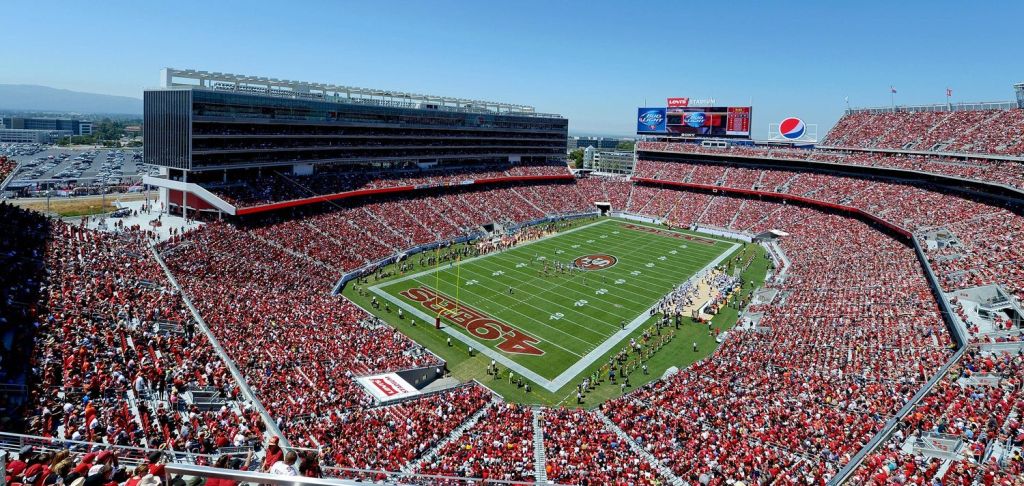
SANTA CLARA, Calif. — Sitting in his sunlit office, Al Guido, President of the San Francisco 49ers, felt vindicated.
“We’ve proven our business case here,” Guido told Front Office Sports. “From a mathematical perspective, I don’t think you can look at this stadium as it relates to the 49ers or the city or, frankly, the larger region and say that this wasn’t a tremendous success in the first 10 years.”
This data was detailed in a study released on Monday, demonstrating that Levi’s Stadium has not only generated more than $2 billion for the local economy but has also contributed nearly $469 million in tax revenue since its opening in 2014.
The Santa Clara Stadium Authority — the public entity created to obtain financing and to oversee the stadium — is more than 15 years ahead of repaying the remainder of the $950 million in loans taken out to construct Levi’s Stadium, which will save about $100 million in interest, according to the 49ers.
“I think it’s a pretty easy win here for the city of Santa Clara because they put up a decent amount of money for a city that size, but they’re getting all that back,” said Daniel Rascher, whose firm SportsEconomics, published the study on behalf of the 49ers.
Rascher’s report included in-person surveys of several 49ers games and other events over the last several months — including two Taylor Swift concerts held at Levi’s Stadium in July. Those two sold-out shows resulted in a total estimated economic impact of $33.5 million and $1.2 million in direct tax revenue for the region.
The 49ers don’t play the Kansas City Chiefs this season, so Swift won’t boost revenues again in 2023.
Guido said the non-NFL events have “definitely exceeded” expectations — minus postseason college football games — from when ground was broken on the stadium site that had been mostly parking lots amid tech companies and the Great America amusement park. Guido has the expertise from not only helping shepherd the opening of the Dallas Cowboys’ AT&T Stadium while he was an executive with the franchise but also as the CEO and chairman of the sports consulting firm Elevate Sports Ventures.
“I struggled to think that without a dome, that we would be as competitive with these events,” Guido said.
However, these non-NFL events have sparked disagreements between the 49ers and certain Santa Clara officials. In 2022, none of the $8.8 million in profits generated from events other than 49ers games contributed to the city’s general fund, as the stadium authority prioritized debt repayment and public safety costs.
Disagreements have escalated between the 49ers and Santa Clara, including disputes over stadium operating expenses, revenue allocation, and the scheduling of non-NFL events. This also extended to the 2026 FIFA World Cup, where Levi’s Stadium secured match hosting rights without prior consultation with city officials.
Guido, however, doesn’t understand the 49ers’ rocky relationship with the city where their headquarters were located for years when they played 45 miles north at Candlestick in San Francisco.
“It’s frustrating,” Guido said. “It’s frustrating because I know that we’re doing a great job by every single metric. I know we’re performing at the highest levels inside of the National Football League. We’re in the top quartile of business. I know how we’re performing on non-NFL events.”
The public financing of sports venues has come under scrutiny as studies repeatedly suggest that the economic benefits of stadium financing through bonds or taxes do not align with the rosy picture painted by teams seeking new venues or major upgrades.
Despite this scrutiny, NFL stadiums continue to receive substantial public funding, with close to $3 billion allocated to the two newest NFL stadiums and two upcoming ones.
- The Buffalo Bills’ new stadium project received $850 million in public subsidies toward their new outdoor venue slated to open in 2026.
- Public funds totaling at least $1.26 billion have been approved for the construction of the Tennessee Titans’ new domed stadium, located adjacent to their current one. The stadium is set to host its inaugural games in 2027.
- The Las Vegas Raiders paid $1.25 billion toward constructing Allegiant Stadium with another $750 million in public funding. The stadium opened to no fans in 2020 due to the pandemic.
In contrast, SoFi Stadium, hosting the Los Angeles Rams and Chargers, boasts a $5 billion price tag, funded entirely by private investments. Over the past two decades, MetLife Stadium, shared by the New York Giants and Jets and opened in 2010, stands as the only other NFL stadium constructed without public funds.
There is an expectation that the trend of using public funding for new venues or improvements to existing ones will continue, even as other teams pursue such initiatives.
“I would even lump the NFL separate from the other three sports leagues,” said University of South Florida professor Michael Mondello, who has studied stadium funding extensively. “Look at the TV ratings, the money, the gambling — all that plays into what makes the NFL fan base different.”
Under the ownership of Josh Harris, the Washington Commanders are expected to secure significant public funding for their next stadium, regardless of its location in D.C., Virginia, or Maryland. The Jacksonville Jaguars are seeking up to $1 billion in public funding for TIAA Bank Field upgrades, and other teams like the Chicago Bears and potentially the Denver Broncos are exploring stadium options.
The playbook is typically the same whenever NFL teams desire a new stadium: tout the tax benefits, job creation, the potential of luring the Super Bowl to town, and the prospects of events like concerts to show the venues aren’t just for football.
The SportsEconomics study explored all those facets when looking at Levi’s Stadium, which cost $1.3 billion to build, and, technically, only $114 million of that was public money with another $200 million coming from an NFL loan. The stadium authority financed the majority of the stadium through private loans.
According to the study, the stadium authority has received nearly $311 million in revenues via ticket surcharge, and lease payments by the 49ers and other income since the stadium opened, monies that go toward debt repayments. The area overall — including Santa Clara, Santa Clara County, and San Jose — has seen nearly $468.9 million in incremental tax benefits.
The SportsEconomics study ran through July, so the data does not include the current NFL season.
While it’s difficult to compare projections from 2010, when a ballot initiative in Santa Clara was approved by voters, Levi’s Stadium has generated $35 million for the city’s general fund without any new taxes.
According to the study, the $546 million in indirect spending, including money paid to suppliers of businesses where fans spend money on game day, created 11,840 full-time jobs.
“There’s a positive reinforcement kind of framing, which is the attractiveness of and economic benefit from the stadium,” said University of Miami professor Michael Touchton, who co-authored a 2020 study with fellow Miami professor Jennifer Marie Connolly on how touting new projects to the public impacts subsidies. “That framing tends to work on the positive side. The negative reinforcement side is a threat to depart, certainly.
“My co-author and I found that [threats to relocate] didn’t work as well for convincing people to part with tax dollars as the jobs framing does, but it’s still an appeal to civic pride. Even though it ends up being a subsidy for billionaires, people still have that pride in their local sports teams, and the better those teams are, the more pride they have.”
Guido said the disputes since the public-private partnership between the team and Santa Clara over the last decade “really hasn’t negatively impacted” the 49ers, who are among the top Super Bowl contenders and were awarded a second Super Bowl by the NFL earlier this year.
“Did we do what we said we were going to do?” he asked rhetorically. “I think the answer is absolutely, emphatically and resoundingly ‘yes.’ We, the team, can be really successful, and we, the community and region, can be very successful if there’s a good partnership.”