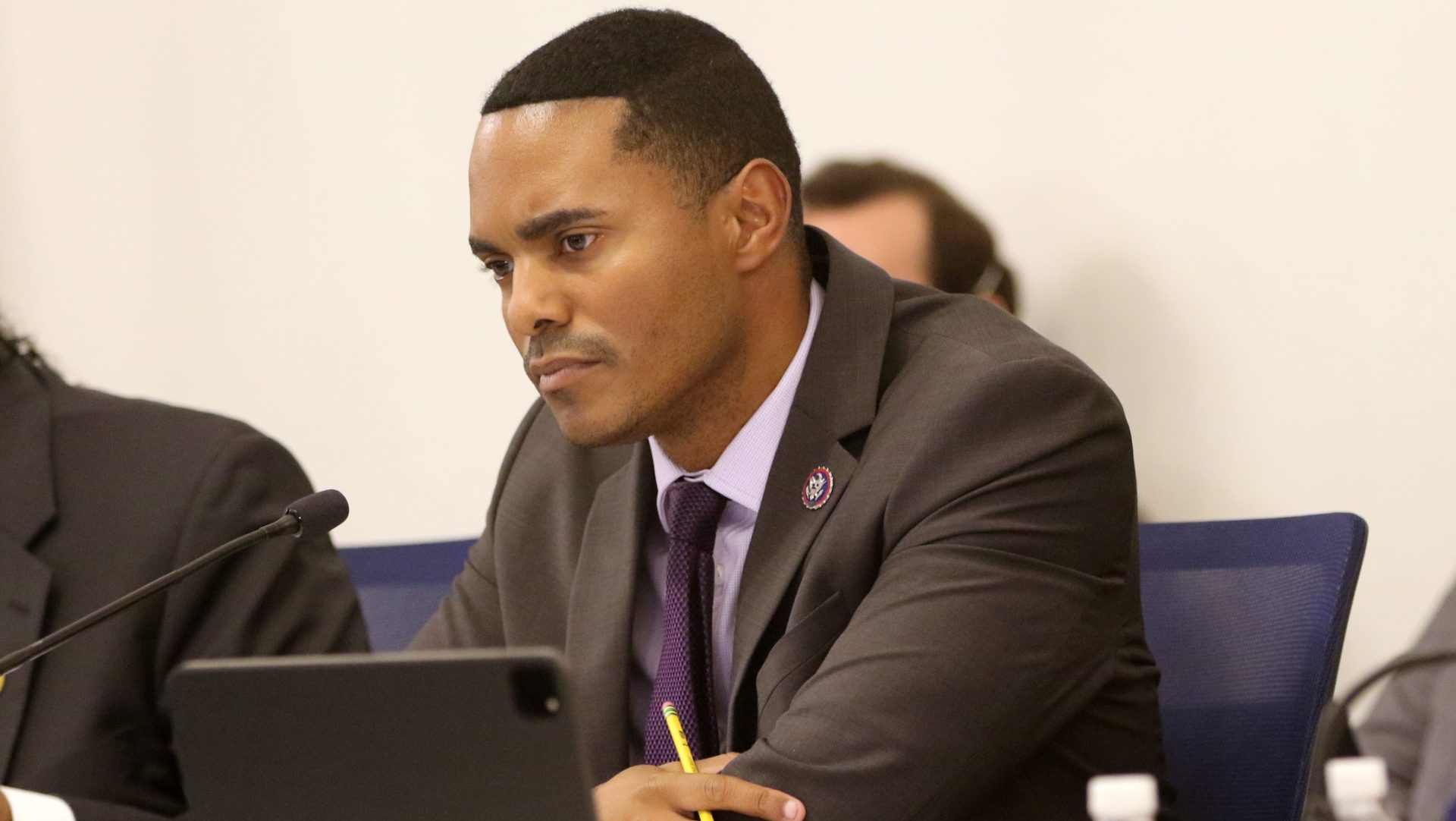
Lawmakers are escalating scrutiny of prediction markets, highlighted by the formal introduction Friday of legislation from Rep. Ritchie Torres that would curb insider trading on the platforms and has the backing of more than 30 Democratic lawmakers, including former Speaker Nancy Pelosi.
The bill from Torres (D., N.Y.), called the Public Integrity in Financial Prediction Markets Act of 2026, would bar federal elected officials, political appointees, executive branch employees, and congressional staff members from trading on event contracts tied to government policy, government action, or political outcomes if they possess—or could reasonably obtain—material nonpublic information through their official duties. In addition to Pelosi, supporters include Rep. Andre Carson (D, Ind.), and Rep. Rashida Tlaib (D., Mich.).
The bill is not bipartisan for now, although Torres hopes Republican colleagues will get on board.
“We encourage all members of Congress to join the bill,” his communications director Benny Stanislawski tells Front Office Sports.
Torres had been working on the legislation for a few months, but was spurred to introduce it after suspiciously timed trades on Polymarket tied to the U.S. military action in Venezuela—including whether President Nicolás Maduro would be removed from power by the end of this month.
While much of the public debate around prediction markets has centered on sports event contracts, which critics say are synonymous with sports betting, the revelation that a newly created, anonymous account reportedly made more than $400,000 in less than 24 hours prompted Torres to act.
“I found it shocking that an anonymous trader could pocket $400,000 from the capture of Maduro,” Torres tells FOS. “The fact that the account could have been a government insider is cause for concern. This has all the hallmarks of potential insider trading. That alone is reason enough to legislate.”
The identity of the person behind the anonymous Polymarket account is not known. But a viral social media post fueled speculation online about a possible link to Steve Witkoff, a real estate executive who is President Donald Trump’s special envoy to the Middle East. The post cited what it described as on-chain data and transaction patterns as evidence.
A representative for World Liberty Financial—a cryptocurrency company founded in 2024 by Witkoff and members of the Trump family, including the president and his sons—denied the speculation in an email to FOS, saying “there’s not even a shred of truth” to the claim.
“These internet rumors are dangerous and completely false,” they said.
Torres says the situation showcases what he views as a fundamental flaw in how prediction markets are regulated, particularly when government insiders are not expressly barred from participating anonymously in markets tied to decisions they influence.
“When it comes to government insiders, the term prediction market is a misnomer,” he tells FOS. “If you’re the one making the decision, or if you’re part of the decision-making process, you’re not predicting anything. You’re simply governing for profit.”
Insider trading is illegal in traditional financial markets—which are regulated by the U.S. Securities and Exchange Commission—but it remains unclear whether existing law applies to prediction markets, which are regulated by the Commodity Futures Trading Commission (CFTC) and operate at the intersection of commodities regulation, gambling law, and financial markets.
“If members of Congress are found to be insider trading in the stock market, they should be prosecuted,” Torres says. “But it’s not clear whether insider trading in prediction markets is illegal under existing law.”
Torres acknowledges the bill is intentionally narrow and not meant to serve as a comprehensive regulatory framework for prediction markets.
“We’re in a brave new world that requires comprehensive regulation,” he says. “This is hardly a substitute for that. But it’s the easiest place for Congress to start.”
He says that both Kalshi and Polymarket have reached out since the bill received attention, but no meeting has yet taken place. “We’re happy to meet with anyone,” Torres says.
Tarek Mansour, cofounder and CEO of Kalshi, expressed support for the bill in a LinkedIn post, saying “insider trading is banned on Kalshi (and always has been).” Polymarket did not immediately respond to a request for comment.
The sports issue should be addressed as part of a broader regulatory effort around prediction markets, according to Torres, although other lawmakers feel sports require their own specific legislation.
New York Assemblyman Clyde Vanel introduced a bill in November that would give the state authority to regulate or ban prediction markets. His bill specifically touches on sports—it would allow event contracts only on certain sports-related matters, such as the outcome of March Madness or other pro sports league playoffs.
In September, meanwhile, a bipartisan group of lawmakers from Utah, Arizona, Michigan, and California issued a letter to the CFTC outlining concerns about sports event contracts.