Want more from Front Office Sports
in your search results?
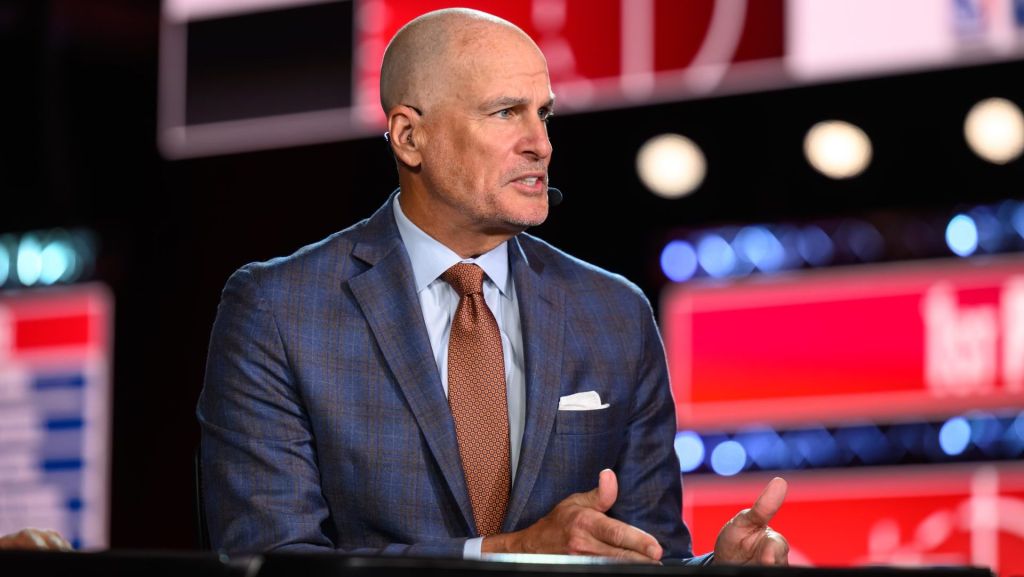
The 2026 NBA draft will take place at the Barclays Center in Brooklyn, New York, on Tuesday night. For the 24th straight year, Jay Bilas will be a part of ESPN’s coverage, serving as an analyst on the network’s TV broadcast.
On the eve of the event, the venerable basketball analyst spoke to Front Office Sports about a variety of topics, including the crazy amount of talent at the top of the draft, whether Darryn Peterson’s injury issues at Kansas give him any concern, and broader thoughts about Dusty May leaving Michigan for the Dallas Mavericks.
This interview has been lightly edited for clarity
Front Office Sports: Who do you think the Wizards are going to pick first overall in the draft and what would you do if you were in their position?
Jay Bilas: The second part is the hard part. I think they’re probably going to take A.J. Dybantsa, but there’s a good case to be made for Darryn Peterson or Cameron Boozer at the No. 1 spot.
This is a draft where there are three, at least three players worthy of the No. 1 overall selection. I think it’s my 24th year doing the NBA draft for ESPN. I don’t ever remember hearing about as many players that people are saying could wind up being the best player in the draft—whether it’s Darius Acuff or Mikel Brown or Caleb Wilson or Boozer/Peterson/Dybantsa, it’s a longer list of [potentially elite] players.
Peterson’s the most talented player, in my view, and the only thing that kind of kept him from being close to the no-brainer category was his cramping issue where he only played in 24 games at Kansas. Dybantsa looks like he was made in a lab to play in the NBA. He checks just about every box. And then I think Boozer is the best pure basketball player in the draft, but it goes so deep. There’s so much depth in this draft of outstanding talent that you can be further down in the draft and feel pretty comfortable you’re going to get a really good player.
FOS: I was going to say, do you think that this is like the most star-heavy draft since 2003? We knew that LeBron was going to go first overall at that point, but it was him, Carmelo, Wade, etc.
JB: I do. It’s funny that you asked that question because I don’t really catalog things like that. So the way I put it, it’s the best and deepest draft of big-time talent that I can recall.
One of the ways is there’s more quality freshmen. The depth of first-year talent and guards is really kind of amazing. And, when you look further down some of the lists, including mine, you get around 12 to 15, and you see Labaron Philon Jr. from Alabama. If he were in another draft, he might be the first guard taken. But you got guys like Acuff, Keaton Wagler, Brayden Burries, Kingston Flemings, Brown. I mean, it’s ridiculous how many quality players there are.
This is just a barroom discussion, but I still think if Cooper Flagg was in this draft, he’d go number one.
FOS: You mentioned Peterson’s cramping issues. How much pause does injury concerns with him give you in such an otherwise loaded draft?
JB: For me, it’s zero because he didn’t have that issue in high school, and it’s not like a back problem or a knee problem or some that would give you a little bit of pause there. This was cramping. From what he said, it started in September when he got this full body cramp where 911 had to be called and he was hospitalized, and so they were cautious with it.
But in the last eight to nine games, he played over 30 minutes in each one of those, so it seems like they worked the issue out. The good news is now, since the last collective bargaining agreement, all the top prospects give their medicals. They didn’t have to do that years ago. That’s part of the draft combine process now is all the prospects show up to Chicago and they have their medicals. So there’s no surprises there. You’re going to have your questions answered. If it were something other than cramping, I might be concerned about it. It’s not, and I don’t have to draft them, so I’m not concerned at all, but I wouldn’t be overly concerned.
FOS: How much attention do you pay to the gambling odds? This is something that has changed over the last several years where now all of a sudden the betting markets are a big part of the draft conversation. I’m interested in how you approach that extra input of information.
JB: Maybe I should look at it, but I don’t. I’m not as concerned about where players are drafted. It’s more what they can do. I actually did this exercise for the weekend, where I just looked at the All-NBA first, second, and third teams. Then I went through, and I cataloged where each player was drafted.
For the first team, Shai Gilgeous-Alexander, was drafted 11th. Nikola Jokic was taken 41st. Luka Doncic was third, and then Cade Cunningham and Wemby were first overall selections. Then you go to the second team. Jaylen Brown, third overall. Kawhi Leonard, 15th. Kevin Durant, second. Donovan Mitchell, 13th. Jalen Brunson, 33rd. On the third team: Tyrese Maxey, 21st. Jamal Murray, 7th. Jaylen Johnson, 20th. There were questions about him because he kind of left his team in the first year after the COVID shutdown. And then Jalen Duren, 13th.
So it’s kind of all over the map. It certainly matters where you’re taken on draft day. But after that, it’s not where you’re taken, it’s how you play. So, this draft could be like all the others that I’ve been a part of, where if you look back in five years, you would have done it totally differently.
FOS: What did you think about Dusty May leaving Michigan for this Mavs job? To me, it was an eyebrow-raising decision.
It was an eyebrow-raiser because of the timing of it. It’s June 22. I certainly saw some of the reports that Dallas was considering and maybe even talking to Dusty and John Scheyer, among others, and you know the possibilities there when there’s an opening like that. But It just kind of goes to what I’ve been saying for a long time now—there’s a lot of energy being wasted on talking about player transfers, and the coaches’ portal is always open.
Think about the ramifications of this. So Dusty May leaves and goes. I don’t fault him. I mean, it’s just the way the business works. But he leaves, and now Michigan—I know they’ve hired Mike Boynton as interim, but it’s just interim—so, in all likelihood, they’re going to take somebody else’s coach. Let’s say they take somebody from a Big 12 school, then that program has to go get somebody else’s coach, unless they’re going to hire an assistant. So how many players and programs are going to be impacted by this one decision? That’s one of the reasons I think college basketball needs a collective bargaining agreement for the players.
And then they need rules with regard to the enforcement of contracts, because you’ve got these coaches that are signed to long-term contracts. Other member institutions talk about tampering with players, but how is that not tampering when you’ve got a member, a fellow member institution with a coach under contract, and you’ve got an opening and you go take that coach oftentimes without any permission from the fellow member school? That’s something I think needs to be addressed if we’re going to lose our minds over players transferring.
FOS: All of that makes sense, but it seems like a lot of coaches have been leaving the sport over the last several years. Some of them aged out, like Coach K and Roy Williams, but it almost feels like anybody in college basketball or college football who could leave for the pro level is doing it. Do you think that these new NIL and transfer portal procedures are driving that?
JB: No, I think that we’ve always had this kind of thing, and it goes sometimes in cycles. This isn’t the first time a college coach has left for the NBA. There are only 30 NBA jobs, so it’s not like we’re going to see a ton of this, but it does happen from time to time.
But I think your point is the right one—the number of coaches who have left the sport. The overwhelming majority of them were due to age. Two—Jay Wright and Tony Bennett—were younger. Jim Larranaga, Leonard Hamilton, and Jim Boeheim were in their 70s. Coach K was in his mid-70s when he walked away. I honestly don’t think that any of them had anything to do with the current landscape. Because if those guys were in their 40s, they would have adjusted just fine to it.
All due respect to people like my colleague, Nick Saban, who has been on Capitol Hill a lot lately. But I just didn’t hear any of these coaches complaining about the state of college athletics when the money went through the roof, including their money. All the complaining has come when the players are making money, and they’re getting their value, and they’ve become a line item that the universities have to deal with because you’re not going to win without the best players. And if the best players cost money, they’re going to spend what it takes.
FOS: Do you think that the NIL has made it so that somebody who might not be a lottery pick but would have gotten drafted at the end of the first round or in the second round is staying an extra year in school and that this helps the college basketball talent pool?
JB: Yeah, that’s a great question—and that’s happening. The numbers confirm that the amount of early entry candidates into the NBA draft has dropped precipitously.
You see players that test the waters and get feedback and then go back. Last year, Labaron Philon, who we mentioned earlier, was one of them. He got feedback at the combine, went back to Alabama, doubled his scoring average, improved his three-point percentage, and became a much better playmaker in his last year in Tuscaloosa.
I don’t remember the exact number, but I think it was about 71 early entry candidates this year, which was down by like two-thirds from what it was in prior years. For people like me who love college basketball, that’s a good thing. You have experienced players coming back that you know, and they’re coming back, and they’re spending their time at an institution of higher learning and getting further education, too. For those like myself who say they believe in education, how could you not be in favor of that?