Want more from Front Office Sports
in your search results?
A month before the Knicks sent five first-round picks across the East River to Brooklyn for another one of his college teammates, Jalen Brunson made a deal with himself and the Knicks.
Less money for him. More money for the Knicks to pay other stars.
Brunson signed a four-year, $156 million extension in May 2024, leaving $113 million on the table in order to help the Knicks build a competitive roster around him.
“Obviously this is no guarantee that we win a championship, right?” Brunson told reporters at a press conference announcing the extension. “This is just me wanting to do my part to help this team try and get one.”
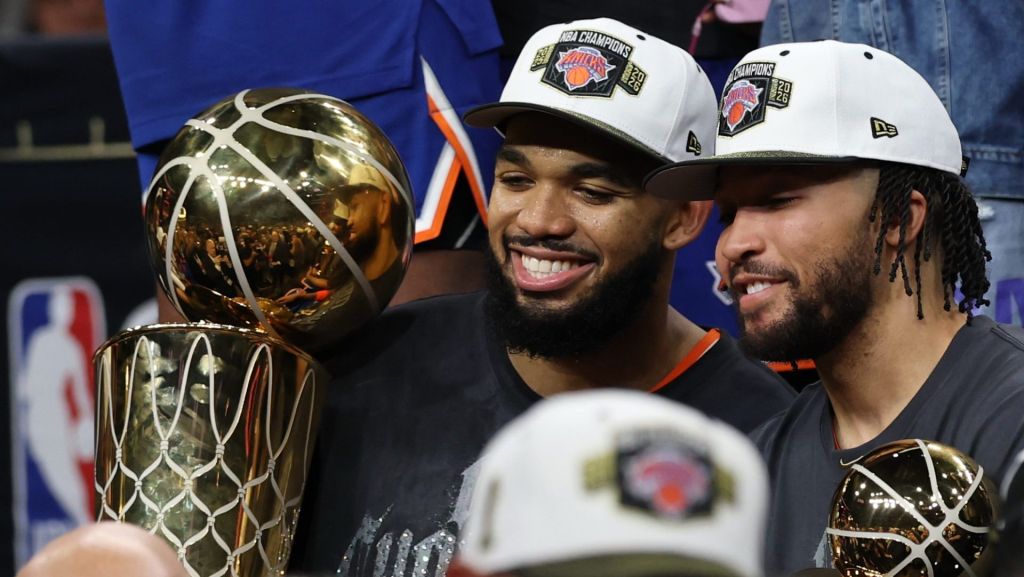
It may go down as the greatest discount in the history of sports. It paid off handsomely for the Knicks and their fans, and Brunson was named Finals MVP on Saturday night after scoring 45 points in the Game 5 win over the Spurs to win the franchise’s first NBA title in 53 years.
Had he waited until free agency the following year, Brunson could have signed a five-year deal worth almost $270 million. But his discount allowed the Knicks to build the championship roster around him. Armed with the extra nine figures of payroll flexibility, the Knicks traded for Mikal Bridges and then extended him for four years and $150 million, re-signed Game 4 hero OG Anunoby a five-year, $212 million deal, and traded for Karl-Anthony Towns and his $220 million contract.
The Knicks’ best player was only the third-highest-paid on the roster this season at $37.7 million, according to Spotrac.
“He understands what winning is about,” Knicks head coach Mike Brown told reporters after Saturday’s game. “He took a pay cut that I wouldn’t take. Every time they would throw that number in front of me, I would say no, and I feel like I’m a great guy. He set the bar. That set the standard.”
But for the Knicks to run it back, Brunson’s co-star will be faced with a similar choice if the team wants to retain key rotation pieces.
Karl-Anthony Towns has one of the league’s richest contracts and made $53 million this season. A year ago, the Knicks declined to extend Towns for the two years and $150 million he was eligible for. Towns didn’t take it personally, citing his relationship with Knicks president of basketball operations Leon Rose, who previously represented him.
“Me, Leon and [senior VP of basketball operations] Gersson [Rosas] and everyone, we’re great,” Towns said in December. “I’ll go have lunch with them right now. We’re good.”
Towns has two years left on his current deal. He’ll make $57 million next season and has a player option for $61 million.
But the Knicks’ decision to not extend him became much more expensive because of the New Jersey native’s postseason. Brown’s decision to change the offense and have it run through Towns helped spur the Knicks’ dominant 16–3 postseason run. Towns is now eligible for a four-year, $260 million extension, and he performed like a superstar worthy of a max deal through the title run.
Brunson’s sacrifice was extraordinary in pro sports. But something will have to give if the team retains key rotation players Landry Shamet and Mitchell Robinson.
The Knicks are currently under the luxury tax for next season at $262 million, but likely have to dip into the first apron to re-sign Robinson, the team’s backup center and longest-tenured player. The injury-prone Robinson is one of the league’s best defensive centers when healthy and could start on most NBA teams.
He made $13 million this season in the final season of a four-year, $60 million deal, but many around the NBA believe he can command more on the open market.
While representing a smaller part of the Knicks plans, Shamet has his own decision to make. The sharpshooter was perhaps the NBA’s best player this season on the veteran minimum, making just $3 million while shooting 39% from 3. Shamet is an unrestricted free agent and could command the taxpayer mid-level exception at roughly $6 million, if not more.
After spending recent seasons on non-guarenteed contracts, asking Shamet to take a discount when he can double his salary—or more—doesn’t seem to be realistic.
The Knicks could also get creative with contracts and backload them, with less money up front to maintain financial flexibility..
Brunson will be eligible in 2028—when he’d be 32 years old—for a five-year contract worth up to $420 million. It could be looked at as an overpay for a player at that stage of their career. But Brunson’s impact on the organization has been priceless.
“Obviously we’d love for them to do right by me,” Brunson told Vanity Fair in February. “I think anyone would. I feel like I sacrificed.”
Download the FOS App
The business of sports, in your pocket.



Scan the QR code to get the app now.