Want more from Front Office Sports
in your search results?
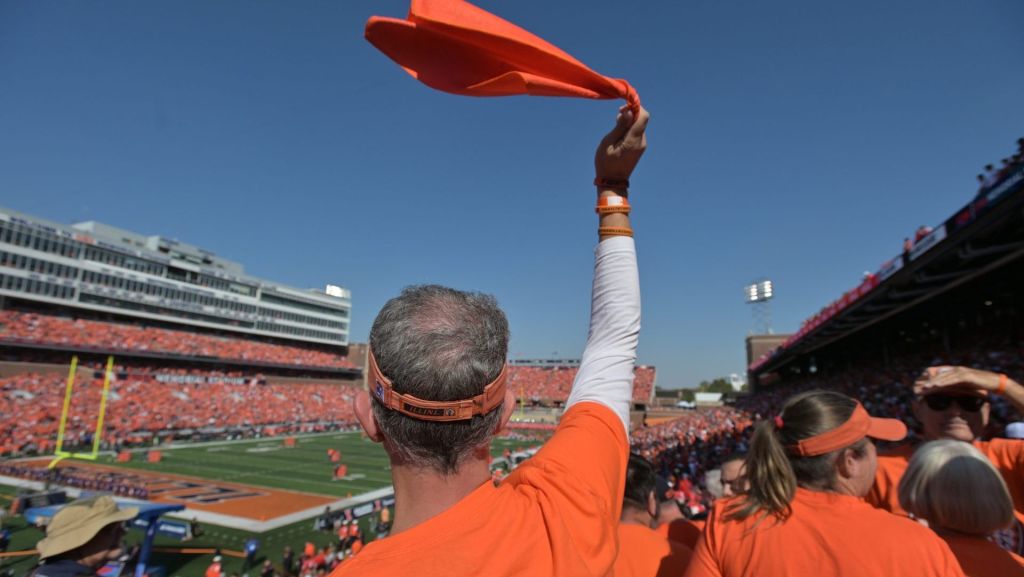
When Illinois installed a new video board at Gies Memorial Stadium in January, it became the largest scoreboard in college football.
The 16 million-pixel display stands 69 feet high by 250 feet wide, and it—along with 15 other new LED screens installed at Gies—cost the school $20,938,463, according to documents obtained by Front Office Sports. The expense was funded by a $100 million donation from alum Larry Gies Jr. Illinois did not respond to multiple requests for comment.
In a press release announcing the installation at Illinois, Daktronics—the South Dakota-based company that built it—stood the screen up against comparable displays at professional stadiums: It “would be the fifth-largest display in professional football. It is roughly the same size as the main outfield display at Citi Field in New York and 3.4 times the size of the main display at Soldier Field in Chicago.”
Since the Illinois project was announced, Daktronics said it has seen interest from other schools. “We’ve also heard professional sports teams mention that project as well,” Will Ellerbruch, Daktronics national sales manager, told FOS.
At the company’s investor day in April, Daktronics board chair Andrew Siegel told the audience “When you look up, we want you to see Daktronics.”
Beyond sports, the company builds and services signage at airports, gas stations, on the side of buildings such as in Times Square, and pretty much everywhere else you might find an LED digital display.
Those screens, while intended to engage, are not necessarily built to be a main attraction. But at sporting events, the screens are meant to draw you in—and they just keep growing.
“I think today, when you go to a sporting event, people want to see replay. It’s also a revenue-generating opportunity,” Jay Parker, Daktronics’ VP of live events and spectaculars, the category that includes college and pro sports, said during an investor day Q&A. The larger the screens, the more room for advertisers to gain visibility in front of thousands of fans at one time.
At the University of Oregon, where Daktronics installed a 46-by-180-foot display in 2020, the school’s board of trustees approved up to $12 million for video board and sound system upgrades at Autzen Stadium. Daktronics completed the work for $11,554,370, according to documents obtained by FOS. At the time, it was the largest display in college football.
“The video board was designed with the priority of what worked best for Autzen Stadium, including pairing it with a state-of-the-art sound system,” said Jimmy Stanton, Oregon’s senior associate athletics director for communications. Regarding future updates to audio and video equipment at athletics facilities, Stanton added, “We’re always looking for ways we can enhance the student-athlete and fan experience.”
Daktronics says the process from initial outreach to fabrication and installation can take anywhere from 12 to 24 months—and it’s not always all about size. “It’s great to have interest in improving size to be the largest display and larger than conference/division rivals, but the conversation goes beyond size and into the realm of having new technologies that drive the fan and athlete interest—especially in today’s world of NIL,” Ellerbruch told FOS.
Daktronics is responsible for eight of the 10 largest displays in college football. Of the top 10, seven were installed in the last six years.
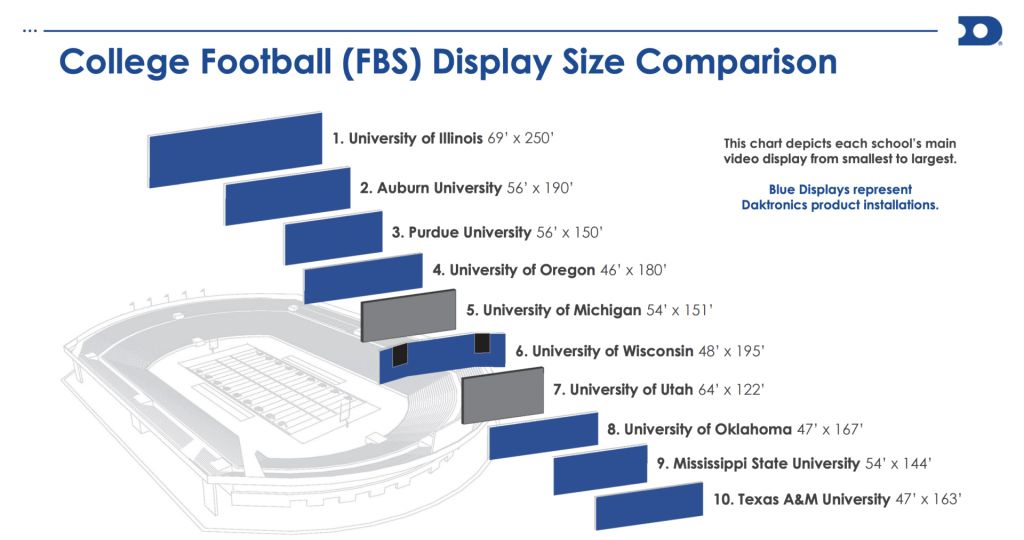
Illinois’s massive scoreboard unseated Auburn’s—also installed by Daktronics, in 2025—as the largest. It’s a sign of things to come as college stadium and arena renovations increasingly look like those of professional venues.
That’s for good reason; Daktronics counts 154 professional sports teams, 1,316 college athletic programs (including 69% of D-I programs), and 400 minor league facilities in its client list.
The company touts itself as a lifetime partner for its clients, meaning Daktronics’s work doesn’t end when installations are complete. Its audio and video systems are powered by proprietary software, and tech support is provided over the full lifespan of its products, which Daktronics estimates to typically be about 10 years.
As more schools look to upgrade their stadium experiences, fans can expect to see new schools join the ranks. Oklahoma, currently the eighth-largest college football screen, is undergoing a $450 million stadium renovation. The scoreboard at Gaylord Family-Oklahoma Memorial Stadium was installed in 2016—it may be time for an upgrade.
Download the FOS App
The business of sports, in your pocket.



Scan the QR code to get the app now.