Want more from Front Office Sports
in your search results?
After a not qualifying for the World Cup, something must be changed.

By Francisco Terreros, @fterreros
I remember as if it were yesterday; I had just graduated high school and had committed to play college soccer at a small college in Utah.
During the summer before Fall semester began, and in preparation for the Korea/Japan 2002 World Cup, my best friends and I transformed my parents garage into what we called, “the chill pad,” which we equipped with two large TVs, two sofa-beds, three recliner seats, a fully stocked mini fridge, and of course… cable television! We had set up our sleeping schedules to match the South Korea and Japan Standard Time Zone (they were the hosts of the 2002 World Cup) so we could eat, sleep and breathe soccer!
As the WC began, more and more friends heard about “the chill pad”, and it eventually became the World Cup headquarters in our neighborhood.
There we were — I can’t even recall how many people, but it felt like 200 strong, all cramped in a 2 car garage-turned living space, standing room only with no AC but lots of soda and chips to go around, as we tuned in on a hot, early June morning, to witness one of the greatest games ever played by Americans on any international stage… USA vs. Portugal.
As we screamed and cheered every goal scored on soccer powerhouse, Portugal, those 90 minutes made me pause and think, “We are onto something here!” And that we were.
Let’s call that game, the U.S. Soccer Pivotal Point, and reflect on what has happened since then:
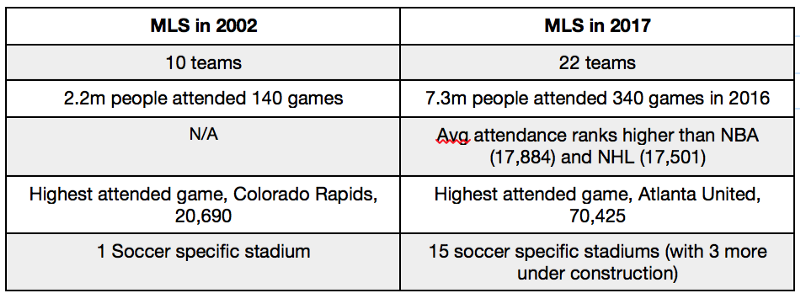
Major League Soccer went from being a struggling league in 2002 (as you may recall, MLS folded 2 teams, Tampa Bay Mutiny and Miami Fusion) and playing its season with only 10 teams, to becoming one of the strongest soccer leagues in our continent.
Here is a comparison:
• USMNT wins 5 Gold Cups (2002, 2005, 2007, 2013 and 2017; Finishes as Runners-up in the 2009 confederations cup and in Fourth place during the Copa American Centennial 2016)
• USWNT wins their 3rd World Cup (2015) and three more Olympic gold medals (2004, 2008 and 2012)
• U.S. Soccer is generating about $3m in revenue from player development, with stars like Bobby Wood and Christian Pulisic leading the mark internationally. (according to the public audited financial statements on the US Soccer website)
So what happened Tuesday? Why didn’t we continue to build on that momentum? Why is it that one of the largest populated countries in the world, who is a world power in almost every other sport, can’t even tie Trinidad and Tobago to qualify to Russia 2018?
There are so many questions and blaming fingers lurking around the web this week, but, in true American fashion, we must dust ourselves off, stop blaming people, and get to work. We need to fix this. WE HAVE TO FIX THIS! Why?
The Problem:
From the business perspective, the US economy will be impacted by USMNT not attending the World Cup. Here are some facts:
• According to the public audited financial statements on the U.S. Soccer website, U.S. Soccer generated its highest peak of revenue during last World Cup 2014, a whopping $76,565,492!
• Items like Sponsorships and TV ($28m), National team games played domestically and internationally in prep for WC ($29m), led the mark as main revenue generating streams. Two of which will be SIGNIFICANTLY hit by missing Russia 2018.
• USSF will be missing out on FIFA’s payout for qualifying to the games, which guarantees a total of $12m for just showing up ($2m for prep fee + $10m for participating in the group stages).
• US fans were the second largest purchasers of WC 2014 tickets (outside of host country, Brazil who purchased an estimated 60% of all tickets), buying 196,838 tickets.
• Then the trickle-down effect begins: Local retail shops who make revenue off of selling USMNT World Cup jerseys will be nonexistent, and the airlines who planned on transporting all those 200k fans won’t be flying as many people. You get the illustration.
I don’t even want to talk about the developmental struggles we will face as a nation from an athletic standpoint. It scares me to think that our youth won’t be as motivated to play soccer within our system simply because, “it sucks.”
The Solution:
I am not suggesting this is the ONLY answer to our problem and that this will fix what our soccer nation is facing this day. But, I am suggesting that actions and goals must be on the horizon so the United States of America can become that soccer power house we all know we can.
My idea? COLLEGE! Yep, I know… The talk of “college soccer reform” has been in place for a while. In fact, last fall, a group of NCAA D1 college coaches started a public PR push to change the format of their crazy-packed fall season (most teams play twice per week, and travel by air in most cases) into one that would mirror the academic year, fall-spring.
During an interview with the Washington Post last fall, one of the best coaches in one of the best programs in the nation, Maryland Head Coach Sasho Cirovski said, “The full-year concept for soccer has been discussed for decades, and over the past three years, has finally been refined into the model we’re preparing for submission to the Division I council. It’s the same number of playing opportunities we have today [25] but it reduces missed class time, gives appropriate rest and recovery time between games and moves the championship into a better weather time of year.”
Let me make this relevant to my solution and why I think it’s the answer to our problem.
As a soccer agent based in the US and doing most of my work with USSF leagues (MLS, NWSL, USL, NASL), I hear GMs and coaches complain about the lack of development a compressed fall season provides college programs to our young talent. Think about it; how can a 19 year old US based college soccer player who is playing 17 games in 2 months, all while attending college classes, grow (athletically speaking) at the same rate as a 19 year old German based soccer player who is playing a calendar year type season in their academy level?
I can illustrate:
This season’s MLS January combine in LA was one of the weakest from a talent standpoint. Not just according to my personal professional opinion, but by that of many in the industry, including athletic directors of major MLS teams and coaches alike.
Miles Robinson was the #2 overall draft pick, selected by Atlanta United as one of those “future” icon defenders our system has produced. Upon signing his contract, he was loaned out to Charleston Battery (USL) where he made 6 appearances and scored 1 goal.
Compare to a more mainstream NFL:
Carson Wentz was the 2nd pick during the 2016 NFL. He played 16 games, attempted 607 passes, completing 379 of them, and scoring 16 touchdowns.
Yes, I am a strong believer that rookies need some time to settle into their new legs, but how much more prepared would these soccer rookies be if they had year round collegiate season-style training?
Miles played for Syracuse University during the 2015 and 2016 seasons, competing in 42 games and scoring 9 goals as a defender. Impressive stats! However, all these games took place during a 4 month span, separated by a full year (fall to fall).
Imagine if Miles would have played the same 42 games in a 6 month span, separated by summer (which most college teams train throughout or male players play at PDL level)? I believe Miles would be starting for Atlanta United today!
This idea is a small and simple change for NCAA, that USSF should assist with, using all of its political power to change the future of our sport.
I still get chills when I think of that June early morning. Sitting next to my friends and screaming as Brian McBride made us dream with the 3rd goal of the night coming off an incredible diving header, which will forever be burned in my memory.
I believe we have the tools to make the United States of America the soccer power house we all deserve and want. Now, we just need to make these tools work to our advantage so kids like Christian Pulisic can lift a World Cup trophy one day.
-Francisco Terreros
EVP, FIFA Soccer Agent
SportBox Entertainment Group
This piece has been presented to you by SMU’s Master of Science in Sport Management.
Front Office Sports is a leading multi-platform publication and industry resource that covers the intersection of business and sports.
Want to learn more, or have a story featured about you or your organization? Contact us today.
Download the FOS App
The business of sports, in your pocket.



Scan the QR code to get the app now.