![[Subscription Customers Only] Jul 13, 2025; East Rutherford, New Jersey, USA; Chelsea FC midfielder Cole Palmer (10) celebrates winning the final of the 2025 FIFA Club World Cup at MetLife Stadium](https://frontofficesports.com/wp-content/uploads/2026/02/USATSI_26636703-scaled-e1770932227605.jpg?quality=100)

Typti U.S. Open Will Launch With $100K in Prize Money
The 2024–25 soccer season was a fairy tale for Crystal Palace, an unglamorous team from South London, which habitually occupies the lower reaches of the English Premier League.
Buoyed by an affable Austrian coach, Oliver Glasner, and a bunch of homegrown talent, they beat Manchester City in the the FA Cup final, England’s domestic competition. It was the club’s first major trophy in its 120-year history.
Ordinarily, it would have meant qualification for the Europa League, the second-tier European competition, which would have drawn more revenue and prestige. Except Crystal Palace was denied.
That was because a French club, Olympique Lyonnais, also qualified. Both Crystal Palace and Lyon were, at the time, owned by U.S. businessman John Textor, and European soccer rules prevent two clubs belonging to the same owners from playing in the same competition. Lyon got the nod over Palace because it finished in a higher position in its own domestic league.
Crystal Palace fans were furious. The club appealed to the Court of Arbitration for Sport. It lost and had to accept playing in the minor Europa Conference League.
The team’s struggle reflects a growing—and increasingly troubling—trend in soccer finance: multi-club ownership (MCO), where big firms buy up multiple teams in different leagues and roll them into one portfolio. Almost everywhere, owners are prohibited from controlling more than one club in the same country’s league, but MCOs spread their assets across multiple leagues.
Each MCO group operates differently, but all see a big financial opportunity in having their hands in multiple teams in different leagues. The bigger their slice of the global soccer pie, the more control they have over talent access and player trajectory, cost efficiency, and even the rules by which global soccer is governed.
MCOs expose the gulf between fans and owners: Supporters want success on the field and a connection with their players; and executives want each club to further the overall performance of the business—not necessarily win games.
Path to the Top
City Football Group (CFG) is one of the oldest and largest MCOs. After buying Manchester City in 2008, the Emirati group went on a multi-year spending spree, acquiring teams in the U.S., Australia, Uruguay, Japan, Belgium, and others. Where they could get away with it locally, CFG switched their clubs’ kits to sky blue and redesigned their crests to create an overarching brand in line with that of Manchester City, the peak of the CFG pyramid.
“Most MCOs have a crown jewel at the top,” explains Johan Rewilak, a senior lecturer in sport management at England’s Loughborough University. “You have a group of teams at the bottom that find the players in their local markets. Then you have teams slightly higher up that train and develop the players, and then the crown jewel, where the best players are transferred, and where the MCO actually benefits from the players’ best years.”
Take the career path of Brazilian forward Sávio Moreira de Oliveira, widely known as Savinho. CFG bought him from the Brazilian league in 2022, and signed him with its club in the French league, Troyes. Immediately, he was loaned out to Spain’s Girona, another CFG club. After an impressive season, he moved up to Manchester City.
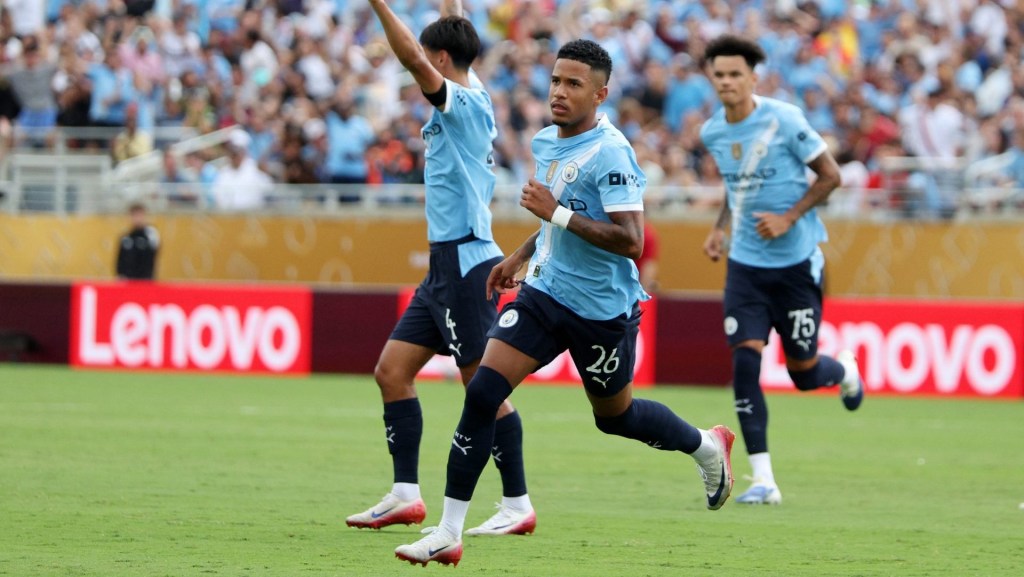
CFG reaped rewards from signing one of the best young players in Brazil for a lower fee and using its other clubs as a testing ground for his development. Savinho is now playing in the Champions League, and has a transfer value many times the roughly $8 million that CFG originally paid for him.
These principles have been taken to their logical conclusion by BlueCo, the soccer conglomerate part-owned by U.S. businessman Todd Boehly, whose other interests include stakes in the Los Angeles Dodgers and the Los Angeles Sparks. BlueCo bought Premier League mainstay Chelsea in mid-2022 for $5.8 billion; a year later, it acquired a controlling stake in France’s Strasbourg for $89 million.
BlueCo has used Strasbourg as a feeder club for Chelsea. In the first season after its acquisition, Strasbourg received two Chelsea players on loan. The following year, three more arrived. This year, it is six.
The best are returned to Chelsea after gaining some first-team experience, while Strasbourg’s own players who shine are shipped off to the Premier League. BlueCo has determined that the Strasbourg captain and star forward, Emmanuel Emegha, will move to Chelsea at the start of the 2026–27 season. Meanwhile, players who fail to make an impression at Chelsea, such as English fullback Ben Chilwell, are being dumped at Strasbourg.
Most recently, BlueCo extended this approach to coaches. In mid-2024, it appointed a young English manager, Liam Rosenior, to helm Strasbourg. When Chelsea needed a new manager at the beginning of 2026, it simply moved him across.
Success and Skepticism
Fans feel disrespected—and in some situations, they’re furious.
Strasbourg fans, for instance, believe the club’s 120-year history and stand-alone success, as well as its community connection, have been diluted now that it ostensibly serves as a testing ground for Chelsea. A group of Strasbourg supporters, Ultra Boys 90, have maintained 15 minutes of silence at the beginning of home matches since the start of the season to protest BlueCo’s ownership.
There is, however, one quasi-MCO that has become very popular with its clubs’ supporters.
Tony Bloom, a British professional gambler, bought a 75% stake in Brighton & Hove Albion in 2009. Under his ownership, the club has been promoted to the Premier League and remained there for nine years. Brighton has become renowned for its sharp dealings in the transfer market: It routinely sells its best player each summer for a huge fee, then picks their successor for a song. In this respect, it is not unlike the approach of some MLB teams.
In a Moneyball-esque setup, these moves are largely buoyed by Bloom’s soccer-data company, Jamestown Analytics.

Bloom has employed his model beyond the Premier League: He bought Union Saint-Gilloise in Belgium in 2018, and then a 29% stake in Scotland’s Heart of Midlothian (known mostly as Hearts) in 2025, sharing the Jamestown expertise with each.
In their Bloom era, each club has enjoyed unusual levels of success—something that has kept fans happy. Brighton has never had such a long period in the top division. Union SG won the Belgian league for the first time since the 1935 in 2024–25. Hearts is at the top of the Scottish Premiership and is bidding to be the first club other than Rangers or Celtic to win the championship since 1985.
One of the reasons fans are more receptive to Bloom’s control is that his group operates horizontally, whereas BlueCo and CFG work vertically.
The latter two work with the Premier League club at the top, with the clubs below it functioning as subservient entities. But in Bloom’s structure, all three clubs have access to the Jamestown database, and players are picked to serve each specific club, rather than with the overarching goal of feeding Brighton at the top. This means that Union SG and Hearts are succeeding in their domestic leagues in a way that Strasbourg cannot within the BlueCo operation.
There are still concerns shared among fans across all MCOs. Mark Donaldson, host of a popular Hearts podcast called Scarves Around the Funnel, is delighted at the prospect of his team becoming Scottish Premier League champions—but is still aware of how Bloom and Jamestown are changing the club.
“They don’t sign players to keep for 10 years. They sign them from obscure places, give them a platform, fatten them up, and within 18 months, if they’re good enough, off they go,” Donaldson says. “We’ve just got to be careful to keep the fabric of the football club. We don’t want Hearts to operate a revolving door where you need a name tag so that your teammates and your fans know who you are.”
‘Up the Pyramid’
As MCOs expand their reach, soccer’s authorities are struggling to keep up.
The European governing body, UEFA, has made decisions that have left supporters confused. In one of its earliest rulings on MCOs in 2017, it permitted Red Bull Salzburg and RB Leipzig, two clubs wholly owned by the energy-drink company, to play in its Europa League competition. Eight years later, it seemed to muddy that ruling in the Crystal Palace–Lyon case; UEFA now says it’s reviewing its multi-club rules.
There’s little indication now that UEFA or other governing bodies will tighten the rules on MCOs. Nick Harris, who runs a Substack called Sporting Intelligence, suggests that more than 200 clubs in Europe are now part of MCOs. Undoing this would be a legal and bureaucratic nightmare.
Shake-ups may need to come at the national level. In late 2025, a French member of parliament, Éric Coquerel, proposed a bill that would ban the acquisition of French football clubs by MCOs. (Those already in place, such as Strasbourg’s position within BlueCo, would not be affected.)
Without any intervention in the MCO system, the future could take a bleak turn.
Rewilak says the next couple of decades could usher in a worrying consolidation to create “a European Super League in which all of the crown jewels play. Below it will be other multinational leagues filled with the feeder clubs, whose purpose is to identify the best players and push them up the pyramid.”
Fans across the globe could find themselves horrified—and left with their hands tied. None of the MCOs responded to requests for comment.