Want more from Front Office Sports
in your search results?
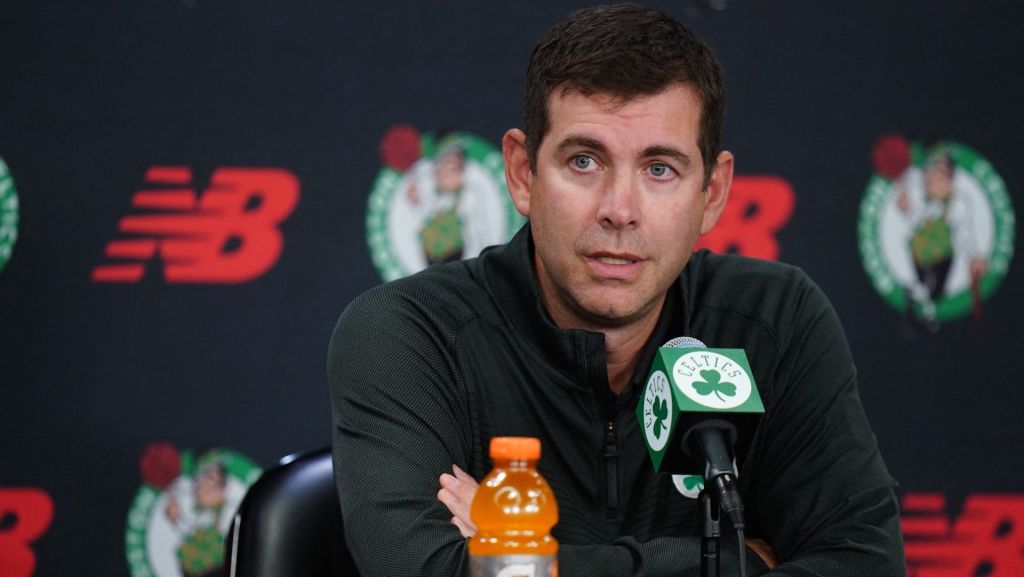
Brad Stevens is aware of his current popularity—or lack thereof—in Boston.
The Celtics president of basketball operations and co-owner Bill Chisholm met with reporters for more than 40 minutes on Monday after the trade that sent star forward Jaylen Brown to the Sixers became official.
“It’s obviously unpopular and most people think it will be wrong,” Stevens said of the deal.
The Celtics acquired Paul George and a slew of first and second-round picks in exchange for Brown, who is set to make $57 million with the Sixers next season and is eligible to sign an extension for an additional two years at more than $70 million annually this month.
Brown’s contract was the richest in NBA history when it was signed in 2023 and was topped a year later by his now former teammate Jayson Tatum’s. The Celtics were sold to Chisholm a year ago after winning the 2024 NBA Finals and Stevens said owing two players more than $600 million combined in the coming years wasn’t feasible in the modern NBA.
“The path looked a little bit more challenging to me with 70% of our cap and such a high percent of our usage tied into two players,” Stevens told reporters.
Brown and Tatum represented 47% of the Celtics cap sheet when the team won the 2024 Finals, before their gigantic contracts kicked in and ballooned it past that. But trading for Paul—who is owed $54 million next season—doesn’t change the Celtics cap situation, which Stevens acknowledged. George also has a player option next summer for $56.5 million. Stevens said trading Brown gave the team more “optionality.” What did he mean by that?
“Paul’s contract is shorter,” Stevens said. “Optionality is length of contract and assets [received for Brown.]”
Stevens said the Sixers made the best offer for Brown, but that he would have preferred to do the deal with a West Coast team to avoid the 6-foot-6 swingman playing the Celtics four times a year.
Brown was the centerpiece of the Celtics’ offer for Giannis Antetokounmpo, who was ultimately traded from the Bucks to the Heat. Despite striking out on Antetokounmpo, Stevens said there was no mandate to trade Brown.
“We didn’t feel like we had to do something,” Stevens said.
Stevens said the organization had no issues with Brown, but the team’s actions could suggest otherwise. In January, Antetokounmpo will be eligible for a four-year extension worth $275 million that any team trading for him would have to offer. Had the Celtics landed the 6-foot-10 forward, they would still have two players accounting for the majority of their cap sheet, which is why the quick decision to trade Brown leaves room for interpretation.
The Brown trade is the latest cost-cutting move Chisholm’s ownership group has made since he was named governor last August. Brown’s exit marks yet another departure from the Celtics’ 2024 title team, joining Kristaps Porzingis and Jrue Holiday, both of whom were traded to save a massive luxury tax bill.
Chisholm, who paid $6.1 billion for the team, said trading Brown was not about a lack of willingness to spend. “The second apron is real,” he said.
He called decisions made with the second apron in mind “basketball decisions” and reiterated that he is willing to spend what is needed to win.
“[This is] not about the money at all,” Chisholm said. “This was trying to put together the right players and assets to win … I know people feel like there must be a smoking gun somewhere around the money. That is just not what this is about.
“The mandate is to win and Brad and his team came with a recommendation that this is gonna be the way to win,” he said. “And I got there. And I recognize this was a big move and frankly I didn’t anticipate it would happen this fast under our ownership group. But we’re here.”
Stevens and Chisholm got almost no questions about the 36-year-old George, who now has to replace the relatively durable Brown after playing just 78 combined games over the past two seasons.
Does Stevens think the Celtics are a better team next year with George over Brown?
“We’ll find out,” he said.
Download the FOS App
The business of sports, in your pocket.



Scan the QR code to get the app now.