
Want more from Front Office Sports
in your search results?
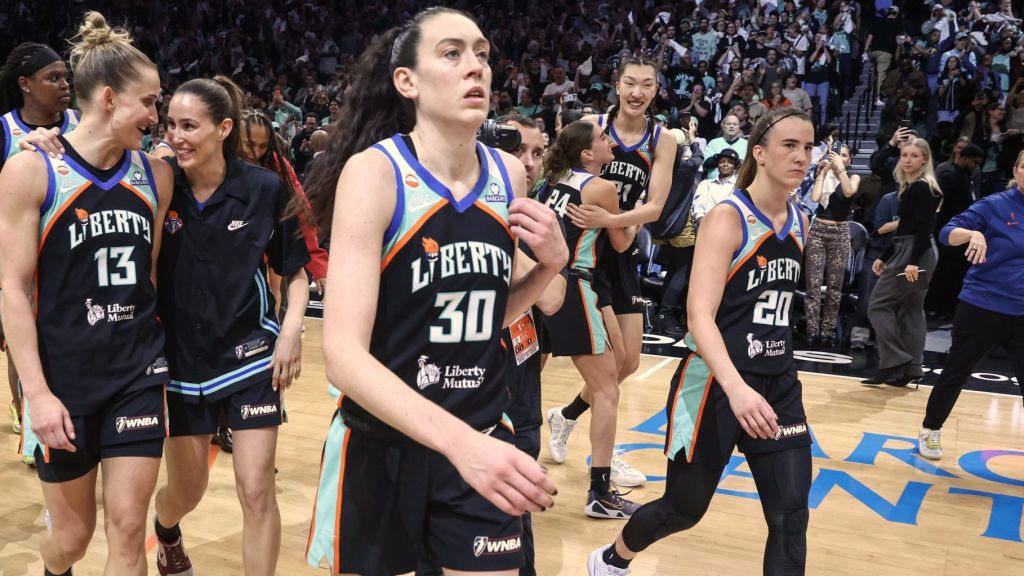
On Tuesday night, the New York Liberty sealed a two-game first-round sweep over the Minnesota Lynx with an 87–71 victory at the Barclays Center, marking the first time a No. 8 seed has upset a No. 1 seed since the WNBA switched to an eight-team, conference-less format in 2022.
The Lynx, who finished the regular season with a 33–11 record, exited the playoffs after playing just one home and one road game, prompting renewed questions over the WNBA’s postseason format.
The league switched to a 1-1-1 format for the first round last season, after the previous 2–1 format drew some criticism for failing to guarantee each playoff team at least one home game. However, some coaches and players have recently pushed back against the new format, arguing that either a different hosting setup or a longer series would provide a more significant competitive advantage to the higher seed. (MLB also has a three-game first round, with all three games played at the higher seed.)
“The 1-1-1, I don’t think is a good setup,” Las Vegas Aces coach Becky Hammon said earlier this month after a late-regular-season victory over the Seattle Storm. “It should be 2-1 or go to a five-game series, because the 1-1-1 is no advantage for the higher seed, really. It’s nothing. That’s not my decision obviously, but I don’t like the setup in that first round.”
Four-time All-Star Liberty guard Sabrina Ionescu expressed a similar sentiment in a press conference last week, foreshadowing her team’s upset victory.
“It needs to be 2–1 or go to a five-game series, as I think anything can happen in a 1-1-1,” Ionescu said. “The team gets hot, the team plays well, and then yeah.”
Fever coach Stephanie White added to the chorus last week, calling the 1-1-1 format “probably the best of the worst-case scenario.”
“I prefer a longer series,” White said. “It wouldn’t be as challenging if the WNBA had Eastern and Western conferences, but it doesn’t, so teams are crossing the country half the time. It’s certainly an imperfect system.”
There is recent precedent for the WNBA expanding playoff series length. The league implemented a best-of-seven WNBA Finals for the first time in its history last year after 20 years of best-of-five finals.
Yet, any further attempts to add playoff games may be complicated by the league’s collective bargaining agreement. The CBA says that an increase in the number of possible playoff games must be accompanied by a proportional increase in merit-based player bonuses, and the league must consult with the players’ union before finalizing any changes.
Playoff Expansion Points
Article XXXIII Section 5 of the CBA states: “If the maximum number of possible playoff games increases beyond twenty-nine (29), the merit bonuses related to playoff achievement of a Team set forth in Article IX hereof shall be increased proportionally.” (The league already is at a maximum of 29 total playoff games.)
As is the case in most pro sports leagues, WNBA players are paid their salaries for the regular season, not the playoffs. Each player on a playoff team gets a bonus depending on how far their team makes it:
- WNBA champion: $60,000
- Runner-up: $20,000
- Second-round elimination: $10,000
- First-round elimination: $5,000
The champion and runner-up bonuses are double that of the Commissioner’s Cup, the in-season tournament that awards $30,000 to the players of the winning team and $10,000 for each player on the runner-up side.
If the WNBA expanded the first round to a five-game series, that would mean the maximum number of playoff games league-wide would be 37—a 27% increase in games. The CBA indicates that an increase in playoff games, even in just one round, would affect “each of the per-player merit bonuses.” So a 27% increase in player bonuses would mean:
- WNBA champion: $76,552
- Runner-up: $25,517
- Second-round elimination: $12,759
- First-round elimination: $6,379
Other possible scenarios would be to increase the second-round series to seven games or even to bring all series to seven games. The bonuses would look like this for each scenario:
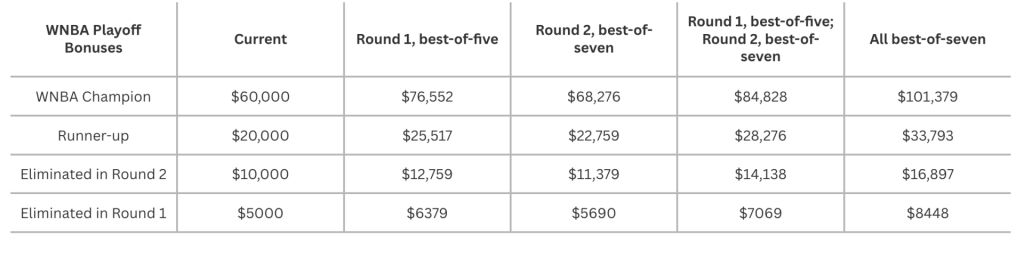
Assuming 12 players per team, this year’s total playoff bonus payout will be $1.44 million. A change to a best-of-five first-round series would increase the pot by about $400,000.
A change to the best-of-seven format across all three rounds would bring the total prize pool to an estimated $2.43 million, about $1 million more than the current amount.
But the league also needs to take into account how the increased number of games will affect the schedule. The 2026 WNBA Finals will end on Oct. 31 at the latest. But next year, the regular season will jump from 44 to 50 games, which could push the end of the season into November. In 2029, the season is expected to increase to a 52-game schedule.
The CBA states that starting next year, the WNBA season, including playoffs, can run until Nov. 21. This can be pushed to Nov. 30 in 2028, because the Olympics are that summer.
As for the start of the season, the CBA states the earliest that training camp can begin is April 1, and the season must start within 30 days of training camp. That gives the league a maximum of six months to fit the 50- or 52-game regular season and any expanded playoff format.
It would be challenging, though, for the league to start much earlier than its usual early-May tip-off. In 2026, for example, UCLA won the Division I women’s title on April 5, the draft was held on April 13, camps opened on April 19, and the regular season started just 19 days later, on May 8.