Want more from Front Office Sports
in your search results?
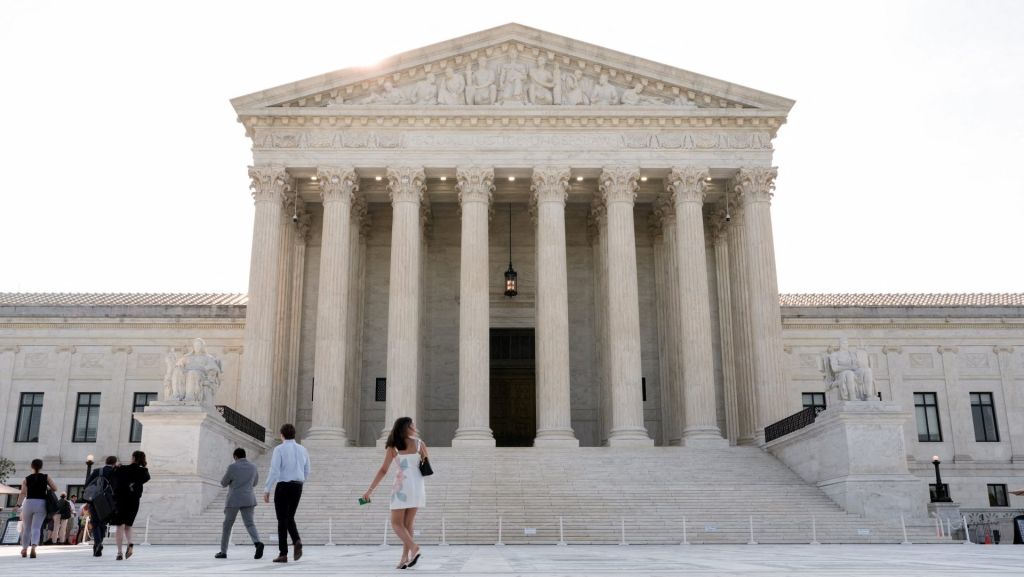
New Jersey is asking the U.S. Supreme Court to take up the fight over sports-event contracts.
The state is asking the Supreme Court to weigh in on whether sports-event contracts should be regulated at the state or federal level. The request came Wednesday, in a petition for writ of certiorari from New Jersey Division of Gaming Enforcement interim director Mary Jo Flaherty and New Jersey attorney general Jennifer Davenport. The petition was filed one day before New Jersey’s deadline to make the request.
“Kalshi bills itself as ‘the first app for legal sports betting in all 50 states’ and believes it can offer that ‘legal sports betting’ without following the sports-gambling laws of any of those 50 States,” the petition says. “Kalshi and the other so-called ‘prediction markets’ have built an entire business model on the claim that Congress silently displaced the States’ authority over sports wagering 16 years ago when it directed the Commodity Futures Trading Commission to regulate swaps in the wake of the 2008 financial crisis.”
New Jersey’s petition comes less than a week after a three-judge panel for the Ninth Circuit, a federal appeals court, unanimously ruled that Nevada can enforce its gambling laws against Kalshi. That decision created what’s known as a “circuit split,” which is when two appeals courts rule differently on the same issue. In April, the Third Circuit ruled New Jersey’s gaming regulator could not stop Kalshi from offering sports-event contracts in the state.
The filing of the petition does not mean the Supreme Court is guaranteed to take up this specific case. Former CFTC lawyer Carl Kennedy, who now works at law firm Katten Muchin, wrote in an analysis last week that the two decisions “arise from preliminary-injunction proceedings, not final merit judgments,” meaning the Supreme Court could either choose to resolve the circuit split now or “or wait for a more procedurally developed case.”
Primary issues in both the Nevada and New Jersey lawsuits include whether the CFTC’s “exclusive jurisdiction” over prediction markets extends to sports-event contracts, and if a federal law called the Commodity Exchange Act (CEA) preempts state law. In the Third Circuit’s April decision, U.S. Circuit Judge David J. Porter wrote that sports-event contracts should be treated as swaps, which are contracts where two parties exchange money based on how something else changes—in the sports context, for example, the result of a game. Swaps generally fall under the CFTC’s authority.
According to New Jersey, the Supreme Court’s opinion is “urgently needed” because the outcome of this fight “will determine whether a multi-billion-dollar gaming industry can suddenly operate free from state sports-gaming laws.”
“Resolution of that conflict is profoundly important,” the petition says.
Kalshi spokesperson Dani Lever said in a statement that the company disagrees with New Jersey’s filing.
“Kalshi is an open, nationwide financial exchange,” Lever said. “It cannot be regulated by 50 different regulators. Both the Third Circuit and the District of New Jersey sided with Kalshi because the CFTC’s exclusive jurisdiction preempts state law.”
She added that “while New Jersey points to a recent decision in the Ninth Circuit, that decision agreed with that key principle. Where it differed, it did so based on a regulation that’s in the process of being rewritten. We remain confident in the lower courts’ rulings, and nothing in New Jersey’s filing today changes our view.”
In June, Kalshi CEO Tarek Mansour told Front Office Sports he wasn’t concerned about an eventual Supreme Court fight.
“We feel very confident about the legal analysis,” he said. “[Federal] preemption is very clear, and I think breaking that preemption would have more dramatic consequences on CFTC-regulated exchanges, SEC-regulated exchanges, all of that.”
Download the FOS App
The business of sports, in your pocket.



Scan the QR code to get the app now.