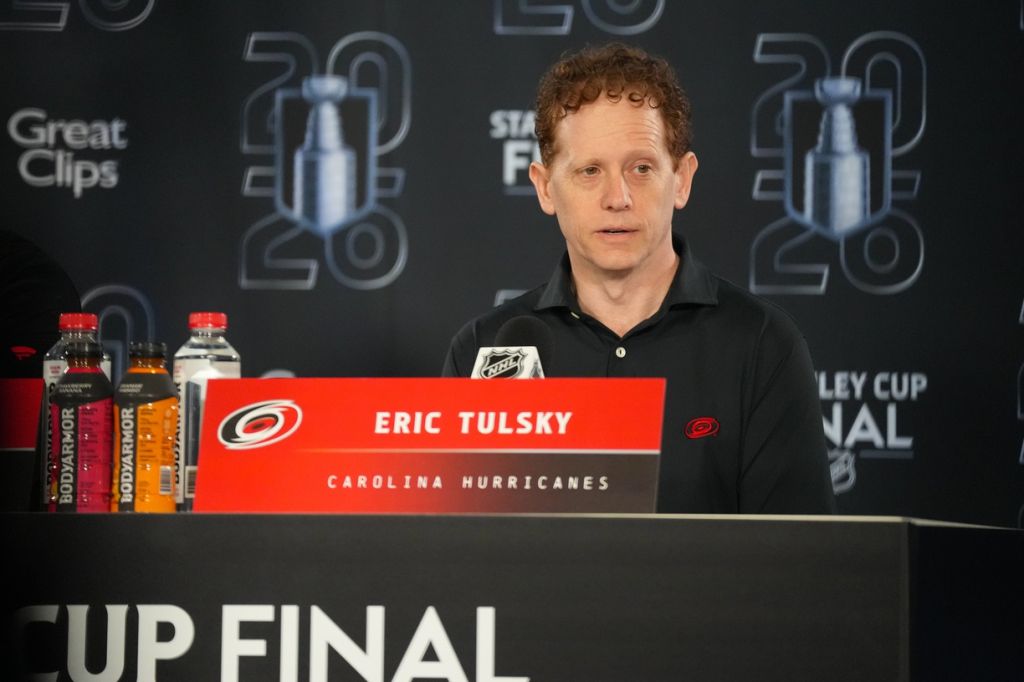
RALEIGH — Even in the nerd culture and analytics revolution that have rippled throughout sports, Hurricanes GM Eric Tulsky stands out with few, if any, peers, and he now has a championship within reach.
Tulsky’s upstart journey into hockey management bears some similarity to other outsiders who have entered sports, as he began writing 15 years ago for a Flyers fan blog, Broad Street Hockey, and successfully parlayed his insights into consulting work in the league, and ultimately, a full-time role with the Hurricanes that began his ascendancy in the organization.
His time before hockey, however, is what particularly stands out—and still informs the highly disciplined and analytical approach of one of the NHL’s most successful franchises. Tulsky earned a dual degree in chemistry and physics from Harvard, and then he earned a doctorate in chemistry from Cal. After that, Tulsky conducted his postdoctoral study at the Naval Research Laboratory, worked for a decade in nanotechnology in Silicon Valley, holds more than two dozen scientific patents, and turned down a potential role with Apple to go full-time into hockey.
In short, Tulsky is a disruptor in what is still in many ways a tradition-bound sport. As the Hurricanes begin the Stanley Cup Final on Tuesday against the Golden Knights, the scientist-turned-executive is nearing his first title.
“It is still wild to me that I ended up here,” said Tulsky, who assumed the GM role in 2024, in response to a Front Office Sports question at a press conference Monday. “I don’t know how that happened. Obviously, [I’m] thrilled with the way it’s going. I never would have thought I’d have this opportunity. Coach [Rod Brind’Amour] and the players have brought us here, and I’m looking forward to seeing how it wraps up.”
A Distinctive Style of Play
Tulsky’s defining presence in hockey has been his insistence on possession-based tactics, and his belief that traditional dump-and-chase play is no longer viable as a primary on-ice strategy. Rather than going on hunches, though, that sentiment was forged in large part by studying vast amounts of player and puck tracking data.
That approach has since been widely copied across the NHL. But under Tulsky, the Hurricanes have still stood out with a scientifically driven system that has included hires of data engineers, neuroscientists, and software developers in the front office. It also informs how Tulsky has assembled the Hurricanes’ roster.
“We’ve really focused on finding people who fit the way we want to play,” Tulsky said. “We ask our players to play a very distinctive style and our scouts have done a great job finding players who came in, look their best, and play the way we need them to play.”
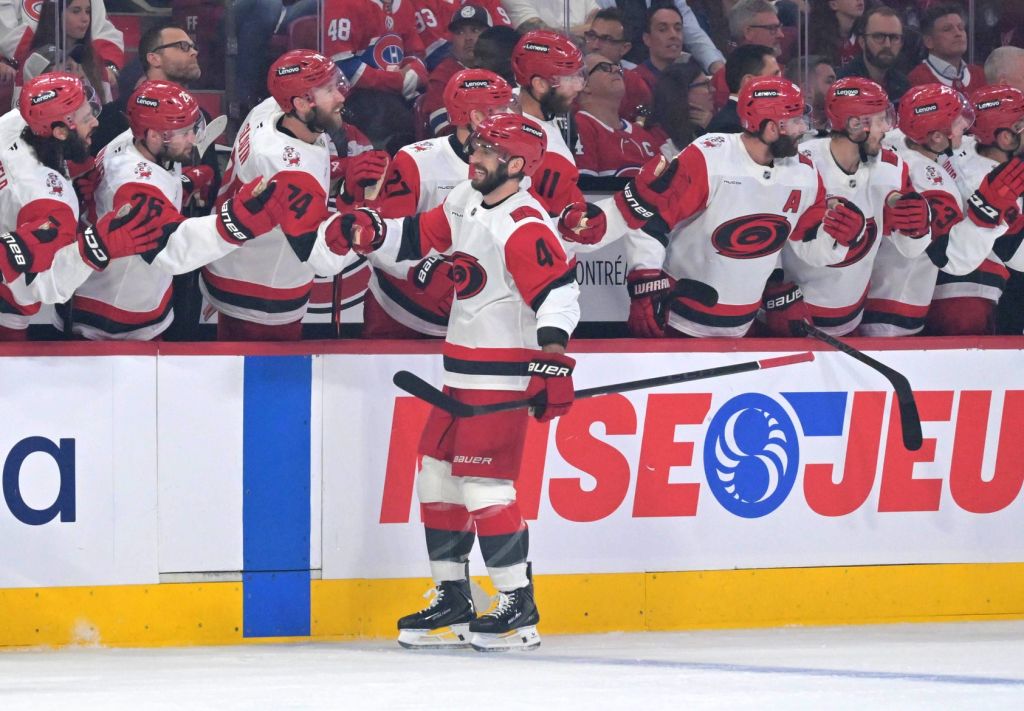
Even as Vegas has forged its own budding dynasty in the league, there is more than a nod of respect toward Carolina, which has won at least one playoff series each of the last eight seasons, including a 12–1 tear so far in this postseason.
“They’ve been consistently building their team. They’ve done it in different ways,” said Golden Knights GM Kelly McCrimmon. “They’ve drafted well. They’ve made astute trades. They’ve signed free agents. Those are the things you need to do when you’re building a roster. And they’ve been aggressive in their way of doing that, and have an idea of what they want it to look like.”
A Steadying Hand
Carolina’s ongoing success under Tulsky also has been a consistent presence for team owner Tom Dundon. The sports empire under Dundon is quickly expanding, as he’s now also the majority owner of the NBA’s Trail Blazers. That basketball era, however, is off to a much choppier start as the team under the new ownership has undergone a series of layoffs and financial cuts.
That situation in Portland also stands in significant contrast to what’s unfolding in Carolina.
“Fundamentally, we want to be aggressive,” Tulsky said. “One of the strengths of our organization is we’re not afraid to take those swings. But we’re also confident that if we just keep staying aggressive—some will work out, some won’t—we’ll end up ahead of where we would be if we just stayed passive the whole time.”