Want more from Front Office Sports
in your search results?
The Rays are finally back in Tropicana Field for the first time in more than 18 months, but the club’s long-term future remains very much a work in progress.
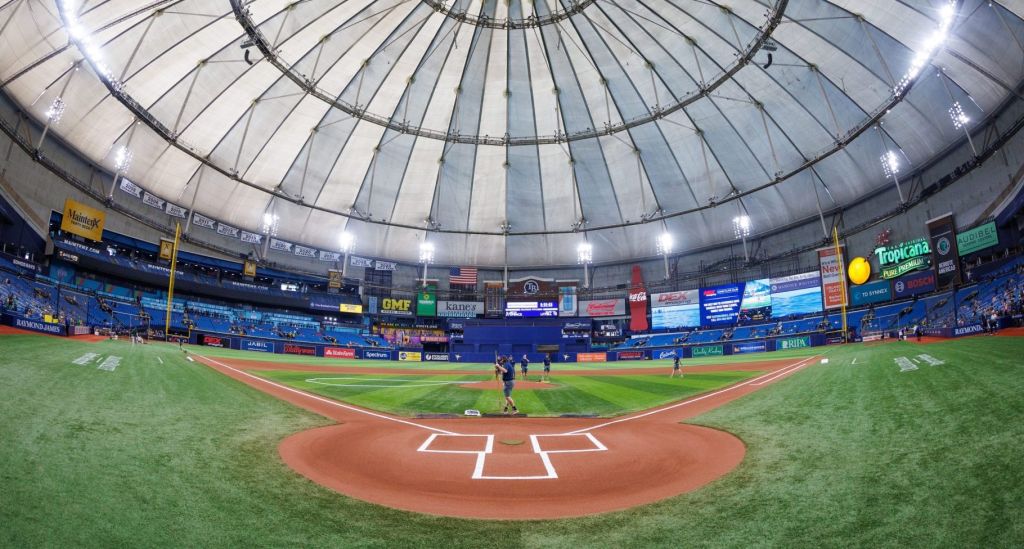
The MLB club will have its 2026 home opener Monday afternoon at the St. Petersburg, Fla., venue, marking a return there after restoration efforts from Hurricane Milton damage that took more than a year and about $60 million to repair. A sellout crowd is expected for the 4:10 p.m. ET game against the Cubs.
Those restorations at the city-owned ballpark, led by the installation of a new roof, were also paired with a series of additional upgrades, including updated suites, a new turf field, an upgraded video board, and an improved locker room. Even the club’s iconic ray tank is back behind the centerfield wall.
As a result, club officials said the oft-criticized Tropicana Field is arguably in its best shape ever.
“This is a truly heroic effort,” Rays CEO Ken Babby said of the ballpark repairs. “It was not long ago that we looked at this building and wondered, ‘Could baseball ever be played here again?’ Not only is this building going to be special on April 6, but our fans are going to walk in and see Tropicana Field in a whole new way.”
The Rays started the 2026 season with a nine-game road trip to St. Louis, Milwaukee, and Minnesota, with Tampa Bay winning four of those games. The club played its entire 2025 home schedule at George M. Steinbrenner Field, the Yankees’ spring training home.
The other big shift during the extensive repair process at Tropicana Field came with the Rays franchise itself. Former owner Stu Sternberg walked away from a deal to build a new $1.3 billion ballpark 13 months ago, and soon thereafter sold the franchise to a group led by a Jacksonville developer, Patrick Zalupski, in a $1.7 billion deal.
The Next Steps
The Zalupski group moved quickly to develop a plan for a new ballpark, and in January selected a site at Hillsborough Community College, near Tampa International Airport. The Rays have a memorandum of understanding with the college and are envisioning building their version of The Battery, the influential mixed-use development the Braves built to surround Truist Park.
That plan involves public money funding about half of the projected $2.3 billion ballpark cost. Specifics around a proposal to city and county leaders, however, are still being formulated, and the surrounding mixed-use development would be in addition to that figure. As part of the taxpayer contribution, the team is eyeing using part of a county sales tax—something that is not legally certain. More specific financing plans, and potential votes by Hillsborough County and the city of Tampa, could arrive later this month.
“[This would be the] second-largest major league private investment ever made and by far the largest private investment ever made into a sports facility in Florida’s history,” Babby said of the team’s planned contribution. “We’re ready to do that, but we have to build the right partnership.”
The Rays have a lease to play at Tropicana Field through at least the 2028 season, and being in a new facility in time for the 2029 season will require the club to strike a ballpark deal within the next several months. Local politicians, however, insist they will not be governed by such external timetables.
In a not-subtle signal to the politics of the moment, the first pitches of the Rays’ home opener Monday will be thrown out by St. Petersburg Mayor Ken Welch and Tampa Mayor Jane Castor—reflecting the club’s intended present and future on each side of Tampa Bay.
Download the FOS App
The business of sports, in your pocket.



Scan the QR code to get the app now.