Want more from Front Office Sports
in your search results?
The WNBA’s year is ending much like it began: with negotiations over a new collective bargaining agreement dominating the landscape.
The talks have now been going on for over a year. The WNBA players opted out of the CBA last October, seeking a “transformational” deal instead of staying in the old one through 2027.
Here’s a look back at the most significant moments in labor talks between the WNBA and the WNBPA in 2025:
New Year
The 2025 calendar year kicked off in the world of women’s basketball with the debut of the startup 3-on-3 league Unrivaled in January, co-founded by WNBPA executive leaders Napheesa Collier and Breanna Stewart. At the time, negotiations had not yet taken off but players took full advantage of the exposure they were receiving while playing in the new league based in Miami.
Two of Unrivaled’s foundational principles were high salaries and an elevated operation, both rivaling what the WNBA was able to offer players. In its inaugural season, Unrivaled paid its players an average salary of $220,000. The WNBA’s supermax salary in 2025 was $249,244.
“We didn’t plan the league based on the CBA negotiation,” Collier told the media at the time. “But when we saw that the timing lined up, we said it was a perfect opportunity.”
What wound up coming out later in the year was Unrivaled also served as the backdrop for Collier and WNBA commissioner Cathy Engelbert’s now infamous, previously private conversation. Among Collier’s accusations was that Engelbert had said “Caitlin Clark should be “grateful she makes $16 million off the court, because without the platform that the WNBA gives her, she wouldn’t make anything.”
Months later Engelbert would deny having made those comments, but the meeting would end up serving as a precursor for a year of contentious negotiations.
WNBA Draft
By the time the WNBA draft rolled around in April, news that the league had failed to respond to a proposal from the union in December was being reported by Bloomberg.
Engelbert disputed the report, saying the league was never offered a proposal in December. Ultimately the disagreement came down to the sides’ interpretations of what constituted a complete proposal. The union said it had submitted a proposal, but the league claimed it was incomplete.
Paige Bueckers was selected with the No. 1 overall pick, but her night was highlighted by the news that she had agreed to a deal with Unrivaled that was slated to pay her more in her first season than she would over the course of her rookie scale contract. When she was asked about Buecker’s deal, Engelbert was dismissive. “I’m really proud of what they’re doing,” Engelbert said of the upstart league. “Of course, we’ll have—by the time we get done—16 teams, over 190 players we need to take care of. So, I know it’s a lot easier to do 30 in one spot.”
By June, the WNBA had officially responded to the union’s first proposal, which the players quickly rejected, setting up a pivotal meeting during All-Star weekend in Indianapolis.
All-Star
All-Star weekend in July marked the first time in negotiations that both sides began trading public barbs.
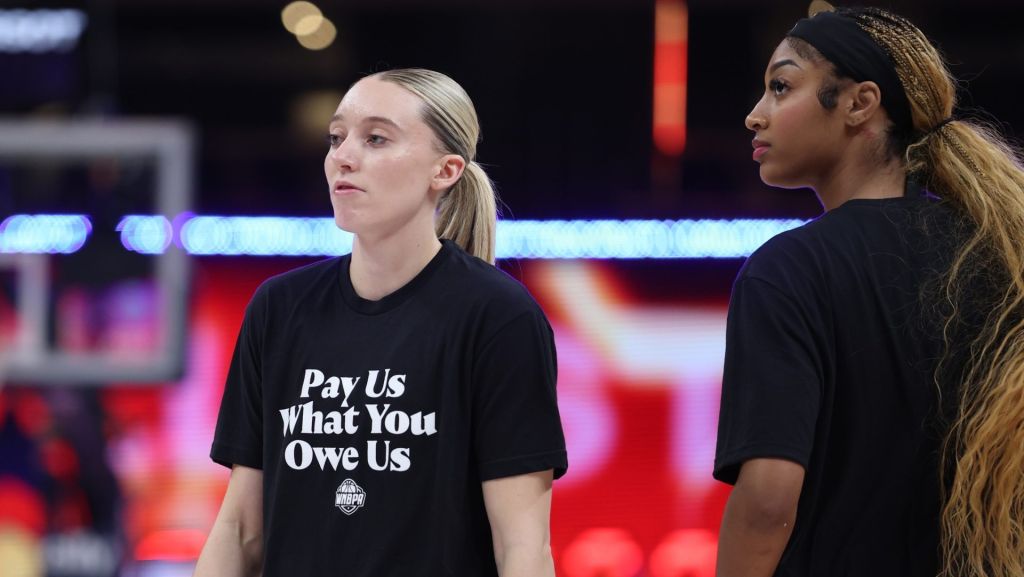
Players characterized an hours-long in-person meeting as being a waste of time. One called the meeting “bullshit” because of the separation between what both sides were discussing in terms of the financial model. Ahead of the actual game, Engelbert stood at a podium where she rejected the players’ interpretation of the league’s first counterproposal as having a fixed revenue sharing model. Yards away from her, the players were taking the court wearing shirts that said “Pay Us What You Owe Us.”
Deadlines Delayed
By August, as teams began gearing up for the playoffs, it became increasingly clear that the October 31 deadline would come and go without a new agreement.
Following the Lynx’s elimination from the playoffs, Collier used her exit interview as a stage to air her grievances out with Engelbert, saying the league had “the worst leadership in the world.” The increasingly personal labor fight largely overshadowed October’s Finals, and the sides ended up extending the deadline to Nov. 30.
Both sides agreed to a second extension hours before the first was set to expire, pushing the deadline into the new year.
Talks Finally Heat Up
After what had been almost a year of relatively little progress, both sides began exchanging proposals at a more regular rate in November. However, the main point of contention has remained the salary model.
After the league proposed a $1 million base max salary with a revenue sharing model that would result in players receiving about 15% of all league and team revenue, the union countered with nearly 30% of total league and team revenue. In addition, details regarding the union’s non-economic proposals began to circulate. Among them were expanded roster sizes, mental health benefits, retirement benefits, parental leave, and the elimination of the core designation. The league’s latest proposal includes a revenue-sharing model that would increase player salary maximums to more than $1.3 million, the average salary would go to $530,000, and the minimum would be $225,000.
The expansion draft has already been delayed by the second extension of negotiations.
The league has never lost games due to a work stoppage. However, if both sides are unable to reach an agreement by Jan. 9, the league’s entire calendar year could be impacted, beginning with free agency.
Download the FOS App
The business of sports, in your pocket.



Scan the QR code to get the app now.