Want more from Front Office Sports
in your search results?
After the Hamas terrorist attack on Israel, every major professional U.S. league — as well as countless teams and athletes — expressed solidarity with the Israeli people, and condemned the terror attacks. As Israel launched counterattacks, some athletes and teams expressed solidarity with Palestinian civilians, too.
But none of the NCAA major conferences released statements or spoke out. Athletic departments did not create graphics; coaches did not discuss the attacks. In aggregate, the college sports industry said little to nothing.
University presidents, meanwhile, have released a flurry of statements amid on-campus demonstrations and antisemitic incidents. The U.S. House of Representatives passed a resolution condemning antisemitism and campus support for Hamas, designated a terrorist group by the State Department.
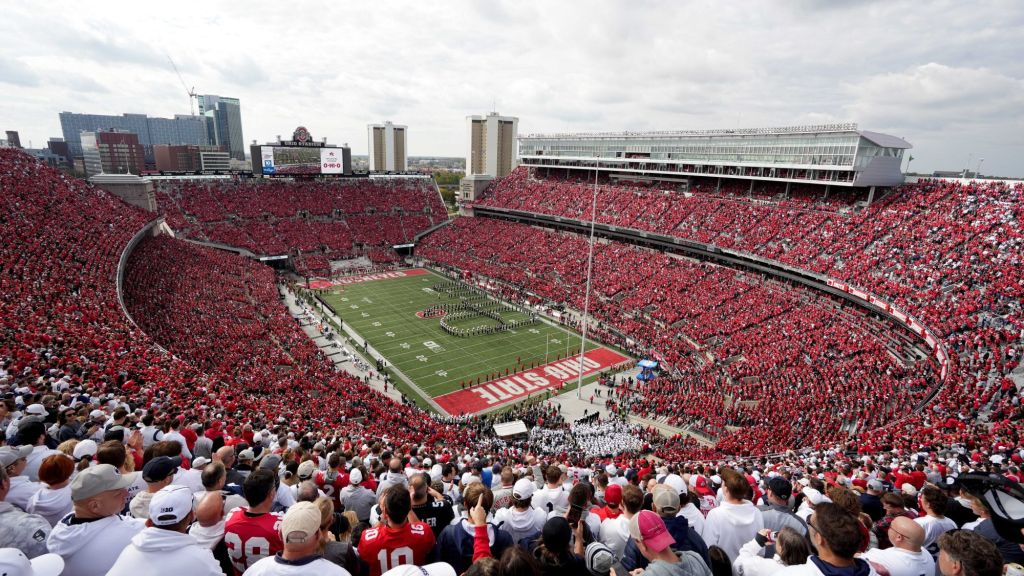
Some schools held moments of silence for Israeli victims at football games, and a handful of coaches, including Auburn men’s basketball coach Bruce Pearl, Arizona men’s basketball coach Tommy Lloyd and football coach Jedd Fisch, made comments through social media. NCAA President Charlie Baker wrote a statement on his personal X (formerly Twitter) account, though not through official NCAA channels.
Front Office Sports reached out to all Power 5 conferences for this story. Only the Big 12’s Brett Yormark, who happens to be the only current Jewish Power 5 commissioner, issued an on-record response: “Israel is a place that has great personal meaning to me. My heart goes out to everyone suffering — I hope for peace across the entire region, and an end to hate-fueled tragedies.”
As for the reason athletic departments — and conferences, which represent them — did not speak out, some experts pointed to the university bureaucratic structure.
Athletic directors are often VPs of a university — so they’ll take the lead of a university president, and in this case, let the university president speak for the school, Arizona State sports historian Victoria Jackson told FOS.
Jackson noted a similar phenomenon with college conferences: University presidents direct the conference to make most major decisions, and likely decided to refrain from using the conferences’ platform.
Athletic departments — and universities as a whole — seem unclear about where to draw the line on what social or political issues to consider.
In the case of the terrorist attack on Israel, “I think people are all too scared…they have just decided to let it go,” one university official said.
Perhaps they saw what happened to pro leagues, which were either accused of taking a side or criticized for not acknowledging the thousands of Palestinian lives lost.
But for many, the attack — which led to the most Jewish deaths in one day since the Holocaust — transcended politics. And in the weeks since the war began, the United States has experienced a 388% increase in antisemitic incidents, according to the Anti-Defamation League.
Several prominent incidents took place on college campuses, like at Michigan State, Cornell, and Cooper Union.
“I do think that institutionally, athletic departments cannot stay silent amid the growing waves of hate on campuses, turn a blind eye to antisemitism or find excuses not to speak out against Hamas terrorism and violence against women,” Yoav Dubinsky, sports business professor at the University of Oregon Lundquist College of Business, told FOS.
The university official noted that a conference or athletic department does not have to take a side in the politics of Israel-Palestine to use their platform to denounce violence and antisemitism. The official expressed concern that the silence “makes it look like Jewish lives don’t matter that much.”
College sports officials handled other recent social and political issues differently.
In the wake of the police murder of George Floyd in 2020, every Power 5 conference, and others, released a statement generally supporting Black Lives Matter. Athletic departments made statements and amplified their athletes and coaches, who marched together in on-campus protests. Some, like the West Coast Conference, implemented new hiring practices aimed at improving diversity.
“Athletes really drove the effort to engage on Black Lives Matter,” Jackson said. Black athletes, while far from the majority of the entire NCAA population, comprise the largest racial demographic of “revenue” sports of Division I men’s basketball and football. (The NCAA does not collect data on the number of athletes who identify as Jewish. Only 2.4% of the entire US population is Jewish.)
Conferences did not make explicit statements after Russia invaded Ukraine in 2022. But the overall conversation amongst the college sports world was prevalent. Stanford women’s basketball coach Tara Vanderveer, for example, used women’s March Madness to launch a fundraiser for Ukrainian humanitarian efforts.
But after Oct. 7, the college sports industry is mostly proceeding with business as usual.
“It is difficult to understand how an industry that has set an example for diversity, equity and inclusion, has so quickly shown nothing but silence to the co-workers and student-athletes within their campus communities that now fear for their own safety,” Jason Belzer, head of Student Athlete NIL, wrote this week.
Download the FOS App
The business of sports, in your pocket.



Scan the QR code to get the app now.