Want more from Front Office Sports
in your search results?
Last week, University of Virginia men’s basketball coach Tony Bennett appeared to be going about business as usual. He participated in ACC media days and spoke about preparing for another season at the helm of the Cavaliers program. But then he took a short vacation with his wife, Laurel, during the university’s fall break this week—and made the decision to immediately retire, he says. Unregulated NIL (name, image, and likeness) payments, the transfer portal, and other issues in college sports had made his job untenable.
It’s an environment caused by the NCAA itself, which refuses to engage in any sort of reform until a court decision forces its hand. The solution to Bennett’s grievances, which he himself referenced, is to engage in collective bargaining. But the NCAA refuses to do so, because that would require athletes to be classified as employees.
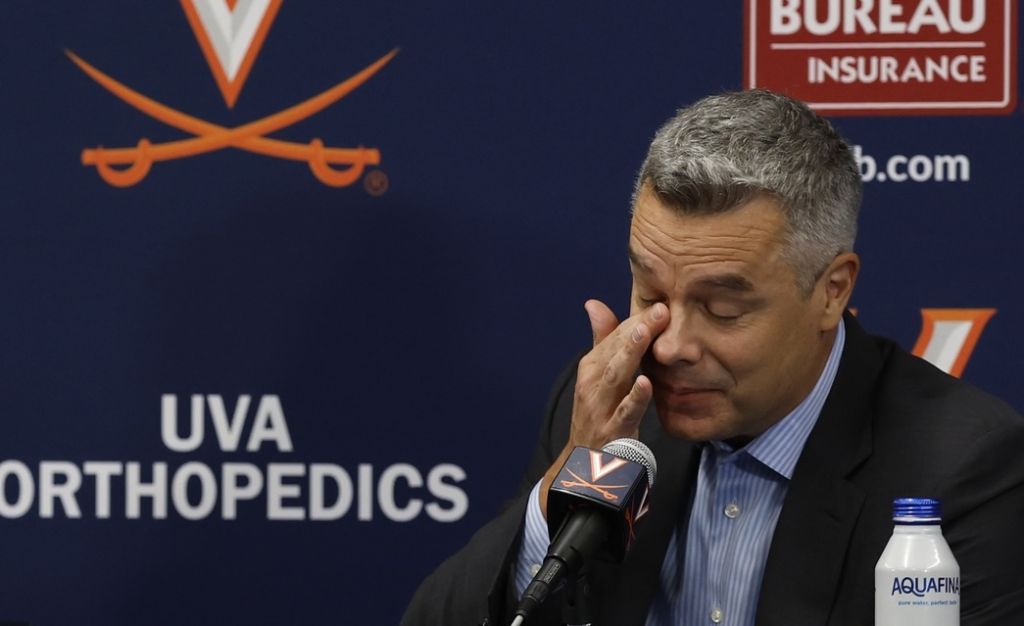
On Thursday afternoon, the Virginia athletic department made the abrupt and shocking announcement of Bennett’s retirement. The following morning, Bennett held a press conference, explaining through tears that the current landscape of college sports has driven him out of coaching.
“I am no longer the best coach to lead this program in this current environment,” he said. “The game, and college athletics, is not in a healthy spot.” Bennett said he believes “there’s still a way in this environment. … But it’s complicated. To admit, honestly, that I’m not equipped to do this is humbling.”
Bennett isn’t the only one who is fed up. He’s the latest big-name coach of several to retire since the beginning of the NIL era: Villanova’s Jay Wright and Duke’s Mike Krzyzewski exited the game after the summer of 2021; Alabama football coach Nick Saban announced his retirement earlier this year; UNC’s Roy Williams did so right before NIL began. But Bennett, at 55, is the youngest of the group—as well as the most candid about the college sports landscape being the reason he cut his career short.
“I think it’s right for players—student-athletes—to receive revenue. Please don’t mistake me,” he said.
But Bennett continued, “There’s gotta be collective bargaining. There has to be a restriction on the salary pool that teams can spend. There has to be transfer regulation restrictions. There has to be some limits on the agent involvement to these young guys. And there are good agents and there are bad agents and they’re driving some of this stuff that we’re in.”
Tony Bennett says it's the right time for college athletes to receive revenue.
— Front Office Sports (@FOS) October 18, 2024
But the Virginia basketball coach says the game and college athletics are not in a healthy spot—and he's retiring just weeks before the season.
"There needs to be change."pic.twitter.com/TULXudeFt2
The transfer portal calendar, which in basketball opens up in the middle of March Madness, doesn’t help, either—and Bennett specifically said he hopes the NCAA changes the calendar.
Bennett referenced a potential way to legally impose restrictions in college sports. Professional leagues, from the NFL to the WNBA, have formal players’ unions that negotiate collective bargaining agreements, and that therefore protect the leagues from antitrust challenges in court. Collective bargaining is the legal mechanism making salary caps, free-agency restrictions, and other league rules possible.
The NCAA is staunchly against formal collective bargaining, however, as that would require athletes to be considered employees. But without it, the NCAA has had trouble arguing in court that any of its compensation-related restrictions are legal.
In 2021, the U.S. Supreme Court found the NCAA was subject to the same antitrust laws as any other entity. Then, the NIL era began without the NCAA being able to legally enforce restrictions, allowing for an influx of NIL collectives and pay-for-play deals and no regulation on NIL “agents.” Two court cases brought by state attorneys general forced the NCAA to allow players to negotiate NIL deals before enrolling in a school, and to transfer as many times as they desired. Pending court cases both in federal court and at the National Labor Relations Board could end with athletes being deemed employees.
The NCAA, meanwhile, is doing everything it can to impose restrictions on athletes without making them employees—maybe an unprecedented situation in sports. “The NCAA believes change in college sports is long overdue and is pursuing significant reforms, such as the expansion of core guaranteed benefits for student-athletes that include health insurance, scholarships, academic counseling, mental health support and career preparation,” the NCAA told Front Office Sports in a statement. “The Association is also advancing a landmark settlement that will allow schools to deliver direct financial benefits to student-athletes. However, there are some issues the NCAA cannot address alone, and the Association looks forward to working with Congress to make needed changes in the best interest of all student-athletes and college sports.”
As referenced in its statement, the NCAA is trying to use the House v. NCAA settlement—which would implement a system of revenue-sharing with players, but also new NIL restrictions—as a pseudo-collective bargaining agreement. It is also lobbying in Congress to codify the settlement’s terms, as well as pass legislation that classifies athletes as amateurs once and for all and gives it protections from future antitrust lawsuits.
While the NCAA races to fix the problems it created, Bennett is considering continuing on with the athletic department in a lesser capacity. As long as it includes lots of vacation time, that is.
“I’ve given everything I can for 15 years,” he said. But the chaotic landscape, worsened by the NCAA’s failure to act, was just too much for him.
Download the FOS App
The business of sports, in your pocket.



Scan the QR code to get the app now.