Dianna Russini Will Seek Credential for Super Bowl Radio Row
Want more from Front Office Sports
in your search results?
Earlier this year, 30-year-old Peter Moran decided to make sports betting his full-time job. On TikTok, where he posts as PickEmPetey, he has an audience of more than 50,000 followers who watch him livestream, recap picks, and share his analysis. Moran also creates content around advice such as bankroll management.
A former investment banker who specialized in risk management, he works from his Manhattan apartment surrounded by four screens. After a morning yoga routine, he’ll spend the day conducting research, reviewing sportsbooks, and narrowing down the plays with the highest value. Now that his TikTok following is flourishing, his audience is willing to buy his advice for picks: $20 a month in the form of props and plays.
Before the Supreme Court overturned the Professional and Amateur Sports Protection Act in 2018, the Buffalo, N.Y.–native did stand-up comedy, and he would slip betting jokes into his routine. “When I started to see that the culture was growing and it became legalized and way more people were familiar with it, I started to make content around that just to support my comedy … and it just naturally shifted to sharing some of my strategies and expertise [for free online],” he says. “People wanted more and more. You realize people are willing to pay for this service.”
Since the pre–social media days, seasoned betting handicappers have made a living selling information to subscribers and dishing out a few free betting picks to entice them. Now, however, the opportunity to become a personality in the sector—and earn as a result—is bigger than ever. As sports betting turns into a lucrative industry that doesn’t feel so different from day trading, creators touting themselves as sports betting experts are cashing in on the public’s new obsession. Many gamblers are looking for easy answers, fast cash, and betting locks, and some will pay a fee to get what they see as valuable insights.
There’s plenty of casual fun to be had—but some experts warn buyer beware.
The U.S. was late to sports betting legalization, but it has seen such rapid growth that it no longer lags in market-development trajectory, says Brett Abarbanel, executive director of the International Gaming Institute at UNLV. This is also the case in sports betting influencer culture.
“Prior to 2018, if you weren’t betting in the select few parts of the U.S., you weren’t getting expert picks from anyone,” says Abarbanel. Now, many people have turned to content creators to fill that gap. Many TikTokers and Instagrammers tout themselves as unparalleled researchers or savvy AI experts who use advanced algorithms to make solid predictions.
Like any influencers, sports betting personalities can grow and monetize their followings in several ways. One of the most lucrative is through affiliate partnerships.
Stephen Master, a professor at NYU who teaches the business of sports betting, points to the Underdog Fantasy program, in which influencers receive an affiliate fee for each new person who signs up for the platform. They also receive an up-front lump sum of around $10,000, plus a few thousand dollars per month as a retainer, depending on the size of their social followings and audience’s loyalty and engagement.
Moran says he knows niche creators who make $60,000 to $80,000 per month from affiliate programs. The bigger the name, the more lucrative the deal; many, adds Moran, make six figures monthly.

There’s a swath of royalty who sit at the top of the ecosystem.
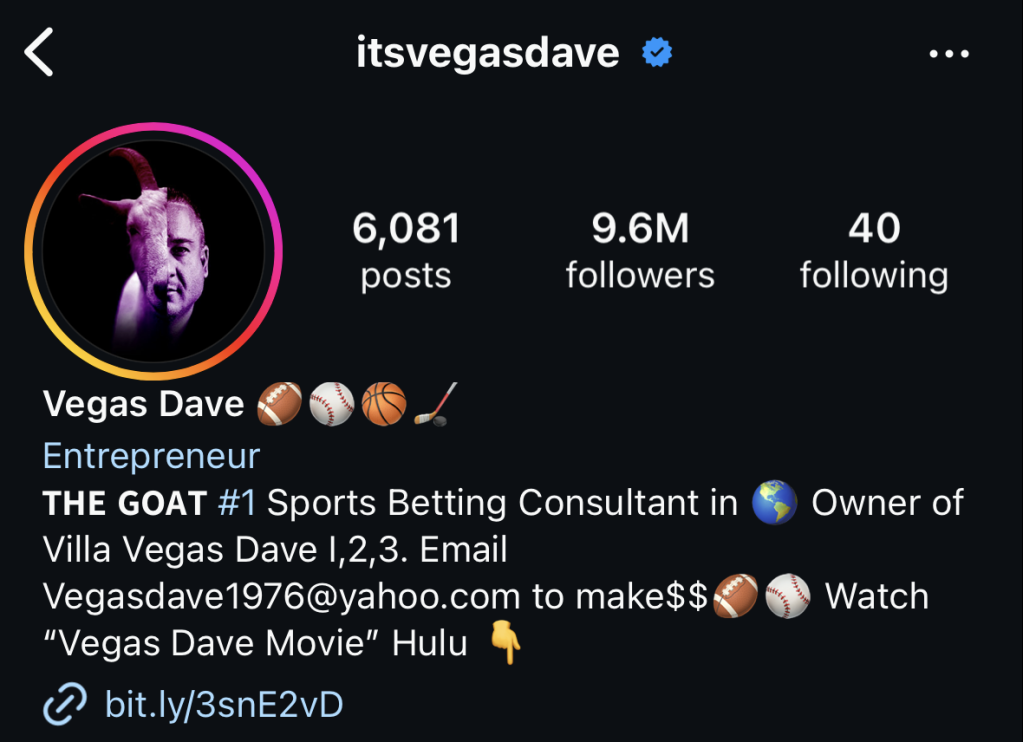
Among them is David Oancea, or Vegas Dave, who has an Instagram following of 9.6 million, and is well known for his high-profile betting wins, including $2.5 million on the Royals to win the 2015 World Series and a $2.3 million payday when the Broncos won Super Bowl 50. Oancea now has a betting consultancy, collaborates with brands on betting platforms, and offers courses on sports betting and ways to capitalize as an entrepreneur. Kelly Stewart, who posts as KellyInVegas, famously turned a $100 NFL bet into $8,000 on a three-team, money-line parlay, and has since become an analyst and host for WagerTalk. Others like Rufus Peabody, cofounder of UnabatedSports, focuses on real-time odds; Bob Stoll uses advanced mathematical models to generate his tips.
For Moran’s part, in addition to affiliate partnerships, he cashes in on revenue streams from sponsorships, managing his own digital communities on platforms such as Discord, and creating content. He didn’t reveal to Front Office Sports how much total money he brings in, but says he has deals with SoBet, OddsJam, and Pikkit, where he packages video content—often an offering of four videos for $2,500. If the content does well and leads to sign-ups, he earns $50 per new customer.
The rise of the sports gambling influencer has exploded alongside ubiquitous, accessible mobile gaming apps and practically inescapable advertising. Master says constant TV presence of the two most popular sportsbooks, DraftKings and FanDuel—plus their high-profile celebrity partnerships that reach millions of social media followers—have made them household names. “It’s like Coke and Pepsi,” he says.
Millions of people wager on their own each day, but the pull of the influencer-as-expert is too much to resist for many casual gamblers looking to get an edge. The parasocial connection of influencers is a big factor as bettors are hunting down tips as fast as possible. “The influencer—the more one-to-one marketing—is only going to grow,” says Master. “It’s really customized to develop and build rapport with your fan base, whoever the influencer is.”

“The presence of sports betting and influencer culture in many ways is capitalizing on influencer culture in general and the ability to reach large audiences, the ability to have sponsorships, to have advertising partners, while also working on something that you think perhaps is interesting or that you think is a major moneymaker,” Abarbanel tells FOS. “With influencer culture, it’s faster. … You make or break yourself as a success story very quickly.”
Some sports betting influencers flash their high-flying, aspirational lifestyles—Rolexes, Porsches, New York penthouses—to their followers. The little-known reality is for many, their purchasing power comes not from gambling success, but rather audience subscriptions, Isaac Rose-Berman tells FOS.
“They are flexing that as a means of showing what they’re capable of from their betting. And with betting you can win,” says Rose-Berman, a professional sports bettor and author of the Substack newsletter “How Gambling Works.” It’s difficult for followers to separate the chaff from the wheat on social media.
Experts who spoke to FOS agree there’s a nefarious side to many of the sports betting personalities who create huge volumes of content. “Even an influencer can get lucky, saying this is a lock, with no research. Plenty of times that will still hit and the audience will think this person is legitimate,” says Rose-Berman.
In 2021, Rob Gorodetsky was sentenced to prison for 28 months for wire fraud, to the tune of $9.6 million. Gorodetsky sat courtside at NBA games and behind home plate at baseball games. He shared photos with Drake and Odell Beckham Jr., and would drop $100,000 on bets. Instead of using investor money for sports wagering, he spent millions on travel and entertainment, and he bought two Lamborghinis—shelling out in excess of $300,000. As Instagram influencer Big Rob, he built the illusion his purchases were from sports betting.
The Guardian also reported in May that some betting accounts weren’t authentic influencers, but rather fake accounts tied to a social media marketing business paid by Paddy Power Betfair.
In 2017, Oancea was indicted on 19 felony charges when authorities said he used fake Social Security numbers to open casino accounts. After a plea deal in 2019, Oancea received a three-year Vegas sportsbook ban.
For this piece, FOS spent several weeks reaching out to more than 15 sports betting influencers to learn more about their crafts, business models, and operations. Besides Moran, none responded to interview requests. Most influencers had automated responses set up on their Instagram messaging: Some prompted users to sign up to Discord communities; others drove people to portals to purchase 10 picks for $100.
UNLV’s Abarbanel argues it’s easy to be fooled by sports betting influencers whose supposed locks are no better than random guesses. To build their cachet, many of these creators share only their victories and inflate their winning percentages. The unreality can be harmful and predatory, she says.
“Markets are very efficient. You can only win if you have information that’s not factored into the market already. And the vast majority of people don’t understand that. And the picks that you see on Instagram and TikTok, the justifications behind them, they’re not saying anything special,” says Rose-Berman. “Sports influencers are people who are trying to make their living off their influencer identity. Maybe they also make money off their bets. But it’s not necessary for their livelihood.”
Moran agrees. “I tell my audience this all the time. If someone is flexing money or lifestyle, or outrageous wins they’re probably a scammer,” he says. “The only thing worth listening to is analysis and long-term verified results. … I tell my followers that this is a hobby that can be dangerous and often expensive, and our goal is to get rid of any risk of it becoming financially disastrous, and find a way to make a little money instead.”
Not all sports betting accounts are nefarious, and, for the most part, says Rose-Berman, most followers are recreational bettors who aren’t looking to get rich off the tips they get from influencers. He says bettors are often looking for a sense of community in a hobby that can be cruel and isolating, where they can discuss their thinking and strategies. He suggests there is some real value in cultivating a network.
“If you can be in a community like a Discord of one hundred people all placing the same bet—even if it’s not a great bet—if you win you get to celebrate together. If you lose you commiserate with the pack,” he says. Influencers can play a role in fostering that critical mass—the concern lies in when the fun tips over into exploitation.
The line is fine when the product is addictive.
And with California and Texas still yet to legalize gambling, the influencer market in its current form may be only the tip of the iceberg. Without regulation or explicit consumer protection, Abarbanel says sports betting content creation is the Wild West. Some people believe a major betting scandal will get eyeballs on regulation that will eventually plateau and even eradicate these personalities; others think regulation will be hard to implement, no matter what.
Plus, even if regulations put a squeeze on the industry, Moran believes influencing could shift bettors into less regulated spaces, where gambling becomes the focus, much like what is happening already with streaming platform Kick.
In lieu of guardrails, says Abarbanel, “we will start seeing a self-regulation presence, maybe from the platforms integrating it in terms and conditions. That kind of policing is tough—it needs attention. It’s obvious, but implementing it could be challenging.”
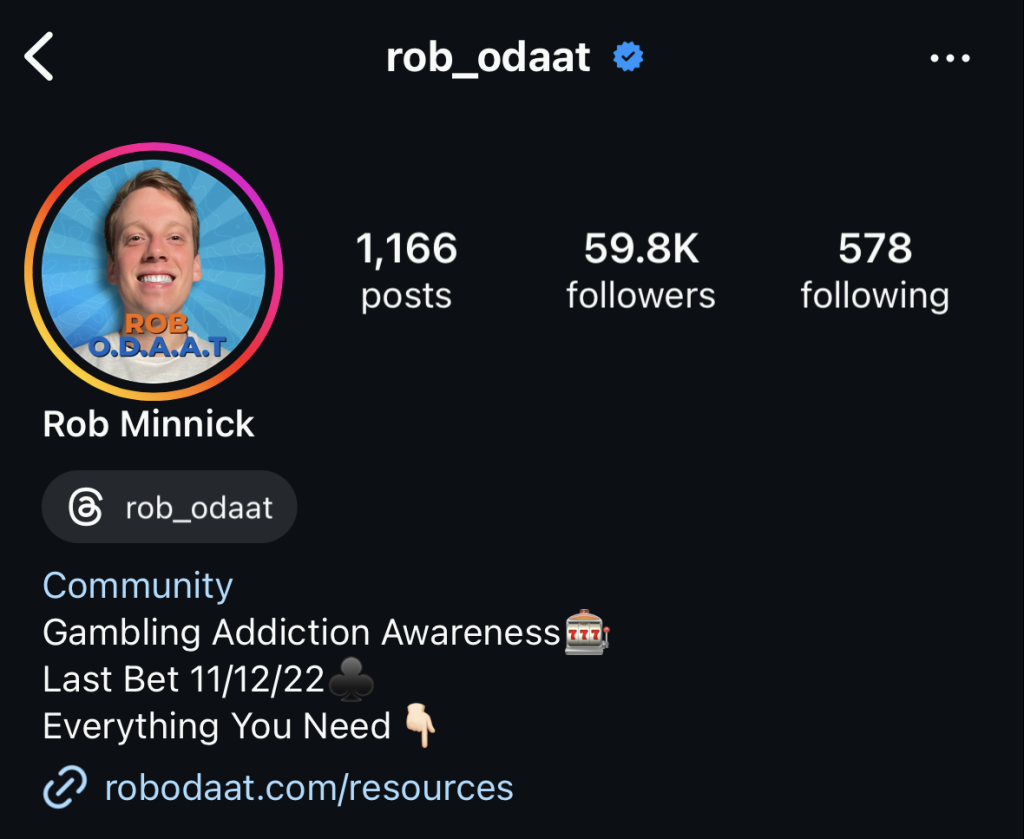
Part of that could come from social media itself. That’s what Rob Minnick, a 25-year-old from Philadelphia, hopes. In 2017, he started with a daily fantasy hobby, making bets with family and friends for fun. He’d bet on Eagles and Sixers games, finding another level of fandom in gambling. After a few early wins, he was hooked. It took Minnick two months before he says he was a full-blown addict. Minnick tells FOS he went to Gamblers Anonymous, and he is now a full-time content creator trying to help people with gambling addiction. As an observer, he sees the sports betting industry as a new get-rich-quick scheme, and he argues young men view sports betting not as gambling, but rather as investing in a skill they can improve on.
“Someone has to win and someone has to lose. When it comes to selling picks it’s not, ‘How can I get my clients the best result?’ It’s, ‘How can I maintain this client for a monthly revenue?’” Minnick says. “And it’s misleading them to think I’m doing a good job even if I’m not.”
For now, Rose-Berman hopes more people see through what these creators put out. But he’s skeptical. “There’s a lot of willful ignorance. People want to make money fast, whether it’s crypto or sports betting,” he says. “They want to hear what bet they can place which is going to for sure hit ten times their money. I don’t know what can be done to change that.”
Download the FOS App
The business of sports, in your pocket.



Scan the QR code to get the app now.