White Sox Co-Owner Mat Ishbia Endorses MLB Salary Cap—and Floor
Want more from Front Office Sports
in your search results?
The WNBA is currently in the midst of selling a new set of national media-rights deals, doing so in concert with the NBA to help forge a potential year-round basketball presence on partner networks. Even before that effort is done, national rights are a focal point of Caitlin Clark’s debut season with the Indiana Fever, in which 36 of the team’s 40 regular-season games will be shown coast-to-coast.
But, last month, perhaps the most interesting and forward-looking part of the WNBA’s current media situation took place at the local level. Over-the-air TV broadcaster Tegna and Fever parent company Pacers Sports & Entertainment struck an agreement to show 17 of the team’s games on broadcast stations in Indianapolis.
Tegna and the team then quickly expanded the pact to increase that coverage to 11 other markets stretching from Davenport and Des Moines, Iowa—the state where Clark starred collegiately—to Cincinnati and Dayton, Ohio. The increased broadcast footprint pulled in five other TV station owners, which turned companies that are rivals in multiple other areas into partners in the fast-growing economy of Clark.
In the course of one rather unusual deal, Tegna and the Fever tapped not only into the unprecedented fan frenzy surrounding the professional debut of Clark but also the rapidly increasing cord-cutting that has prompted teams such as the NBA’s Suns and Jazz, the NHL’s Kraken and Golden Knights, and the WNBA’s Mercury to broadcast all of their local games on free television.
“This movement is opportunistic on so many levels,” Brad Ramsey, Tegna senior vice president of media operations, tells Front Office Sports. “It’s just a perfect storm in the most positive way. … As soon as we announced the partnership in Indianapolis, we started to hear from fans in other markets, including Iowa, Louisville, and all sorts of other places. Other broadcasters started to reach out as well to say they’d love to be a part of this.”
The Tegna-Fever deal also highlights a previously undervalued element of a WNBA that is now set for major expansion: full-fledged local team affinity, built significantly through local broadcasts. Historically, local team broadcast coverage has not been a prominent fixture of the league’s overall media presence, particularly compared to what the league receives through a series of national partners such ESPN, CBS, Ion, Amazon, NBA TV, or on social media.
Each of the league’s 12 current teams already has some level of local coverage to supplement the national deals, whether those deals are based on over-the-air distribution, on a cable-focused regional sports network, or via streaming. In recent years, though, that mixed collection of distribution structures and number of available games have not been as much of a featured component for the WNBA. And for the league, local broadcast coverage also hasn’t had nearly the type of economic stakes that the ongoing bankruptcy of Bally Sports parent Diamond Sports Group does for MLB, the NHL, and the NBA.
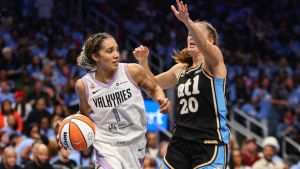
In a 2023 season filled with significant growth across a series of national media, social, and attendance-based fronts, the WNBA did not highlight its local broadcast performance. But there are growing signs of change in this area. In addition to the groundbreaking Tegna-Fever agreement, other new local pacts for the ’24 WNBA season include one between the ’23 league runner-up New York Liberty and WNYW-TV, and another between the Atlanta Dream and Gray Television. In the case of the Liberty, the new deal moves the local games away from the YES Network, where it sometimes ran into scheduling conflicts with that outlet’s flagship team, MLB’s Yankees.
“Expanding our local reach and ensuring we are widely accessible wherever fans watch Liberty games is imperative in today’s ever-expanding media landscape,” said Keia Clarke, Liberty chief executive.
The WNBA preseason, however, has already dramatically shown that individual teams making games more “widely accessible” still hasn’t been enough to satiate the surging fan demand. Earlier this month, after a Chicago Sky–Minnesota Lynx preseason contest was mistakenly labeled as available through the League Pass service, a fan livestreamed the game from her phone, drawing more than two million total views for the unauthorized distribution.
Days later, the Connecticut Sun tried to offer a live, raw feed of a preseason game against the Liberty on their YouTube channel, but it was quickly shut down due to copyright issues with the video. It was flagged by the NBA’s own artificial intelligence program, Videocites, that identifies league content on the internet.
Still, these various last-minute efforts to show preseason games online are a sign of an inflection point for the WNBA’s rise in popularity, where fans expect to have virtually every game—at any point of the season—available, just as they are for men’s major pro leagues.
“The growth is happening so fast, it’s so accelerated,” said Lynx coach Cheryl Reeve. “Business as usual isn’t going to work anymore; you’re going to get left behind.”
That desire to deviate from the norm was also at the core of the Tegna-Fever deal. In addition to bringing in five other station owners—Coastal Television Broadcasting, Gray Television, Nexstar Media Group, Sinclair, and Weigel Broadcasting—the agreement involved a mix of locales within the Fever’s existing broadcast territory, some shared with the Sky, and some outside of any team’s core market. Financial terms were not disclosed, but those stations will gain local advertising inventory central to many sports rights deals, and the local coverage of Clark and the Fever will now span five states.
“While it’s somewhat easy for the fan, at the end of the line, to watch these games, and is designed to be, this is a complicated, technical puzzle,” Ramsey said. “You’ve got a different infrastructure in each of those individual companies and individual markets.”
Other WNBA teams, of course, do not have Clark. But Ramsey said he still sees the Fever deal as a template for other franchises in the league. In addition to the rising popularity of the WNBA itself, the ongoing struggles with RSNs and the overall cable television business are fueling the accelerating movement back toward over-the-air broadcasters.
“I absolutely could see this” with other WNBA teams, he said. “If we can put more games on our air, make our audience happy, and help these teams reach more fans, it’s win-win-win.”
Download the FOS App
The business of sports, in your pocket.



Scan the QR code to get the app now.