Want more from Front Office Sports
in your search results?
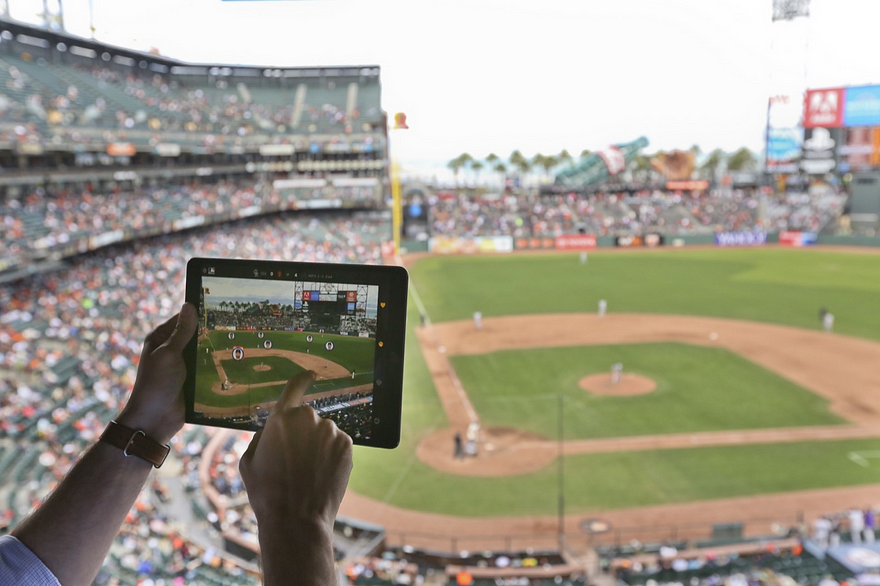
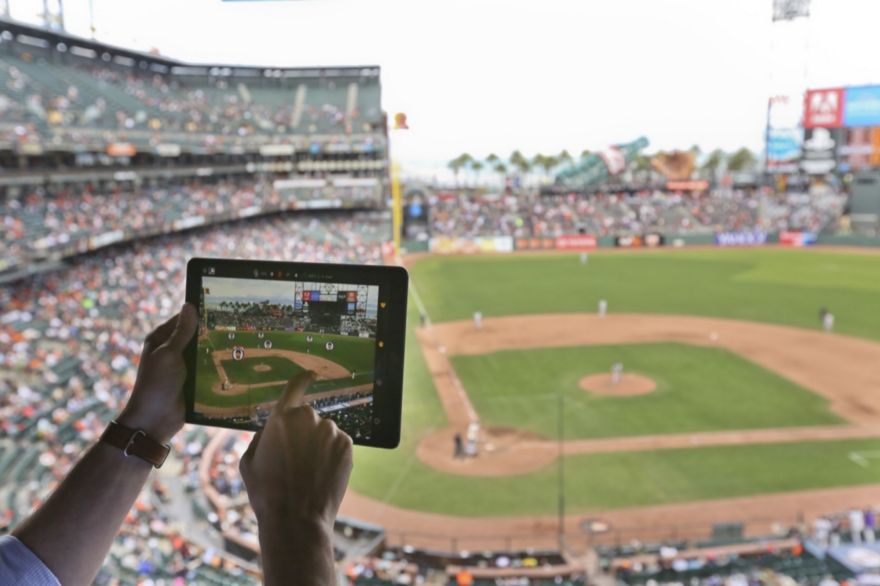
MLB At Bat has AR built in, but will it be a hit? (Photo via USA Today)
Augmented reality (AR) and virtual reality (VR) have both been on the radar for sports fans and industry professionals for several years. From apps that complement live fan experiences, to VR applications which substitute for events, a wide range of products have been proposed and/or developed.
Though for consumers, a clear use case for mixed reality is yet unclear, sports is the one place where fans could feasibly use the technology today. That said, mixed reality is still in its early stages — and as such, the variance in expected outcomes is large. It could either fade in our collective conscience, or become the industry-shifter many are predicting.
AR Applications
Virtual reality can clearly be used as a substitute for TV — which, if broadcast numbers decline at any point, could become the medium of choice for leagues. While this is unlikely to happy anytime soon, given fans’ inelasticity of demand, it is foreseeable that, as the marginal benefit of the cable bundle continues to decline as the internet continues to progress, the set of sports fans who are willing to pay for a cable bundle will be limited to only those in the upper echelon of fandom.
For that reason, leagues must prepare for a future in which traditional broadcast rights are not a core revenue stream. Maintaining the status quo could lead to precipitous and unsalvageable losses.
Augmented reality is much different, in that it is mostly an additive product. A full dispersion of AR likely won’t drastically affect the way the industry will operate, much in the way that a change in the broadcasting model may.
The MLB, NBA, and NFL have all released smartphone apps exploiting some form of AR, but thus far, only the MLB seems to have made a concerted effort to make this a part of their business. Indeed, MLB At Bat’s new features were one of the AR apps teased during Apple’s most recent keynote.
Third-party developers are trying their hand as well. Virtex Apps is one such example — through AR competitions at sporting events and concerts, Virtex’s goal is to fill the “empty spaces” during the game.
“Right now during these breaks, the team or league will have entertainment that they’ve arranged… Even though there is something simple, fans will get really into it. The idea of this is taking it to the next level… you’re participating with everyone in the arena.” — Jeff Green, Founder of Virtex Apps
Apps like this may provide fans with an experience that comes close to actually attending games — meaning that if they reach widespread usage, teams could leverage the app as additional real estate to sell sponsorships.
What AR Apps Need to do to Succeed
Apps like Virtex compete against apps such as Facebook and Twitter — whose value is predicated on filling the empty spaces of life. And, as the defaults, they will have an inherent advantage — especially if they decide to enter the AR space.
In addition, for third-party apps which rely on AR as their core competency, they will need to answer two questions:
- What can be done when fans don’t come to games? There will be less of a compelling reason to use, let alone download, the app. An overwhelming majority of fans only attend a few games a year. How can they convince them to continue using the app when they are watching from home?
- In addition to this, how would an app solve the issue of upfront costs? That is: even if an app is free, usage will rely on fans’ willingness to download it onto their phones – creating friction before they even take part.
In other words, the success and adoption of an AR app will be predicated on a perceived marginal benefit of using the app that exceeds the marginal costs of using it.
For this reason, I fear that, in today’s tech landscape, the outcome in AR could simply be one where the defaults succeed (a good reason to be bullish on At Bat). It will certainly be difficult to develop a successful AR-only app – that is, the benefit to fans will likely be too limited for it to succeed (this is a question of volume, rather than value per usage).
Rather, an orthogonal business model, where sports is complementary to a business, rather than its driving ambition, might be the best way to structure an AR startup. Social AR apps may find this particularly difficult to overcome. If a business relies on network effects to succeed, and reaching critical mass is exceedingly difficult due to its capped market, it is also unlikely to ever reach that point.
That said – for Virtex Apps, whose expectation is high churn rates, succeeding with the best fans: that is, those who are most willing to pay, and will therefore willing to attend the most games, is paramount. If they are able to reach casual fans, as well hardcore fans, they have an opportunity to succeed. If first mover advantages hold, they have the chance to become the default before any competitors can obtain a foothold.
Download the FOS App
The business of sports, in your pocket.



Scan the QR code to get the app now.