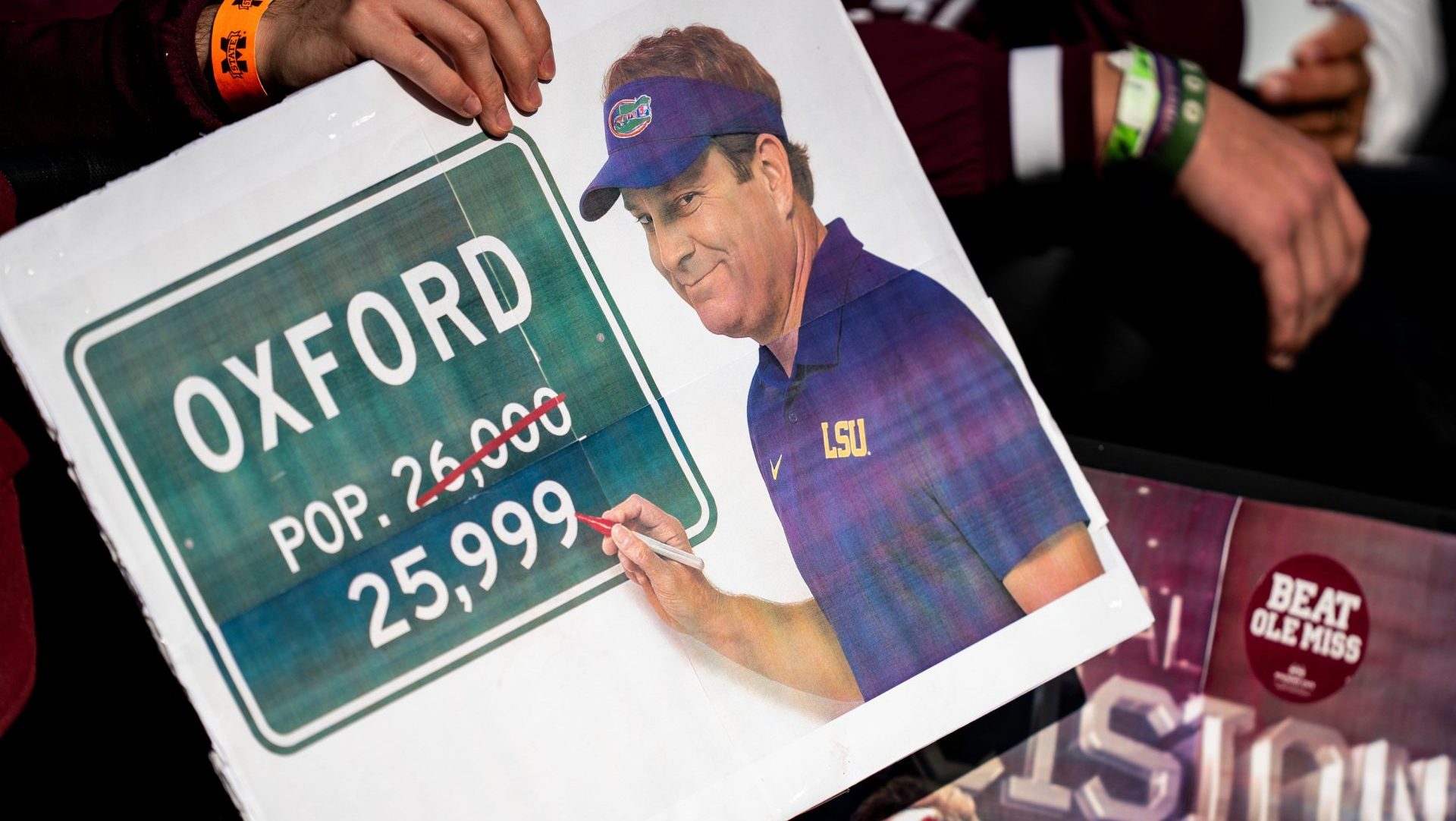
After Brian Kelly was fired from LSU, Louisiana Gov. Jeff Landry vowed that the next coach would have a “patently different contract.”
Lane Kiffin’s contract with LSU is patently different than Kelly’s—but seemingly not in the way Landry originally wanted. Kiffin’s buyout appears to be even larger. And unlike Kelly’s, it’s guaranteed.
Kiffin, who boarded a plane to Baton Rouge after a messy exit from Ole Miss on Sunday, has signed a seven-year, $91 million contract with LSU, according to The Advocate. Only Georgia’s Kirby Smart is known to make more with his 10-year, $130 million contract.
If LSU fires Kiffin without cause—the vast majority of firings, even for poor performance, are without cause—the school would owe Kiffin 80% of his remaining salary. The contract also does not include an offset or “duty to mitigate” clause. That means that Kiffin would not be obligated to find another job, nor would his salary from his new job offset whatever LSU would owe him.
In other words, the school has agreed to pay Kiffin 80% of his contract no matter what. If Kiffin were fired tomorrow, the school would owe him $72 million,with no recourse. If they were to fire him after next season with $78 million left on his contract, he would be owed $62 million. And so on.
LSU has also reportedly agreed to pay Kiffin’s buyout for leaving Ole Miss, which is $3 million.
Kiffin claimed during his introductory press conference that the terms of his gargantuan deal were unknown to him. “I’m telling you right now, I don’t know what my contract is here.”
Kiffin told his agent, CAA’s Jimmy Sexton, to withhold the specific numbers on his contract from him, though Kiffin says was told LSU’s offer was similar to that of at all four schools Kiffin considered. But Kiffin said he did ask Sexton for the numbers on the NIL packages at all four schools. They “were not similar.”
Sexton did not respond to a request for comment sent before the press conference.
The offset and mitigation clauses are common (Brian Kelly had one at LSU) but not universal (Mark Stoops didn’t have one at Kentucky) and can save schools tens of millions of dollars. James Franklin had an almost $50 million buyout at Penn State. But because he had an offset clause, he agreed to take a $9 million lump-sum buyout before taking a new job at Virginia Tech. Texas A&M famously did not have an offset clause for Jimbo Fisher who is owed $75 million from the school while he works as an ACC Network analyst.
After Kelly was fired in October, Gov. Landry went on a press tour criticizing Kelly’s buyout and vowing to ensure that the next contract would be different. (Landry said that the football contracts were coming out of the state budget; they are funded by private donors and athletic department revenues if needed.) Athletic director Scott Woodward departed in the fallout from Landry’s comments.
“I think that everyone is in agreement… The next coach that we hire is going to have a patently different contract,” Landry told Pat McAfee shortly after Kelly was fired.
During another interview, he floated the idea of assigning more of the contract toward performance-based compensation, rather than guaranteed money. Kiffin does have a major incentive in his new contract: a bonus if he wins the national championship that would make him the highest-paid college football coach in history. LSU has also agreed to pay this season’s postseason bonuses in Kiffin’s Mississippi contract.
During Kiffin’s introductory press conference Monday, he said he spoke on the phone with Landry during the hiring process. He described the conversation as “unique” and that Landry exuded “passion and energy.” He added that Landry appeared aligned with the rest of LSU leadership.
Then, on Monday evening, Landry posted on X appearing to give Kiffin—and the LSU administrators who brought him in—his blessing: “I would like to congratulate the great team we have assembled to lead LSU into the future,” Landry wrote. “They have done an outstanding job at recruiting a new head coach!”
Landry’s office did not respond to a request for comment.
Kiffin has been fired several times before. Raiders owner Al Davis called him a “professional liar” when he fired Kiffin in 2008; USC notoriously fired him at an airport after his team hit rock bottom in 2013; Nick Saban fired him as offensive coordinator at Alabama before the national championship game in January 2017.
Meanwhile, LSU has agreed to pay the full $54 million after Kelly filed a lawsuit against the school. LSU will owe Kelly less if he finds another job.
The athletic department is also still paying off the multimillion-dollar buyout for Kelly’s predecessor, Ed Orgeron.