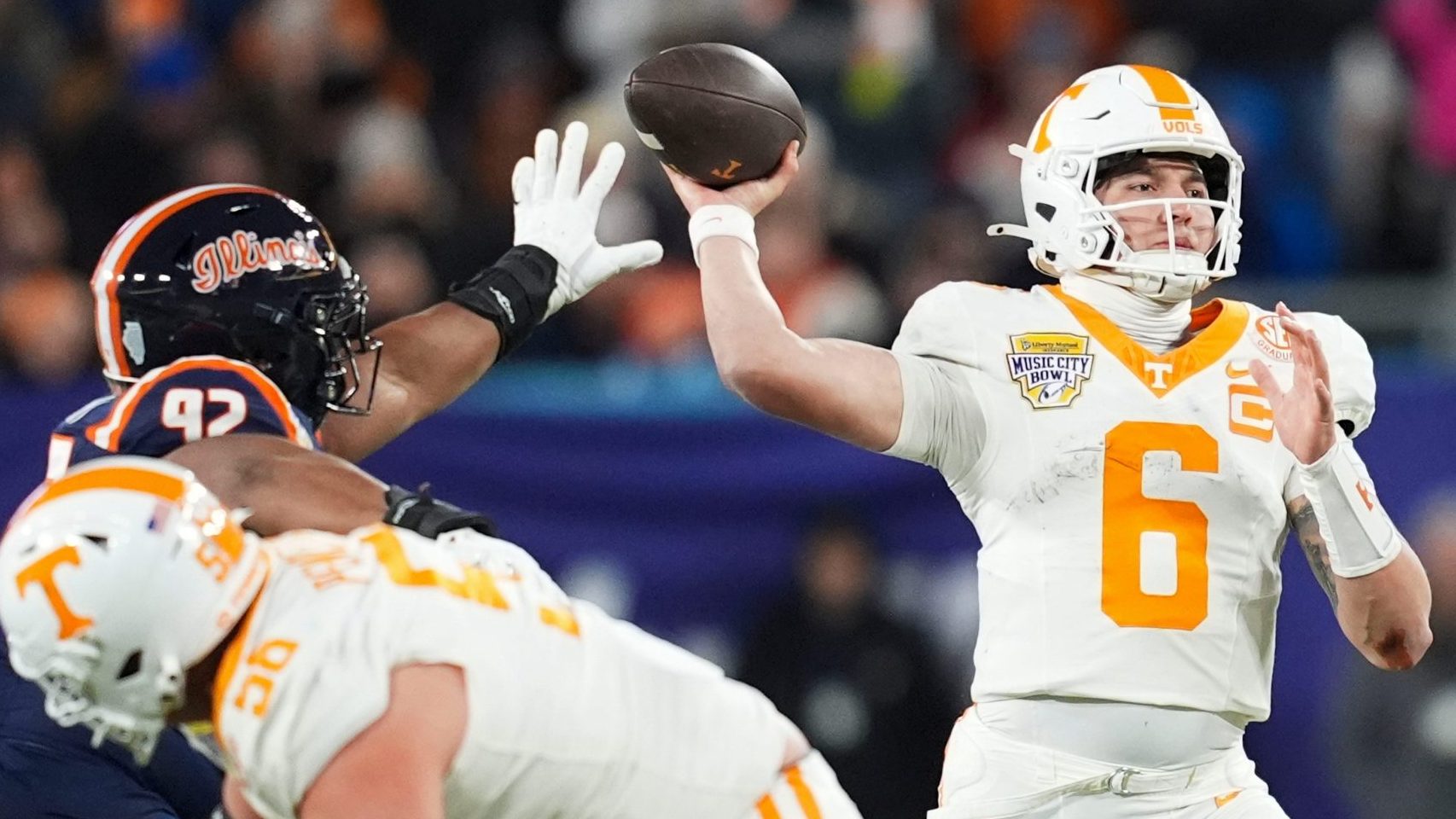
Tennessee quarterback Joey Aguilar will not have the opportunity to suit up for the Vols next year.
On Friday, Knox County Chancery Court judge Chris Heagerty denied Aguilar’s request for a preliminary injunction as part of his lawsuit against the NCAA challenging the legality of its junior college eligibility rule under Tennessee state antitrust law.
The ruling has major implications for the NCAA’s overall eligibility battle, which counts more than 55 lawsuits. But now that the NCAA has been successful at the state level, the case could deter players from pursuing the legal strategy of filing an antitrust case in state court.
“The NCAA is thankful for the judge’s decision today which demonstrates the court’s consideration of eligibility standards and protecting access to the collegiate experience for current and future student-athletes,” the NCAA said in a statement Friday, adding its usual request for Congress to pass a law like the SCORE Act that it says would protect the NCAA from lawsuits over its rules.
Aguilar first enrolled at San Francisco City College in 2019, where he redshirted. The following year, his season was canceled due to the pandemic. Aguilar played the 2021 and 2022 seasons at Diablo Valley Community College, and then transferred to Appalachian State University, where he played two seasons.
He won eligibility to play a fifth year of college football in 2025 after Vanderbilt quarterback Diego Pavia won a preliminary injunction in his federal antitrust suit, and the NCAA granted all players a one-year waiver.
For the 2025 season, Aguilar first transferred to UCLA, but was forced to re-enter the portal after then-Tennessee quarterback Nico Iamaleava abruptly left the Vols for UCLA. Aguilar completed the first quarterback “swap” in college football when he then transferred to Tennessee.
Because the NCAA only gave a one-year waiver, Aguilar is technically out of eligibility. To get another year, he, along with several other players, joined Pavia’s ongoing lawsuit in November (which is also awaiting a preliminary injunction). But in February, he removed himself as a plaintiff and filed his own antitrust lawsuit in state court, arguing he’d lose between $2 million and $4 million in NIL (name, image, and likeness) earnings if he doesn’t get to play this year.
The hearing for a preliminary injunction took place on Feb. 13. During the two-hour hearing, Judge Heagerty asked Aguilar’s lawyer how he could prove he’d actually lose between $2 and $4 million; he also asked how many players within Tennessee’s jurisdiction were being harmed by this rule. At the end of the hearing, Heagerty said he could not rule from the bench, suggesting he needed time to review evidence and testimony.
Broader Implications
The NCAA’s eligibility fight began with Pavia’s 2024 lawsuit filed in federal court. It challenged NCAA rules based on federal antitrust laws—and many lawsuits have used that same strategy. The NCAA was mostly, however, winning at the federal court level.
But players have seen more success at the state court level. For example, Trinidad Chambliss argued the NCAA had committed a breach of contract with its eligibility rulings on a case-by-case basis, rather than challenging the legality of those rules in general. Though the strategy wasn’t foolproof—the NCAA prevailed in the case of now-former Alabama men’s basketball player Charles Bediako.
Aguilar’s case, however, is part of a different group of lawsuits filed in state court. His complaint argued that the NCAA’s rules stating years played during junior college count toward NCAA eligibility violated Tennessee’s state antitrust statute.
That strategy did not succeed, however—now, the NCAA will have another lawsuit to cite in future state court cases.
Meanwhile, Tennessee will have to choose a new starting quarterback.