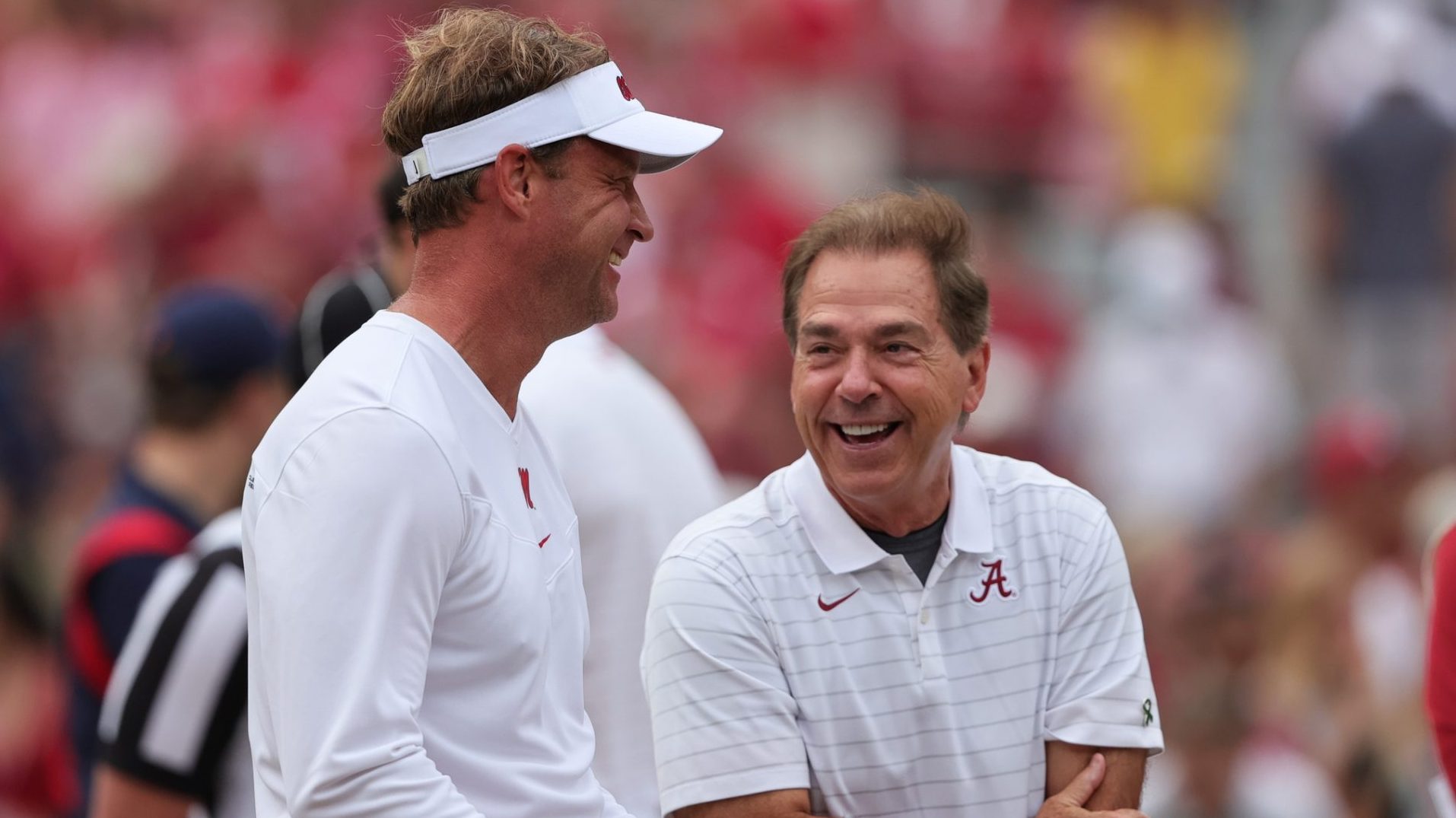
The controversy surrounding Lane Kiffin’s abrupt exit from Ole Miss to take the head coaching job at LSU has embroiled someone not employed by either university: Nick Saban.
During his introductory press conference Monday, newly minted LSU coach Kiffin confirmed former Alabama coach and current ESPN analyst Saban counseled him to take the job in Baton Rouge. The news prompted many to wonder whether Saban’s involvement might be a conflict of interest, given that he also argued on ESPN’s College GameDay on Saturday that Ole Miss should allow Kiffin to keep coaching the team through the season even if he leaves for LSU.
It was clear at that moment Saban was deeply tied up in the situation: In private, he advised Kiffin to leave Ole Miss; in public, he voiced his support of a special exception Kiffin was pushing for and did not get.
Saban, as an analyst, is considered more of a retired coach on air than a journalist. But he’s being paid to comment on football matters and coaching moves—while apparently doling out career advice to those same subjects.
ESPN declined to comment on any potential conflict when reached by Front Office Sports on Monday night.
When news first surfaced suggesting Kiffin was in talks for the LSU position, it was expected that Saban would counsel Kiffin in one way or another. Saban is not only one of Kiffin’s known mentors, but he is also a client of renowned CAA agent Jimmy Sexton while at Alabama—the same agent who negotiated Kiffin’s move to LSU. (Saban was even rumored to have been offered the job before Kiffin.)
On College GameDay on Saturday, Saban defended Kiffin’s potential choice to leave Ole Miss just before the team’s College Football Playoff run—and went so far as to suggest the Rebels should allow Kiffin to coach through the Playoff even if he signs a contract with their biggest rivals in the SEC.
“This is not a Lane Kiffin conundrum,” Saban said. “This is a college football conundrum.” He added: “None of this is fair to the players.” Saban also said he believed Kiffin should be allowed to coach at Ole Miss.
Saban also appeared to convey Kiffin’s current line of thinking on the LSU job offer: “I think one of Kiffin’s apprehensions is that he’s had to use the portal to build his team at Ole Miss each year. And at LSU he probably could recruit better talent and then just supplement his team by need with the portal.”
Criticism mounted even before Kiffin confirmed Saban’s counsel. ESPN announcers, as well as fellow analyst Kirk Herbstreit, were also criticized for their defense of Kiffin. “You’ve never done what you’re doing right now,” Herbstreit said. “Let Lane Kiffin—if he leaves—and these players finish the run this year.” He was criticized for these comments by multiple national college football reporters.
Finally, in Baton Rouge on Monday, Kiffin all but confirmed that Saban told him to leave Ole Miss for LSU. “Coach Saban kinda coached at another place in this conference, so I can’t … really say exactly what he said,” Kiffin said, pausing for laughter in the room. “I’ll say I think the world of Coach Saban, and I respect him, and so there’s a reason why I’m here.” His comments were followed by a round of applause.
On Tuesday, LSU posted a quote from Saban praising the hire. “I have no doubt he’ll be a great fit at LSU, and I’m confident he’ll continue to elevate the tradition and meet the expectations of the program at a high level.”
Saban is hardly the first coach or player turned sports media analyst to get caught between their current TV role and their connections inside the sport itself. Fox Sports analyst Tom Brady has been criticized for the apparent conflict in covering NFL games—which involves press access to teams, players, and coaches—while also being a part-owner of the Raiders.
Saban is completely out of the coaching game. But the question persists: At what point does a network that employs a former coach or player consider that person’s continued direct involvement in the sport they cover a conflict of interest?