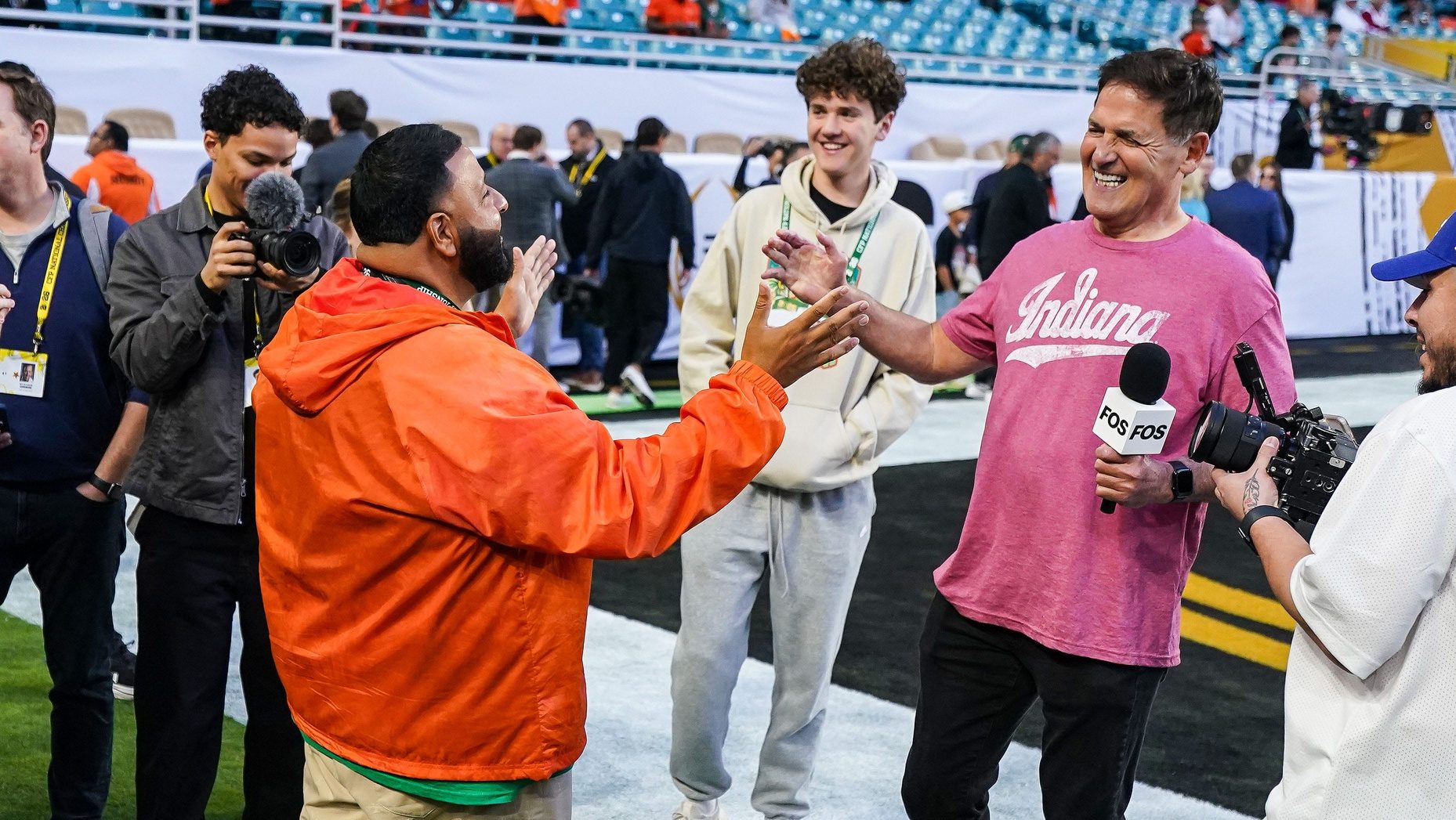
MIAMI — Mark Cuban embraced an Indiana football player on the field during the national championship postgame celebration. “Thanks for the support,” the player said while Cuban beamed.
On the field after the Hoosiers won their first-ever national championship, completing a historic 16–0 season, Cuban was one of the most popular people. Fans and fellow alums wanted pictures with him. Reporters swarmed him. Players hugged him. Cuban embraced quarterback Fernando Mendoza as if the star quarterback were one of his sons.
Cuban would be popular in most scenarios: He’s a billionaire, a television personality, and minority owner of the Dallas Mavericks. But now—when players can finally, legally, get paid—he’s more than just a famous alum or someone who helped pay for an athletics facility. He’s helping fund player compensation directly.
Cuban declined to say how much he gave to this history-making roster, and made it clear during a pregame conversation with Front Office Sports that it wasn’t all about the money. But one thing is clear: Whether it’s to galvanize a fan base, offer business advice, or provide cold hard cash, in the revenue-sharing and NIL era of college sports, everybody needs a billionaire.
Cuban, a 1981 graduate of Indiana, had little involvement in the athletic department up until recently. In 2023, the Hoosiers went 3–9, one of the worst teams in college football. The name, image, and likeness era was underway. But while that new dynamic gave plenty of lackluster teams new life to compete, it seemed like no amount of money would save the Hoosiers.
But in November 2023, Indiana hired head coach Curt Cignetti, who turned the program around almost overnight. They won 11 games last year and made their first appearance in the College Football Playoff. It was Cignetti who inspired Cuban to contribute to the Hoosiers’ war chest. They bonded not just over football but also over the fact that they were born in the same Pittsburgh-area hospital. During an ESPN interview on Monday morning, Cuban described Cignetti’s pitch to him as akin to a business plan he received on his show Shark Tank.
“We kind of hit it off right off the bat,” Cignetti told reporters of his relationship with Cuban. He joked: “If Mark Cuban wanted to give $10 million, that would be like me donating $10,000.”
It also helps, of course, that Indiana’s billionaire happens to have experience building a professional sports franchise. Cuban spoke at length about his relationship with AD Scott Dolson, and conversations they had over the years about his time building an organization with the Mavericks. Dolson described Cuban’s influence as “phenomenal.”
“Every team … has to have an identity. You have to understand how you want people to fit in,” Cuban told FOS. “You have to understand how you use economics, and I think what’s really set IU apart is—we’re not like, ‘O.K., let’s raise as much money as we can to pay everybody more.’ It’s more about, how do we structure, how do we build a culture, how do we set roles so that when guys come in they’re happy and they know exactly what they’re going to do.”
The team Cignetti put together doesn’t appear to be an NIL juggernaut. Many teams spent well over $20 million this year—in combined NIL and revenue-sharing dollars. Yes, there was Heisman Trophy winner and transfer Fernando Mendoza, who likely cost the program a decent amount of money amid a bidding war in the transfer portal. But the roster famously doesn’t have any five-stars, a testament to Cignetti’s ability to recruit players who will succeed on the field, rather than those in the headlines or on top of recruiting rankings.
“Our NIL is nowhere near what people think it is, so you can throw that out,” Cignetti said during his championship press conference.
But Cignetti has also said that success breeds more success. And he already has more money to work. Cuban previously told FOS he increased his donation to the Hoosiers—and with that money, they’ve already begun to assemble another top-notch roster.
“It’s not necessarily what I’ve given, it’s what the whole, all alumni have given—that’s what matters,” Cuban said on the field during the pregame. “It’s more important how we spend that money—and with who.”