Want more from Front Office Sports
in your search results?
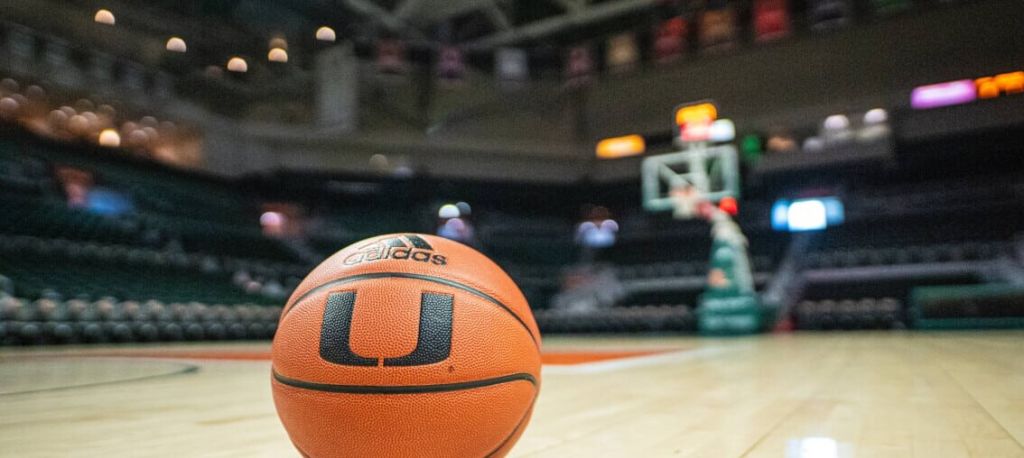
In April 2022, women’s basketball players Haley and Hanna Cavinder decided to transfer from Fresno State to Miami. The social media stars — and two of the top name, image, and likeness earners — told Front Office Sports that NIL was not a factor in their decision.
“I know that a lot of people can assume it could be about NIL,” Hanna Cavinder said at the time. Instead, it’s about winning — finding a place where the two could “have the best opportunity to get to the March Madness tournament.”

But almost a year later, the Cavinder twins’ transfer is the subject of the NCAA’s first NIL infraction.
Miami women’s basketball coach Katie Meier was punished for “facilitating” a meeting between a booster and prospective athletes, the NCAA said — confirmed by Sports Illustrated to be Miami businessman John Ruiz and the Cavinder twins. Ruiz also met them earlier than he should have, and provided a “recruiting inducement”: a free dinner.
The punishments were little more than a slap on the wrist. Meier was suspended for three games, and the team — currently on the March Madness bubble — incurred a one-year probation and a fine. The Cavinder twins were not punished, and Ruiz was not asked to “disassociate” from the program.
In a statement provided to Front Office Sports, Meier called the violation an “inadvertent mistake.” While Miami acknowledged responsibility in a separate statement, it added: “The University encourages the membership to review NCAA bylaws that have been on the books for decades and may no longer be applicable or realistic in today’s environment.”
The NCAA warned that the punishment isn’t a precedent for future violations. But the case itself gives clues to the NCAA’s overall NIL adjudication strategy: It wants to go after high-profile deals, punish even the smallest infractions, and use a plea bargain-esque tactic to avoid lawsuits.
The Perils of Promotion
It might seem surprising that the NCAA’s first infraction was handed down in women’s basketball, rather than football.
But the choice likely wasn’t about the sport — it was about fame.
The Cavinder twins are two of the most famous faces of the NIL era, with projected earnings at or above $790,000 each. Ruiz has almost single-handedly put himself, and Miami, in the national spotlight using his barrage of interviews, openness about deals, and daily Twitter presence.
“Of all of the people and all of the schools, it doesn’t seem like a coincidence that this is where the NCAA went after first,” sports attorney Dan Lust, who works with schools in the NIL space, told Front Office Sports. “If there is compensation that goes from one source to an athlete, does it need the corresponding tweet to tell everybody you did it? That’s the question that needs to be asked in this arena.”
The NCAA said it was alerted to the case by tips. But it also noted in its report that it learned of Ruiz’s dinner with the twins because of a photo he posted on Twitter in April — several days before the transfer was announced.
It’s impossible to know the NCAA’s specific motivation. But it’s easy to see why the governing body, which is losing some of the power over these matters it once held, would be more interested in investigating NIL deals that are all over the news, rather than ones that have flown under the radar: It’s a show of force.
Expect the governing body to go after high-profile cases going forward, as it has codified this concept. In January, a new bylaw went into effect saying news reports or social media posts can constitute evidence of a violation.
No Infraction Is Too Small
The NCAA is still willing to go to great lengths to prove an infraction, no matter how miniscule. And it doesn’t care if the violation occurred when a rule wasn’t clear.
The NCAA could not find any direct evidence of serious NIL-related inducements at Miami. Meier never asked Ruiz to offer the athletes a deal. The NCAA put in its report that NIL opportunities weren’t discussed between Ruiz and the Cavinder twins at dinner.
Ruiz himself pointed this out on Twitter: “After digging for months and finding nothing [the NCAA] had to create something.”
Yet, the NCAA is having the last laugh. The very publication of an infraction is a punishment when the name of a school, player, or booster ends up in the news cycle.
The NCAA even made good on its promise to adjudicate violations that came about before a memo concerning these types of situations was distributed.
In her statement, Meier noted that she had a conversation and helped arrange the meeting between the twins and Ruiz prior to the release of a May document suggesting that wasn’t allowed.
A Potential Legal Cover
The NCAA took 18 months to issue its first infraction because it was scared of getting sued, not because it had finally decided to stop exerting control over athletes.
The Supreme Court decision in NCAA v. Alston suggested that the governing body can be scrutinized in court for antitrust violations if it tries to regulate anything related to athlete compensation — including NIL.
And the fear is justified — Ruiz tweeted that if the violation “affected our companies, I would go after the NCAA.”
The NCAA is currently protected because the punishment came from a “negotiation” between the NCAA and Miami, Lust noted. Since the school effectively signed off on the decision, it probably can’t sue.
Because Ruiz and the Cavinder twins weren’t directly punished, there’s less of a reason for them to sue — even if they are being dragged through the mud.
Silver Lining
The case could actually allow some in the industry to breathe a temporary sigh of relief.
“I think for the programs that are quietly doing everything the right way, this has to be viewed as somewhat of a win,” Lust said.
The case is also an opportunity for athletic departments: They could finally exercise control over boosters.
The NCAA awarded them this ability with NIL collectives. In its most recent memo, the NCAA said athletic departments are allowed to endorse a collective to the detriment of others that may not be following the rules.
But there’s been no such mechanism for individual boosters. Lust predicted that the NCAA going after Ruiz “might make the boosters take a step back,” because they would see how their cherished departments could be harmed by their blasé activities.
Ruiz ended his Twitter rant with: “NCAA will eventually disappear!”
It’s a long shot, but if did happen, we’d almost certainly see showdowns with more schools before it was all said and done.
Download the FOS App
The business of sports, in your pocket.



Scan the QR code to get the app now.