Want more from Front Office Sports
in your search results?
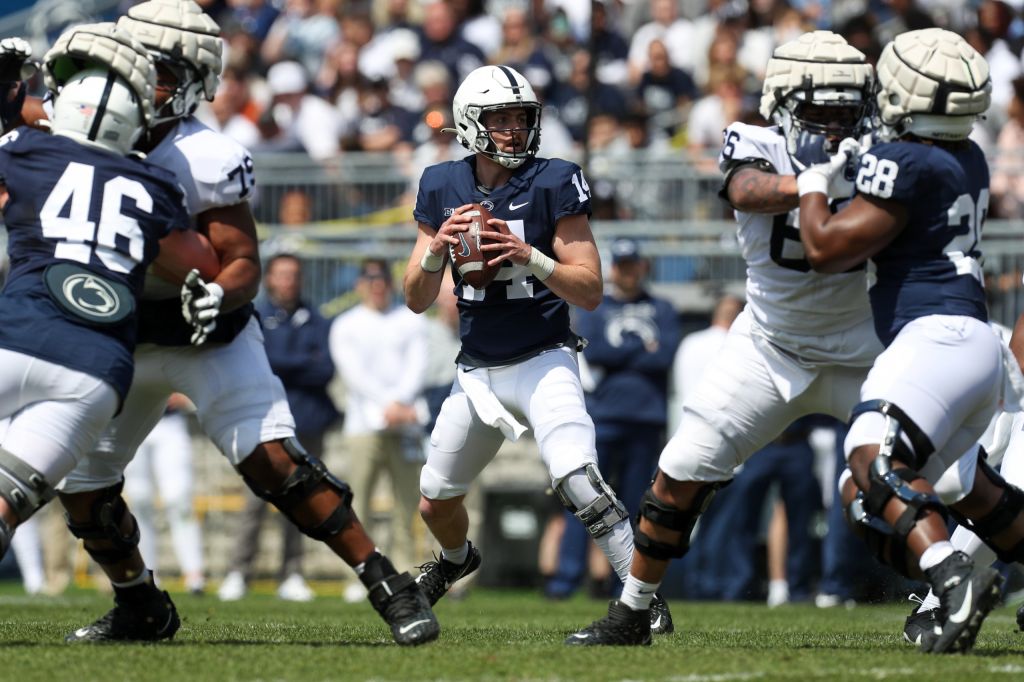
College Football Players Association executive director Jason Stahl had a plan to negotiate with the Big Ten on behalf of athletes. In mid-July, he met in person with the entire Penn State football team, many of whom signed up to be part of an effort pushing for media rights revenue sharing and better medical care in the conference.
But that plan quickly went off the rails. Last Friday, media reports painted a disjointed picture of the movement’s strength, ideas, and future. Quarterback Sean Clifford, who Stahl characterized as initially enthusiastic, published a statement distancing himself from it.
The saga illustrates the logistical difficulties of organizing players, despite their interest.
Stahl said it also appears to be a successful attempt on the part of Penn State and Big Ten administrators at breaking up a budding movement for athletes’ rights. “There was this back-channel activity by administrators that wanted to bust a nascent labor-organizing effort,” Stahl said. “It’s that simple.”
A Growing Movement
Stahl launched the CFBPA last year, and has spent months trying to build an organization of former, current, and future players to improve athletes’ rights.
This summer, it had a chance of taking off — he had connected with Clifford and traveled to the school, spending eight days meeting with football players about joining his college sports reform association. He had several conversations with Clifford.
Stahl provided photo evidence to FOS of a meeting where he says Clifford was integral in drafting three demands to the conference: two about medical care and one about media rights revenue-sharing.
Stahl was snuck into Penn State facilities for a meeting with the entire team at 7:30 a.m. on July 14. He gave a powerpoint presentation, which he described as being met by “thunderous applause.” Part of his pitch: to make athletes aware of the gargantuan media rights deal the Big Ten was about to sign.
By the end, about a third of the team signed on to join the CFBPA.
A formal plan would begin on July 18. The group wanted to meet with Commissioner Kevin Warren and discuss the demands. If that didn’t work, it would consider taking steps to form a formal players’ union.
The “plan” didn’t happen, however. “I thought we’ve got this very tight campaign cooked up,” Stahl said. “And I think it’s going to be successful.”
“And that’s obviously not how it played out.”
The Ultimate Breakdown
Stahl attributes the movement’s demise to the last five minutes of the team meeting, when an assistant coach came in and saw what was going on. Stahl said he believes that coach alerted Penn State administrators, who then told others throughout the Big Ten.
During the following week, Warren spoke with Clifford about the organization’s demands. A source confirmed that while the team was in New York for a career development exercise, Warren met with players.
As has been previously reported, Warren also had an hour-long phone conversation with Stahl on July 21 about his demands. “He absolutely did not want to talk” about media rights revenue sharing, Stahl said. But Warren was more open to conversations about improved medical care.
The Big Ten did not immediately provide an on-record comment for this story. But at Big Ten media days, Warren did not discount the idea of revenue sharing in the future, and said he would discuss that as well as other reforms with athletes.
A source with knowledge of the conversation clarified that Stahl asked for attendance to Big Ten media days and Warren said yes, and was looking forward to saying hello.
But on Friday, the story about the call — and Clifford’s involvement in the movement — leaked.
Clifford then released a statement saying it would be “inaccurate” to characterize conversations he’s had with Penn State and Big Ten officials as being on behalf of the CFBPA. He said the CFBPA had offered “interesting ideas” to him, but he had ultimately decided to work directly with Big Ten officials instead to improve athletes’ rights in the conference.
FOS could not immediately reach Clifford for further comment through a Penn State spokesperson.
Stahl confirmed to FOS that he was disinvited to media days two days after his call with Warren, and was not in attendance.
Clifford, for his part, will be part of a new Big Ten student advisory committee. At media days on Tuesday, Warren characterized the group as one that would “listen to our student athletes even more to understand what’s important to them, what we as a conference can do better.”
The CFBPA’s Future
Despite the complications, the CFBPA — and its requests — aren’t dead.
Stahl clarified that Clifford’s involvement would have helped, but it’s certainly not a requirement. “I said, ‘Sean, this is not about you. I want you to be involved, but I don’t need you to be involved.’”
At the end of the day Monday, Stahl said more than 20 Penn State football players were still signed up. “They’re into what we’re doing,” Stahl said. “It’s not because of the revenue sharing” — he claims it’s because athletes want better medical care.
And even if Stahl’s effort isn’t successful, there are plenty of other forces — from the courts to Congress and the NLRB — that could precipitate revenue sharing agreements and standardized medical care for college athletes in the future.
“I’ve been going at this problem for eight years,” Stahl said. “I’m not about to stop because one person disagrees with me.”
Download the FOS App
The business of sports, in your pocket.



Scan the QR code to get the app now.