Want more from Front Office Sports
in your search results?
Big tech companies and incumbent startups alike are becoming increasingly infatuated with wearable technologies — namely wrist worn trackers.
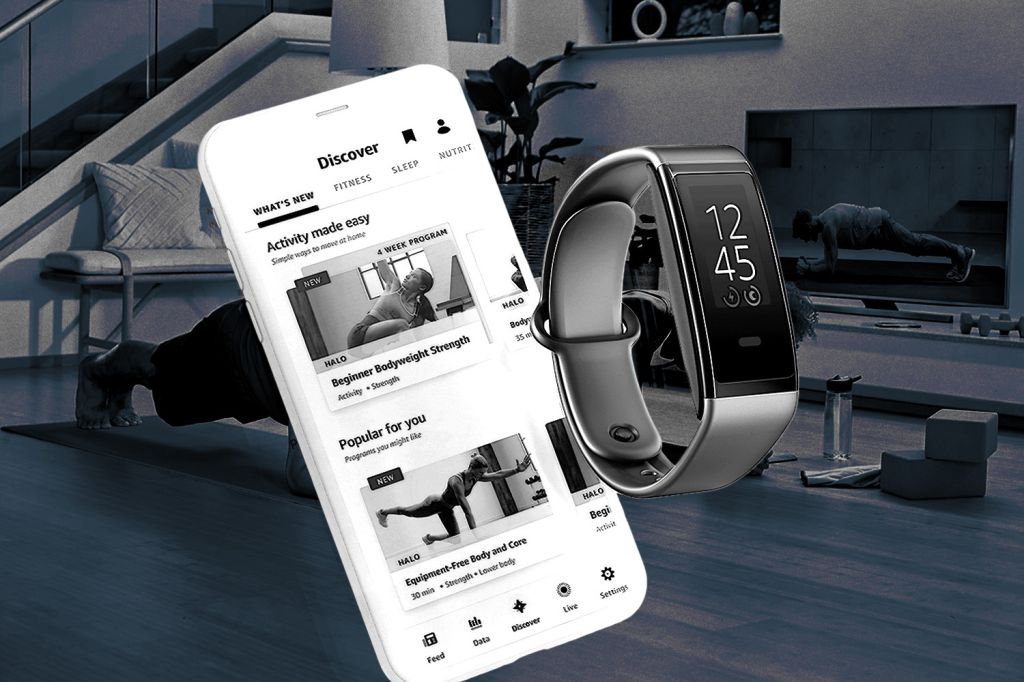
On Tuesday, Amazon announced a plethora of new products and features related to its health and fitness services, including:
- Halo Fitness, an interactive home workout service similar to Apple Fitness+
- Halo Nutrition, a highly personalized meal planning service
- Halo View, a new wearable device with a screen akin to the Apple Watch
The Amazon reveal comes on heels of Apple announcing a partnership with UnitedHealthcare, Fitbit releasing the Charge 5 wearable, and Whoop launching its Whoop 4.0 after a $200 million capital raise at a $3.6 billion valuation.
Clearly, connected fitness and trackable biometric data is in high demand. In 2021 alone, funding for wearables and the “quantified self” has already reached the $2.9 billion mark with more than 260 companies receiving funding, according to Pitchbook.
- Apple announced at its WWDC that iOS 15 would allow users to seamlessly share health data with family members and physicians.
- Whoop was adopted as the PGA Tour’s official wearable due in part to its ability to detect the presence of COVID through changes in respiratory rate.
- Oura Ring was selected as the NBA’s official wearable during the Bubble for similar health-related reasons.
We continue to see legitimate health applications for these consumer devices as health data moves “upstream” in the doctor-patient relationship and regulations on telemedicine integrations are simplified.
The Healthcare Perspective
What about the $12 trillion elephant in the room? That’s right, healthcare.
Big tech, healthcare, and fitness are on a collision course as companies like Apple, Facebook, and now Amazon introduce products and partnerships that integrate health and wellness into their ecosystems.
These partnerships and initiatives, however, are nothing without hardware. In order to penetrate the healthcare market, tech companies need hardware that performs up to the standard of medical grade devices.
How are the various players in the space fairing in that battle? Let’s take a look:
- Google’s $2.1 billion Fitbit acquisition has yielded less than stellar results. The company also partnered with Samsung to bolster its Wear OS and the results have been equally tepid.
- Apple currently owns over one-third of the global smartwatch market. The infrastructure to integrate with healthcare is in place, they have user trust with data privacy, and a public mandate to disrupt the space.
- Amazon has the least amount of time in the market with its Halo product. However, the company has already made inroads into the healthcare sector with its $750 million acquisition of drug delivery service Pillpack in 2018. The Prime ecosystem, along with Alexa as a pseudo physician assistant, could also potentially lead to a closed loop healthcare ecosystem for Prime users.
- Facebook has yet to release its planned wearable device, and one glaring issue stands in the way of its aspirations: privacy concerns. Facebook has eroded trust with users, which will likely make adoption a difficult sell.
- Peloton reportedly has its own wearable fitness device coming — not a surprise after it acquired Atlas Wearables for an undisclosed amount earlier this year.
- While Whoop doesn’t have nearly the same level of resources, capital, or infrastructure as its larger tech competitors, they’ve been pioneers in the hardware space. The $200 million injection of capital seems to have been earmarked for further innovation in performance as opposed to penetrating healthcare.
Big tech likely has its sights set on full healthcare disruption, while incumbents like Whoop have the potential to own lucrative niches, such as quantifying performance, instead.
The Fitness Perspective
Apple and Amazon are leveraging their ability to create, curate, and distribute workout-related content. Whoop is focused on becoming ubiquitous with “fitness tracking.”
Apple has Apple Fitness+ and its bank of highly qualified trainers who, like Peloton trainers, utilize the platform as a means to engage with their audience. Amazon now has fitness tracking, fitness coaching, and nutritional coaching in its rapidly evolving Halo system. Whoop recently acquired PUSH — a velocity-based training app that lets users track weight lifting metrics — to further cement its position.
There’s a divide between the content platform play (Apple and Amazon) and the pure lifestyle brand play (Whoop). While the former seems to have stronger mass appeal, the latter has established a cult-like following.
So, Who Wins?
This question is tricky because fitness wearables aren’t exactly a zero-sum game.
The three companies at the forefront of the space have fundamentally different end goals.
Amazon is focused on getting individuals into its Prime ecosystem at any cost. For this reason, they can price their hardware ($80) and software ($3.99 monthly subscription) significantly lower than an Apple Watch ($279) or Whoop monthly subscription ($30).
Apple already owns a lion’s share of the wearables market and has made healthcare and fitness a part of its growth thesis since as early as 2014. And then there’s Whoop — a software business disguised as a hardware product built for select high-performance individuals.
Ultimately, I believe that Apple wins out. Scale is scale, and very few can beat Apple in that game.
While the idea that another giant like Amazon could build out its own mini healthcare system is intriguing, wearables are consumer products that need to look and feel good. If Amazon is more concentrated on undercutting prices and using the Halo system to increase Prime memberships, its wearables won’t be able to compete with Apple’s ambitious design, market-leading UX and UI, and telemedicine infrastructure.
A decade ago, we didn’t know any of these companies would be at the forefront of health and fitness. Only time will tell how the category evolves in the near future.
Download the FOS App
The business of sports, in your pocket.



Scan the QR code to get the app now.