
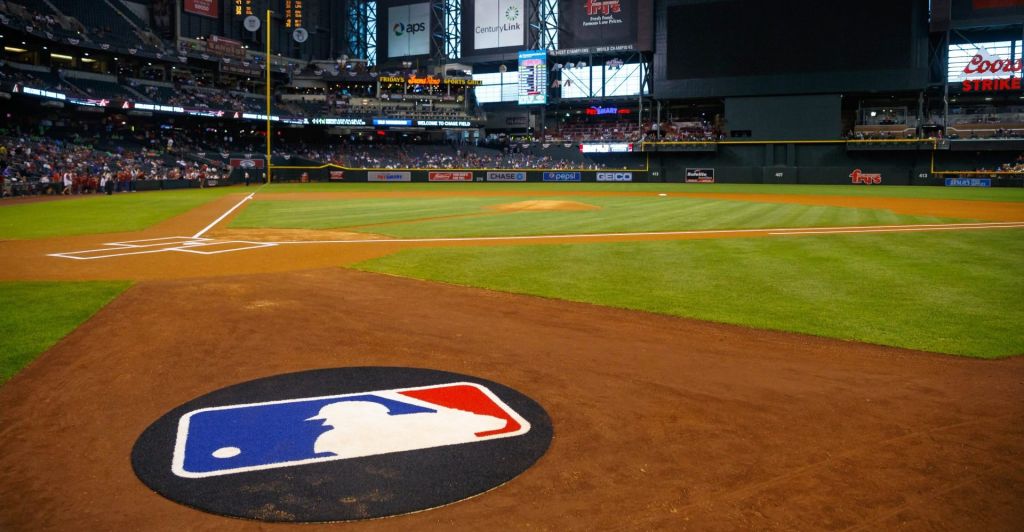
MLB team owners have made another sweeping labor proposal, this time seeking to dramatically change how most player contracts operate in a new bid that is unlikely to become reality.
Among the key terms that management offered to the MLB Players Association during a Thursday bargaining session focused primarily on the reserve system:
- A maximum contract length of five years for all free-agent players switching teams, and six years for those staying with their existing teams, as well as an end to all contract deferrals. Those measures would make it impossible for any future deals like the historic 15-year, $765 million pact Juan Soto signed with the Mets in late 2024, and the 10-year, $700 million contract Shohei Ohtani signed with the Dodgers in late 2023 that defers all but $20 million of the money.
- A $202 million limit on free-agent deals for players switching teams, representing 15% of a team’s annual salary cap. That overall contract number would mark a significant rollback in current salary trends, as there are more than two dozen current player deals in excess of that, and four that more than double it. The maximum contract value for a free agent staying with his current team is $265 million over six years.
- An elimination of the qualifying offer that provides draft-pick compensation to teams losing top free agents. The union has sought to end this.
- An increase in minimum salaries to $900,000 for players with one year of service time or less, up from the current $780,000. The minimum for those with at least two years of service time would rise to $1 million.
- A limit of 12 years and $500 million for any contract extension for a player not yet a free agent. That 12-year limit, however, would apply to only rookies, with that maximum contract length decreasing with every subsequent year of service time.
“Today, in addition to proposing the largest-ever increase in the minimum salary, earned by over half of MLB players, we accepted two landmark changes to free agency that have been in place for 50 years,” said MLB spokesperson Glen Caplin. “We agreed to both the MLBPA’s proposal to provide earlier access to free agency, and their proposal to eliminate the qualifying offer system, a provision players view as a drag on free agency.”
All of this, however, would be expressly contingent on players accepting management’s recent proposal for a salary cap—something they are vehemently against.
Not surprisingly, the union immediately rejected the latest bid in what was described as “spirited” bargaining on Thursday.
“The overall drag on player compensation here dramatically outweighs the benefits suggested here,” said MLBPA interim executive director Bruce Meyer soon thereafter. “Some of the suggested benefits are of no benefit or value at all in a cap system. … In a cap system, it’s a zero-sum game, and it’s just moving money around.”
A Divided Negotiation
The latest labor talks follow a series of sessions in which players and owners have been deeply split on nearly every other core issue discussed so far.
Owners helped lead off the negotiations by making the salary cap proposal, something that was long expected but nonetheless had not been formally broached in the sport for more than three decades. Players, as vehemently opposed to a cap at any point in the union’s six-decade history, instead are seeking widespread increases in minimum salaries and enhanced player eligibility for free agency.
Those MLB team owners, however, did agree to allow players ages 30 and older with five years of service time to become free agents—in line with a union proposal—but did so in conjunction with a salary cap.
More recently, management also presented a proposal that would dramatically reshape how and when amateur players enter professional baseball. Among the widely rebuked elements of the offer were making U.S.-born teenage players ineligible for entry and offloading a sizable portion of the league’s player development functions to college baseball.
The existing labor agreement between MLB and the MLBPA expires Dec. 1, and a real risk of losing games won’t become truly palpable until early next year. As a result, the current talks are still rather at a preliminary stage in which each side is detailing its intended vision for the sport’s future, and the two camps have not yet reached a stage of truly negotiated trade-offs.
“What’s being proposed now is really illusory given it’s all in the context of a cap,” Meyer said.
Meanwhile, these talks have already been marked by a much greater level of public discussion compared to prior rounds. During the latter part of Bud Selig’s tenure as commissioner, in particular, he actively sought to tamp down public discourse about labor negotiations as much as possible.
That’s fundamentally changed this time, though, as an accelerating spending gap between large- and small-revenue teams, and how best to address it, is forcing a much more open discourse.
“The biggest issue baseball fans want solved to strengthen the game is fixing the payroll disparity that leaves too many fans without hope of their team competing for a World Series title,” Caplin said.