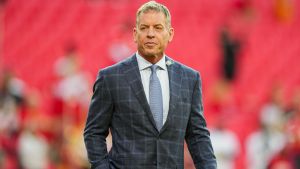
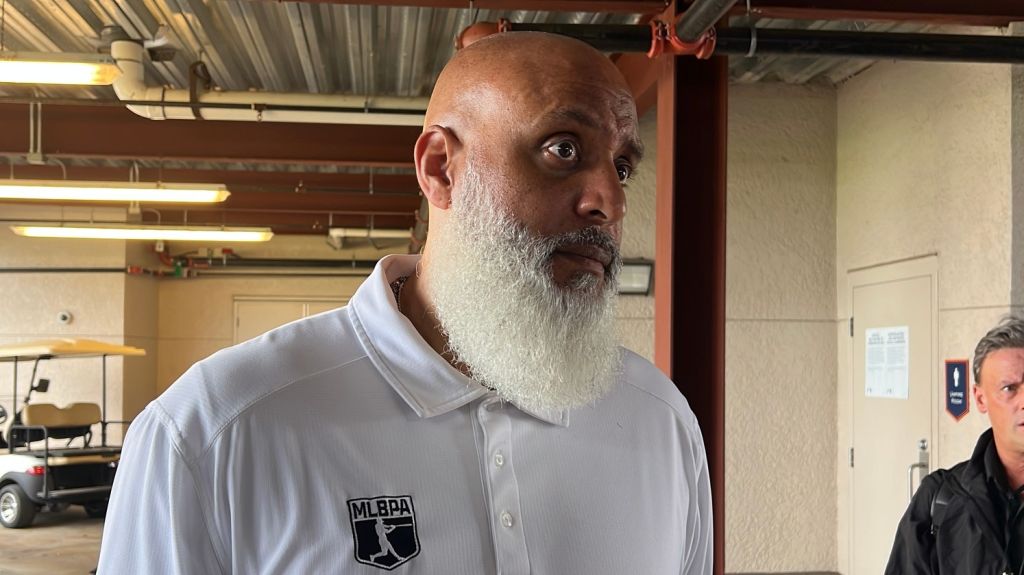
MLB Players Association executive director Tony Clark resigned from his position, a massive development as players enter a potentially industry-shaking labor negotiation with team owners this year.
Clark, the union’s day-to-day leader since 2013, has been under federal investigation since last year by the Eastern District of New York, along with the organization itself, over complaints of alleged self-dealing and misuse of licensing money.
The move arrives at a critical time as the current, five-year collective bargaining agreement with MLB expires Dec. 1. As a fiscal divide within the sport continues to grow, many owners are expected to pursue a salary cap, something the union has long resisted. A fractious set of talks is anticipated.
Clark was scheduled to be part of a customary preseason tour of spring training camps, but a planned stop Tuesday at the Guardians’ camp in Arizona was canceled.
The move places the MLBPA in a somewhat similar transition period as the NFL Players Association. That union also has an interim executive director, and though in the middle of a long-term labor agreement with the NFL, is facing rising pressure as a push grows for an 18-game regular season.
An announcement of an interim MLBPA executive director is expected very soon, with deputy executive director Bruce Meyer standing as the most obvious candidate.
ESPN, meanwhile, reported Tuesday afternoon that an additional element surrounding Clark was an internal investigation that revealed an inappropriate relationship with his sister-in-law, hired by the union in 2023.
Union leadership met late Tuesday, but have not yet appointed a successor to Clark.
“As always, the players remain focused on their ongoing preparations for collective bargaining this year,” the MLBPA said in a statement. “The strength of this union is—and will always be—the solidarity of our membership.”
A Bumpy Tenure
Clark, a former 15-year veteran who played for six MLB teams and became the first player in the MLBPA executive director role, initially brought a sense of stability after the tragic, cancer-related passing of his executive director predecessor, Michael Weiner, in November 2013. Clark’s tenure included new labor deals with team owners in 2016 and early 2022, the latter arriving after a 99-day management lockout that nearly ended MLB’s streak of not missing any games due to a labor dispute since 2015.
Recent years, however, have been much more internally disruptive as some players have grown frustrated over a perceived lack of gains, both in monetary and workplace-related matters. Two years ago, there was an unsuccessful insurgency for Clark to be replaced by Harry Marino, a former minor league player turned lawyer who helped unionize the affiliated minors. Clark, along with Meyer, survived that effort, but scars remained.
More directly, though, the ongoing issue regarding the MLBPA’s involvement in OneTeam Partners has remained problematic. After a whistleblower complaint, federal authorities have been investigating claims of self-dealing, nepotism, misuse of union resources, and an abuse of power—including by Clark.
What’s Next
Active labor talks with MLB owners are expected to pick up after Opening Day late next month. Both sides are pushing for big changes, and on the management side, calls are rising for a salary cap or a cap-like structure. The intent is to even out a situation where the Dodgers, the sport’s current two-time defending champion, are set to nearly quintuple the 2026 player payroll of MLB’s lowest spender, the Marlins.
The union, however, has firmly resisted salary caps for its entire six-decade existence, previously going through several prior work stoppages in part to fight against them. The MLBPA has long pointed to recent issues in cap-based systems in other major sports, such as frequent cap-driven roster cuts and contract restructurings in the NFL.
“Those other situations enter every conversation we have when we educate players on what a salary-cap system is and what it isn’t,” Clark told Front Office Sports last summer. “It fundamentally erodes guaranteed contracts. It pits players directly against one another. … It is the opposite of what you often hear it described as.”
MLB declined to comment on Clark’s news, but regarding the forthcoming CBA talks, commissioner Rob Manfred said last week, “The only projection I can make, because we haven’t agreed on a calendar with the MLBPA, and it does take two to tango, as they say, is that historically after Opening Day, we kind of get started.”
Clark earned $3.41 million in 2024, according to a report filed with the U.S. Department of Labor. A new filing for the calendar year 2025 is expected soon.