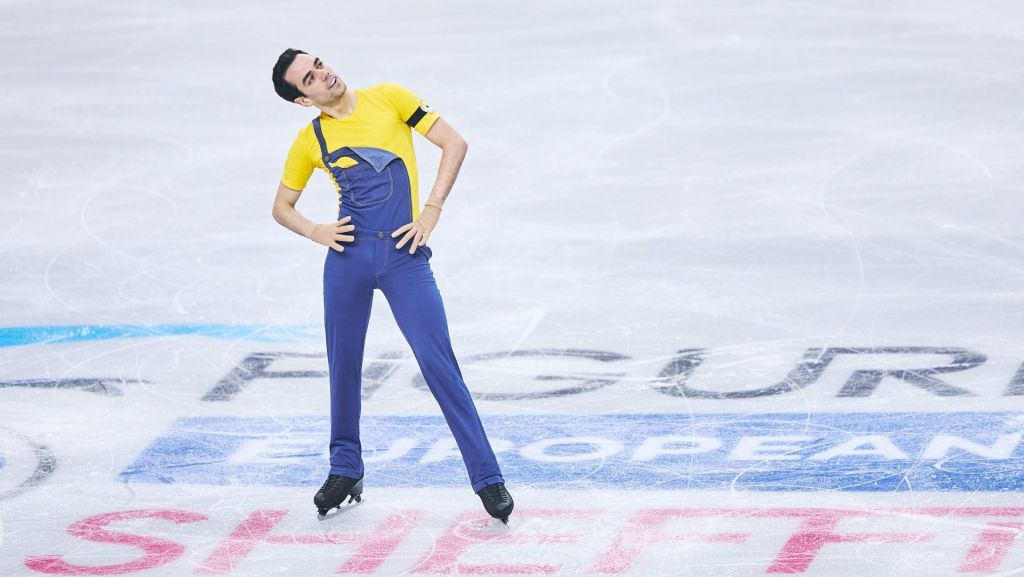
The Minions are going to Milan, after all.
Following a week of uncertainty trying to obtain the rights to the music used for his short program, Spanish figure skater Tomàs Guarino in a statement on Friday said “I am very happy to announce that we have made it: we have obtained the licenses for all four musical pieces, and I will be able to skate my Minions program at the Olympic Games.” The Royal Spanish Ice Sports Federation said that Guarino is also cleared to use the music “at future international events during the current season.”
The saga began on Monday when Guarino said he had been notified that the music—a medley of songs from Universal Pictures’s Minions franchise—was no longer cleared for competition.
His post went viral, and fans from around the world rallied behind the 26-year-old first-time Olympian, calling on Universal to allow Guarino to use the music.
The four songs in Guarino’s program are: “Universal Fanfare,” a version of the Universal Pictures theme music performed by the Minions; “Vicious Funk” by Heitor Pereira; “Freedom” by Pharrell Williams; and “Papaya (Vaya Papayas)” by The Minions & Juan Alcaraz.
Universal Pictures’s parent Comcast is the U.S. broadcast partner for the Olympics. The company administers the rights to “Universal Fanfare” and “Vicious Funk.” Pharrell’s song “Freedom” is partially administered by a subsidiary of Sony Music. “Papaya (Vaya Papayas)” is a remix that samples Juan Alcaraz’s “Banana Bounce,” as well as music from the Minions movies.
Guarino on Tuesday shared the first bit of progress in getting the music cleared, writing, “Universal Studios reconsidered and officially granted the rights for this one special occasion,” Guarino wrote, thanking everyone who supported him. Guarino said Universal cleared two songs, and that he was working to tie up the clearances for the other two.
Alcaraz also posted on Instagram Tuesday, “Today I was able to talk to Tomas and we are solving the problem so that he can use the song…in the Winter Olympics Milan 2026.”
Guarino, who has previously skated to “Cotton Eye Joe” and whose free skate program is a medley of Bee Gees songs, has said he only aims “to bring joy and playful style to the ice while still meeting every required element to show that skating as a male Olympic figure skater can be fun.”
Universal did not respond to requests for comment.
Music Copyright and Sports
In his statement celebrating the clearances, Guarino wrote, “I would like to thank ClicknClear and the RFEDH for their work, as well as Universal Pictures, Pharrell Williams, Sony Music, and Juan Alcaraz for managing the music rights in such a short period of time so that I can perform my program in Milan.”
Getting clearance from each of those individual rightsholders was critical for Guarino to be able to use his program music without a looming threat of being sued.
While performing without obtaining proper copyright clearances is not illegal, it leaves the athlete and any broadcaster that may be airing an event open to potential litigation from the music’s rightsholders. This largely procedural step is unique to artistic sports such as gymnastics, figure skating, artistic swimming, and cheerleading, and is meant to protect the athlete.
Rights clearances became a more pointed issue after the 2022 Beijing Olympic Games. The band Heavy Young Heathens sued U.S. pairs skaters Alexa Knierim and Brandon Frazier, along with U.S. Figure Skating and NBCUniversal Media, after the skaters used the band’s cover of “House of the Rising Sun.” The suit was settled, but it set a modern precedent for what could happen to athletes who do not properly get their music cleared.
According to music guidance for athletes provided by the International Olympic Committee in November, athletes “are responsible for obtaining permission for 100% of the song/composition, across every country in the world.”
U.S. champion figure skater Amber Glenn told the AP that it should not be athletes’ responsibility. “First we get a website or some sort of application to track things. And then once we’re like, ‘OK, yeah, it’s cleared. It’s good,’ then it’s not a reliable source anymore,” Glenn said. “OK, then what do we do? And especially as an athlete, this is not something that we should be worrying about. That’s not my job. My job is to train and perform.”
In his post earlier this week where he lamented not being able to use the music, Guarino said, “I followed all required procedures and submitted my music through the ISU ClicknClear system back in August, and I competed with this program throughout the entire season.”
The sport’s governing body, the International Skating Union, said in a statement to Front Office Sports, “Copyright clearances can represent a challenge for all artistic sports. While the ISU does not have a contractual relationship with ClicknClear, we continue to work collaboratively with rights clearance stakeholders to ensure that thrilling performances can be accompanied by stirring music.”
ClicknClear was founded with the intention of helping athletes across all artistic sports to get the proper licenses and rights clearances for their competition music.
“We have worldwide blanket deals with thousands of record labels and music publishers—including the majors (Sony, Universal, and Warner)—that allow us to offer instant licenses to athletes from a growing pre-cleared catalog of music for sports such as gymnastics, artistic swimming, and dressage, in addition to figure skating,” ClicknClear founder and CEO Chantal Epp said in a statement to FOS.
“Where music is not yet in our pre-cleared catalogue, we help athletes—if requested—to seek licenses from the record labels and publishers, who have the sole discretion to approve or deny uses of their music, and set license fees,” Epp said.
Guarino is not the only Olympian dealing who had music copyright issues in the lead-up to Milan. The Canadian ice dancer pair Marie-Jade Lauriault and Romain Le Gac had been using two Prince songs for their rhythm routine, but were notified last year that the tracks would not be cleared for the Olympics.
U.S. figure skater Alysa Liu’s free skate routine at last month’s U.S. Figure Skating Championships was set to Lady Gaga’s “Bloody Mary,” but Liu said she would not be taking the routine to the Olympics.
“I don’t even think I’m going to do [it] at the Olympics,” Liu said. “But I really wanted to do it once at least… I always wanted to do ‘MacArthur Park’ for the individual free skate event,” referring to the Donna Summer song she has been skating to.
As for Guarino, who will skate during the men’s singles short program on Tuesday, he said his “only goal is to give my very best on the ice and deliver a program worthy of the affection I have received from people all around the world. I am deeply moved by the love shown to a small skater from a small federation.”