The 2026 Olympic Games will open in Italy with the lighting of the Olympic flame in a cauldron inspired by Leonardo da Vinci’s knots. The ceremony marks the beginning of competition, and also the end of a long journey that has included 501 different torch-bearers over a nearly three-month stretch.
It’s a massive logistical lift that requires years of planning and involves thousands of people.
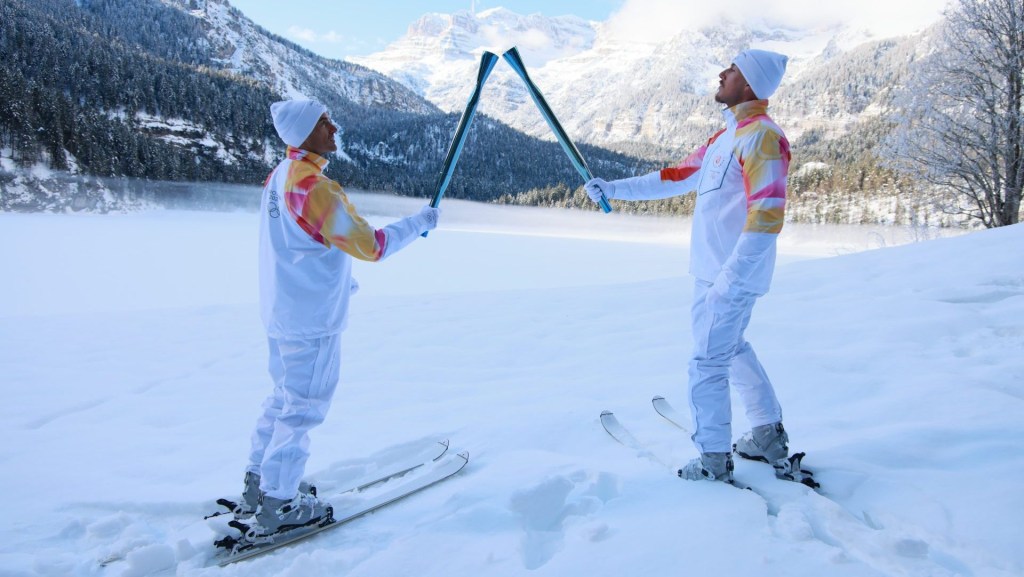
For every Olympics, the Olympic Torch journey begins in Ancient Olympia, the birthplace of the original Games. The flame is initially lit using a traditional method: concentrating the sun’s rays to a single point with a parabolic bowl. It’s transferred to a torch, carried by a torch-bearer, who begins the Olympic Torch Relay—a sequence of flame transfers among torch-bearers that ultimately lands the flame at the Opening Ceremony.
This year’s flame was lit on Nov. 26. Since then, it’s been on a 63-day, 7,500-mile sojourn to Milan. The Torch Relay for the 2026 Games has hit 60 cities, all 110 provinces in Italy, and passed among hundreds of individual torch-bearers. (A separate Relay, one for the Paralympic Winter Games, has traveled a shorter route from the U.K. to Verona.)
“Each Games is different—the nation is different, the time in history is different, and each Relay is unique,” says IOC expert advisor Bill Morris, who also directed the London Organising Committee responsible for the 2012 Olympic and Paralympic Games Opening and Closing Ceremonies and Torch Relay.
Sometimes, the Relay involves thousands of torch-bearers, and rides on planes or ships. And as it did in Athens in 2004, it can last nearly five months. It’s a lot of effort and pomp, but even in its simplicity, it’s crucial to the spirit of the Games.
“If you want to take this thing down to the bare bones, it’s a person walking along with a big matchstick that’s on fire, then they hand it to someone else, and they carry it,” Morris says, “and yet, whichever country it goes to, some sort of magic occurs.”
Morris says that each Games’ respective planning committees generally take between three to five years to fully plan the Torch Relay.
Those committees need to consider the route, the communities the flame will pass through, how the flame will cross oceans or rivers, who will carry the torch in a given community, security and logistics in each community, and how many days it’ll all last. They also consider corporate sponsors, logistics contractors, and local agencies (fire, police, public works departments, etc.).
Contingencies have to be in place—including backup flames carried in special lanterns following the torch-bearers, too. Designated people also stay with those flames the entire time, similar to “Keeper of the Cup” in the NHL, who travels with and safeguards the Stanley Cup.
“We have to make sure that we have police and fire resources ready to do our part. We have to turn out crowds, work with the Olympic Committee, create a safe route, and source volunteers,” says Dennis Taylor, who was the city manager of Billings, Mont., when the flame passed through in early 2002 on its way to the Salt Lake City Games. “It was an all-in exercise for the City of Billings and the entire community. Everybody was jazzed about it.”
Taylor says that one big issue Billings dealt with when the flame passed through was the fact that it was January in Montana—snow and ice covered the streets, and it was cold. The city needed to make sure torch-bearers wouldn’t slip, and that volunteers and spectators were able to keep warm.
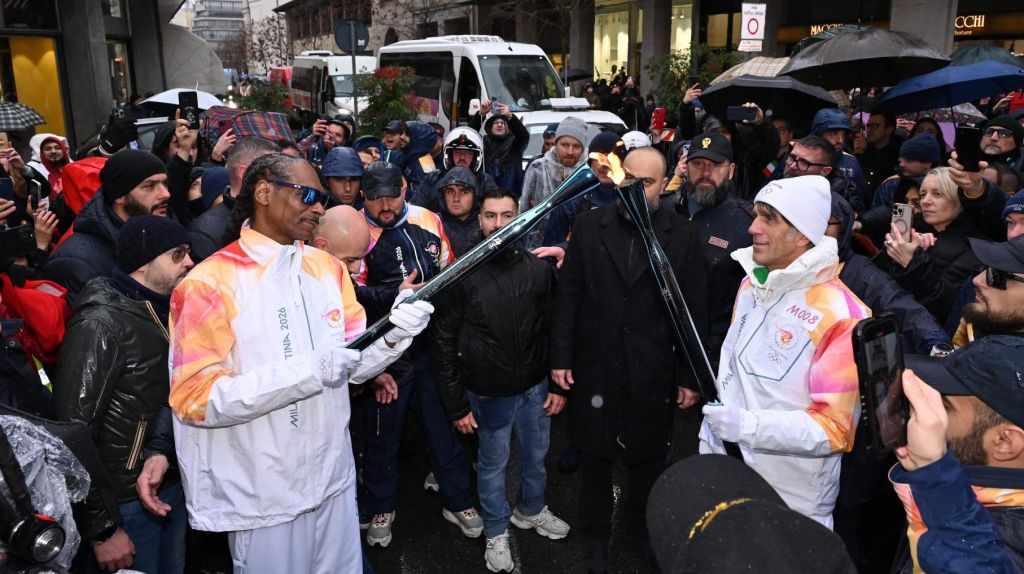
Celebrities and athletes often serve as torch-bearers. This year, the stars of the hit hockey-romance show Heated Rivalry carried the Torch in Feltre on the 49th leg of the Relay. K-pop star Sunghoon of ENHYPEN, who was nominated by Olympic partner Samsung Electronics; rapper Snoop Dogg; actor Jackie Chan; American ultra-trail runner Courtney Dauwalter; and two-time Chinese Olympic gold medallist Eileen Gu were all part of the route as well.
But most of the hundreds—sometimes thousands—of torch-bearers are regular people, who Morris says “have been selected because they’ve done something extraordinary.” That can include people who’ve contributed to their communities or who are important to the places along the Relay route.
In Billings, Taylor got to carry the flame, which he says was the “honor of a lifetime.” That same year, Sharon Delaney McCloud, carried the flame on Dec. 5, 2001 through Western North Carolina, near Asheville. She was the evening news anchor at the NBC station in Raleigh and a known charitable contributor. “My GM nominated me,” she says. “I was very surprised.”
Torch Relays draw thousands of spectators—Morris says that ahead of the 2012 Games in London, around one-third of the adult population of the U.K. went to the roadside to see the flame pass. Its journey to Milan is winding down, but Morris believes the Relay is bigger than the miles it covers.
“It’s very easy to be cynical about Olympic values, but in the world we’re living in right now, those values are more relevant than they’ve ever been,” he says. “For me, the relay is where those values live.”