
Dave Portnoy on Fox ‘Big Noon’ Exit: Ryan Day Thinks I ‘Doxxed’ Him
Want more from Front Office Sports
in your search results?
How do you house thousands of elite competitors in one secure, self-contained environment that supports rest, recovery, and camaraderie—all under the most intense competitive pressure of athletes’ careers? It’s a uniquely Olympic problem.
Since the first purpose-built Olympic Village debuted at the 1924 Paris Games, these pop-up cities have grown into massive, high-stakes infrastructure projects, measured by their logistics and delivery as much as their design.
For each Games, groups from all over the world compete to design the Olympic Village. Years in advance, they submit blind proposals to a selection committee for judgment: blueprints and floor plans that cover even the most minute details.
The winning bid for Milan came from Skidmore, Owings & Merrill (SOM), a New York–based group responsible for the Burj Khalifa, One World Trade Center, and Willis Tower. SOM beat out 27 groups of 71 studios from 9 different countries—including Italy itself. (There’s been some “polite” grumbling from Italian architects about an American group winning, says the project’s lead designer Colin Koop.)
SOM convinced Italian officials to entrust a cornerstone Olympic project to an American company with an athlete-friendly layout, a sustainable long-term plan, and an expedited construction strategy to meet an immovable deadline. The project “required no hiccups,” Koop says. “Everything had to go perfectly.”
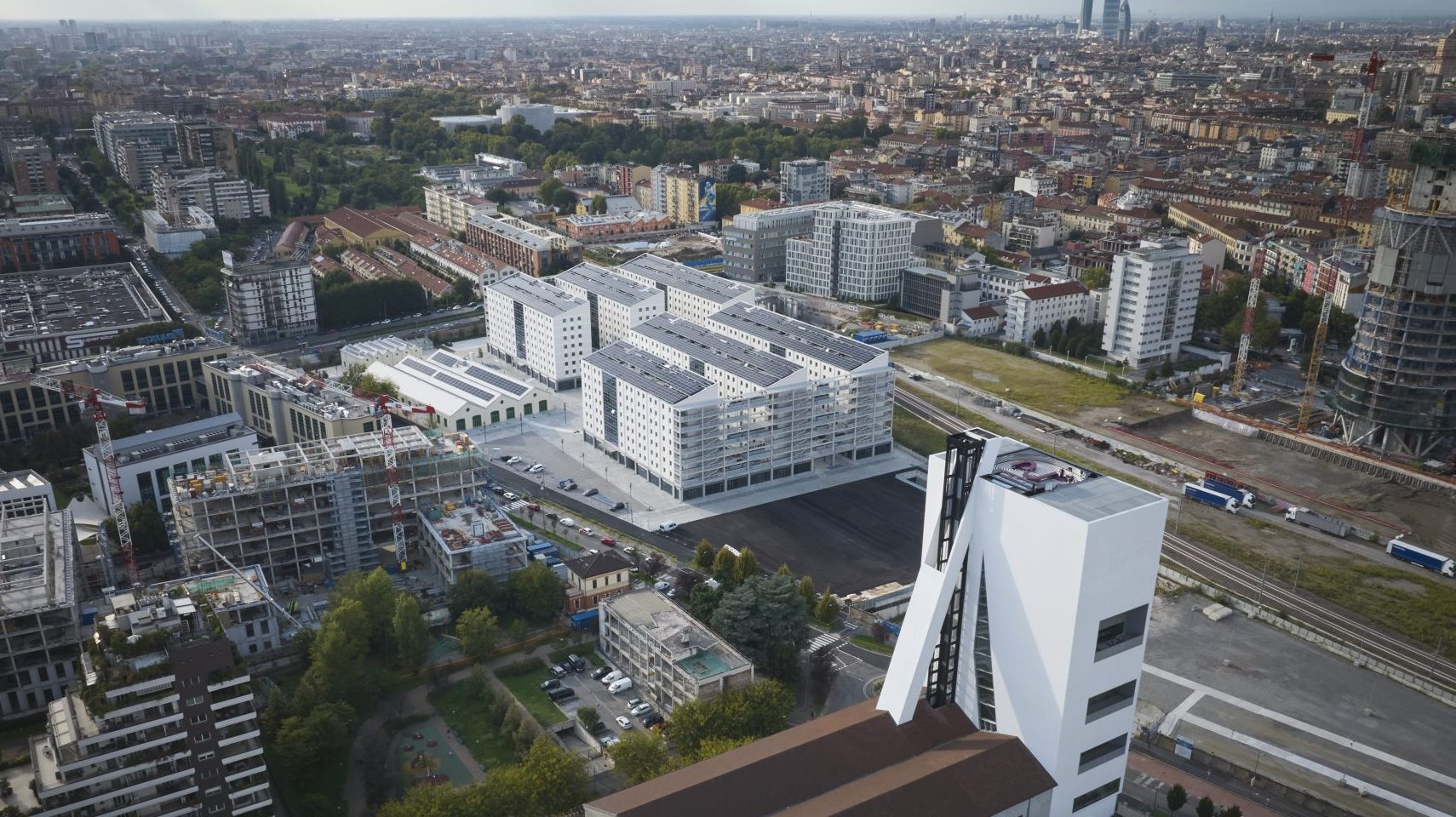
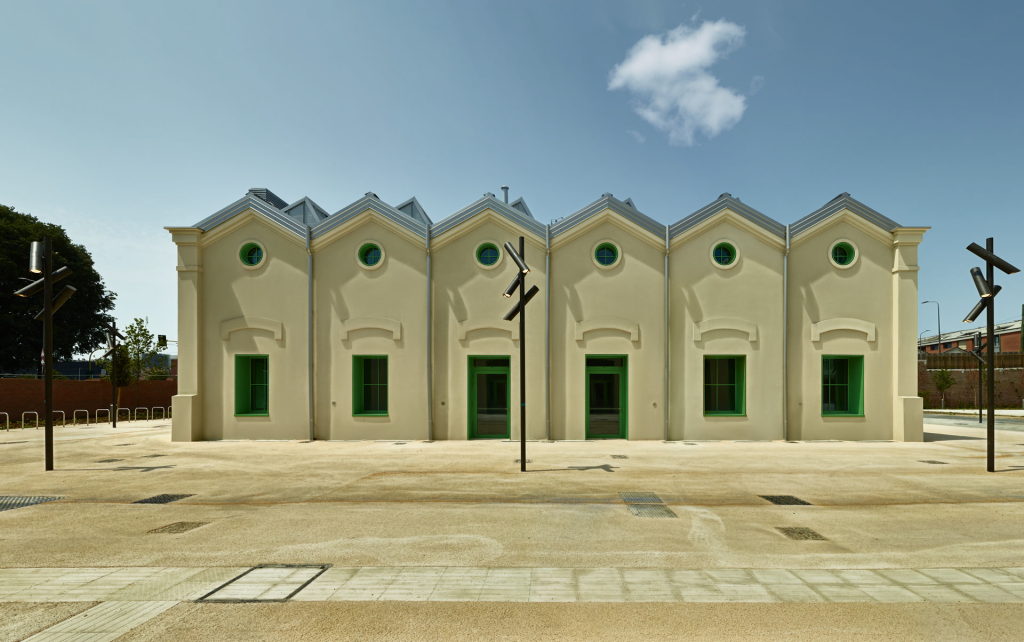
Since securing the contract, SOM has spent the past five years—practically “warp speed” by architectural standards—working to get the former railway yard in Porta Romana turned into an Olympic home base of six long, seven-story housing complexes along with two renovated historical buildings.
Koop himself visited the Milan site around 20 times to coordinate with an army of engineers, lighting designers, contractors, and city officials to ensure the site’s development didn’t disrupt the city’s dense historical fabric. “It’s a very sophisticated design environment to work in,” he says. “And so there was a lot of careful work with those local communities and architects who were involved.”
The Village is now teeming with 1,500-plus athletes from 42 delegations. And the site is also ready for a rare second act once the closing ceremony wraps.
Preparation—Then Party
What should these Olympians expect when they walk into their rooms? Koop says the goal was to deliver both privacy and community—a contradiction informed by extensive research with the International Olympic Committee.
“If athletes haven’t competed yet, they want focus and silence and don’t want much interaction with each other,” he says. “And then the minute they’re done with their competition, they want to party. … That is what happens in an Olympic Village.”
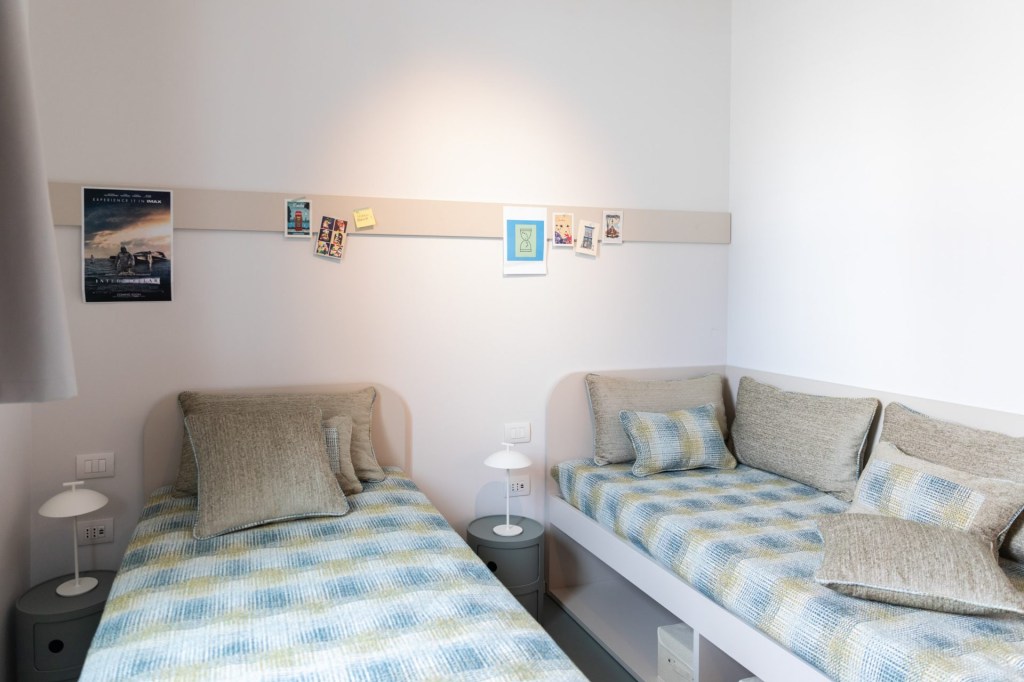
Each room—ranging in size from singles and doubles to accessible units—is designed to be “compact, well-lit, and organized around a central corridor,” says Luca Mangia, GM of lead real estate developer COIMA REM, working with SOM on the project. Rooms are outfitted with permanent furniture: a bed (not the highly discussed cardboard versions that Paris introduced in 2024), bedside table, wardrobe, and a fully equipped bathroom. The walls are thick with modern soundproofing for sleep, silence, and separation.
Beyond the private rooms, the athletes have a wide range of shared facilities—dining and catering areas (which include one large, electric-stove kitchen on each of the seven floors), social and leisure spaces, fitness blocks, medical suites, and lounges and recreation zones—meant to produce camaraderie (and yes, partying) across sporting and national lines.
“All of that gets set up on the ground floor, and they’re able to interconnect with each other,” Koop says. “The building is part of their routine, and we want them to be successful in whatever sport they’re competing in.”
From Moon to Milan
As big as the undertaking is to stand up the Olympic Village, even getting to this stage was a huge lift.
SOM’s bid for the Milan project started far from Northern Italy—rather, in outer space. Ahead of the 2021 Venice Biennale of Architecture, SOM partnered with the European Space Agency and the Massachusetts Institute of Technology to imagine a lunar settlement where humans could survive and thrive on the moon.
While working on the initiative, Koop and his team connected with COIMA head Manfredi Catella, who encouraged SOM to submit a design to revamp the entire Porta Romana railway yard. Koop’s consortium—filled with various engineers and landscape architects—enlisted in the competition.
SOM finished second overall, but Catella was enamored with its vision for the Olympic Village. He soon rallied SOM to compete again, focusing on only the Village itself.
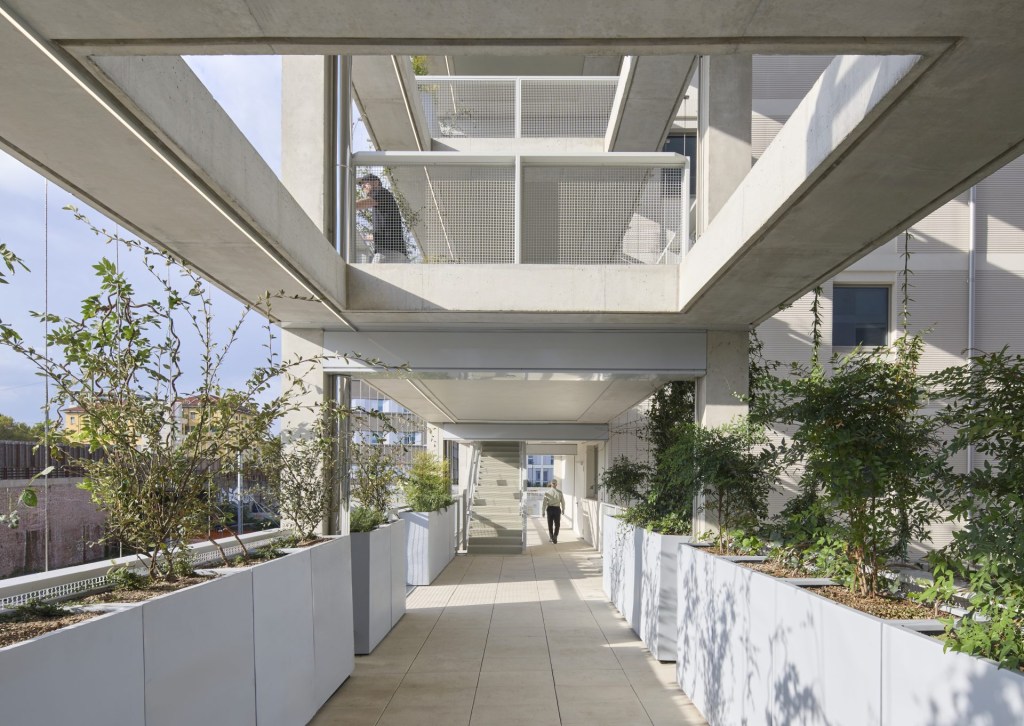
With a strong foundation in place, SOM blindly submitted boards and PDFs with more detail (vegetative balconies, communal terraces, renewable energy systems, efficient building methods) to the selection committee. The group also focused on sustainability, with tilted, solar-paneled roofs, eggshell-white-painted wooden façades to promote cooling, and an all-electric grid, which Koop says “becomes a carbon net-zero building over time.”
COIMA’s Mangia says SOM’s win came down to its integration into the site’s history; a holistic balance among architecture, landscape, and public space; and its long-term vision. Just as important was SOM’s truncated construction time using prefabricated elements—such as ready-made bathrooms—that would be crane-dropped and assembled on-site.
“Their methodical and highly coordinated approach proved perfectly suited for a development of this scale,” Mangia says.
Second Life
At its core, an Olympic Village exists for just several weeks. During the Games, Milan’s main Village will serve as a secure home base and transit hub for arena-based athletes, including hockey players and figure skaters. (The remaining outdoor athletes stay in six other temporary villages within and around the Cortina mountains.)
But immediately afterward, it’s set to become a 1,700-bed student housing complex—a transition meant to help address Milan’s housing shortage, with a meaningful role in the surrounding community. That includes new communal green spaces, renovated historic train sheds, and neighborhood retail—all combining to avoid the “white elephant” fate of some past Olympic sites, which have fallen into decay.
Mangia says a seamless transition into a second act was always the plan for the Milan Olympic Village project—something which made the design proposal even more challenging.
“That’s an interesting problem right off the start,” Koop says. “How do you design something whose purpose is fulfilled almost immediately upon completion? And then it has to have this much longer second life—and what is that second life?”
This forward-looking approach to turn an athletic village into Europe’s largest student housing complex is not only a boon for the city of Milan but also the Olympians, who get to stay in housing that’s more robust, comfortable, and livable than at previous Games.
“I’m hoping that this Village supports those athletes performing at the highest level and is adopted naturally into this community … and that there is a sense of community that’s cultivated within the walls of the building and community of students,” Koop says. “I’m optimistic that we’ve done both well.”