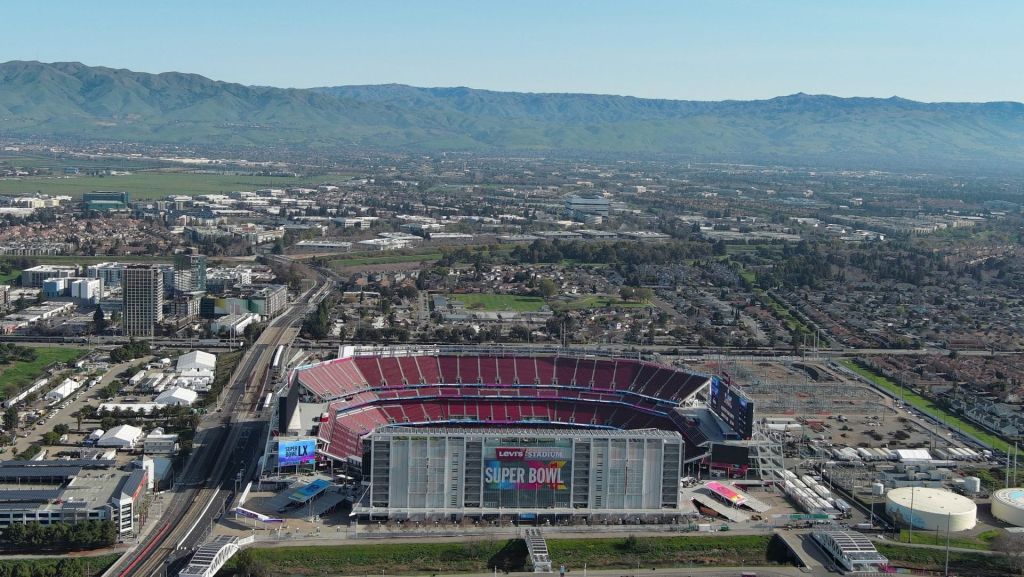
Levi’s Stadium, where the Patriots and Seahawks will play in Super Bowl LX, has been home to the San Francisco 49ers since 2014, but is not in San Francisco; it’s roughly 40 miles south in Santa Clara. That’s about an hour’s drive away from the heart of San Francisco, depending on California’s infamous traffic.
The distance from downtown to Levi’s Stadium is a striking contrast from Super Bowl LIX last year at Caesars Superdome, which is practically walking distance from everything game-related in the heart of New Orleans: the Super Bowl Experience fan zone, Super Bowl Radio Row, and other satellite events. In 2024, Super Bowl LVIII also had a walkable location at Allegiant Stadium, just off the Las Vegas Strip.
Of course, not every Super Bowl stadium is in a downtown proper—Super Bowl LVII at State Farm Stadium in Glendale, Ariz., was about 15 miles outside Phoenix. But as the NFL’s championship returns to the Bay Area for the first time since 2016, the footprint for this week’s festivities will be massive to accommodate the spread.
The host committee behind this Super Bowl, and event organizers and businesses, have been tasked with the thorny assignment of ensuring the many events smoothly spread across those many miles.
“The thing that makes the Bay Area so special is that it is diverse and it has a lot of places you can activate and be included and welcome,” Bay Area Host Committee president and CEO Zaileen Janmohamed tells Front Office Sports. “That also makes it challenging because you have to be in a lot of different places to operationalize all of these things, versus being in the city of New Orleans, where everything’s very centralized.”
The estimated 90,000 visitors from outside the Bay Area who are coming to town will find themselves ping-ponging around to get the full Super Bowl experience.
Six days before the game, Super Bowl LX opening night will be held even farther from San Francisco than Santa Clara is, at the San Jose Convention Center—another eight miles south. Tickets are free, and entry will be on a first come, first served basis.
Typically, that event (formerly known as Super Bowl media day) is held at the host stadium, but in November the NFL announced it was moving it out of Levi’s Stadium in an effort to protect the venue’s grass playing surface.
On Tuesday, the focus shifts back to San Francisco for the Pro Bowl Games at the Moscone Center, another convention center being converted into a flag football arena for the evening. Then, the NFL Honors will take place at the Palace of Fine Arts in downtown San Francisco on Thursday.
Even the teams playing in Super Bowl LX are hitting the road this week—the Patriots will practice at Stanford in Palo Alto, while the Seahawks will practice at San Jose State.
It’s a lot of moving around, a lot of time in traffic, but Janmohamed says it was by design: “It was a very big focus of ours to get as much of the Bay as possible to engage in and be included in what the Super Bowl is.”
Plus, a big footprint means the influx of tourists for Super Bowl LX will spread the wealth throughout the region. More than 100,000 hotel room nights are booked for the game across multiple cities, and the hundreds of millions of dollars in economic impact will hit not just the 47-square-mile San Francisco County but also Alameda, Contra Costa, Marin, Napa, San Mateo, Santa Cruz, Solano, and Sonoma counties.
The short-term rental market is also booming. “Demand is up all around the Bay Area, not just in the San Jose–Palo Alto market [closest to Levi’s Stadium],” Bram Gallagher, director of economics and forecasting at short-term rental data company AirDNA, tells FOS.
San Jose–Palo Alto, which includes Santa Clara, is seeing a 70% increase in booking compared to the same week last year, according to AirDNA, while San Francisco and Oakland are both up around 40%.
There are more than 14,000 short-term rental listings in the Bay Area during Super Bowl week, compared to roughly 6,000 in New Orleans and around 11,000 in Las Vegas. Occupancy in the Bay Area was already at roughly 70% before the NFL’s conference championship weekend, and Gallagher expects that to eventually reach 90%.
The big finale of the week will also be the biggest challenge for organizers, when roughly 75,000 fans make their way to Levi’s Stadium on Super Bowl Sunday.
Public transportation will be key, with the majority of fans using the Valley Transportation Authority light rail service as their final transit to the venue, Janmohamed says. Routes from close-by Mountain View, Winchester, Santa Teresa, and Alum Rock will drop off right next to Levi’s Stadium.
Meanwhile, Capitol Corridor, an Amtrak-operated 168-mile passenger train route in Northern California, has created a special Super Bowl LX service schedule, with three trains going to and from Levi’s Stadium on game day. Those routes extend all the way up past Sacramento and into Nevada.
If all the tricky logistics come together smoothly, it will be a boon not only for Super Bowl week but also for the summer’s FIFA men’s World Cup, which will have six matches at Levi’s Stadium. The campaign to bring back the Super Bowl—perhaps sooner than a decade this time—will also be a priority for local organizers. The NFL has picked host cities for 2027 (Los Angeles) and 2028 (Atlanta), but the league is still exploring options for 2029 and beyond.